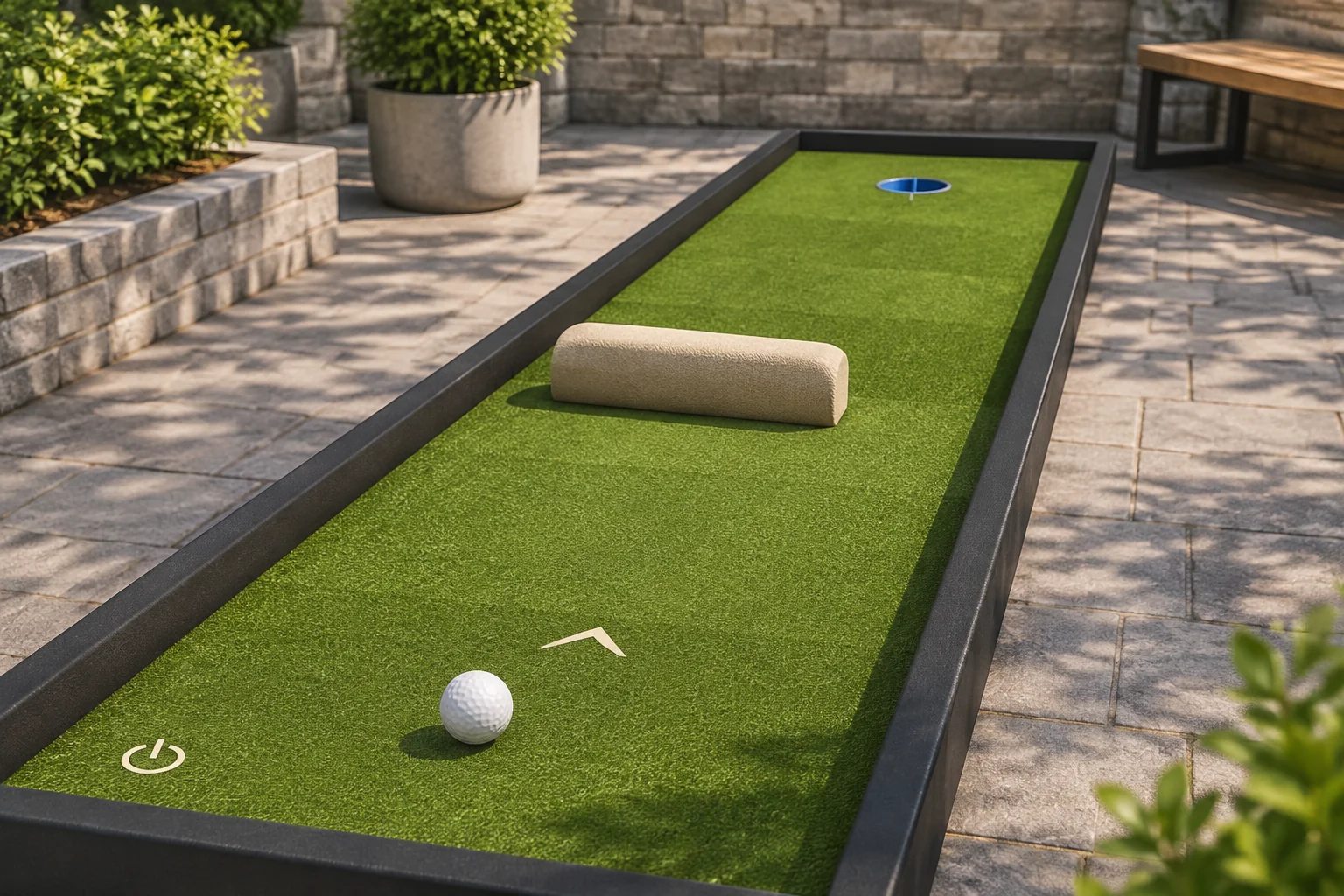
Start your mini-golf game with one hole where aiming at the cup sends the ball into an obstacle. Leave enough room to bank off a rail, then make power decide whether the ball stops short, drops into the cup, or rolls past. A player who misses should be able to tell which part of the shot to change.
This fictional courtyard uses a simple grid under a 3D course. The rules give you an exact route to check before you add slopes or smooth rolling physics. Put a short direction marker and a power meter near the ball so the player can make both choices before taking a stroke.
Lay out the tee, blocker, and cup
Use a rectangular course seven columns wide and four rows deep. Let x increase east and y increase north. Count from 1 in both directions. Start the ball at (2, 2), put a soft blocker at (4, 2), and place the cup at (6, 2). The first decision is whether to aim along the row or send the ball toward the north rail.
Give the player eight compass headings and a power setting from one to five. Each point buys one movement step in the chosen direction. A diagonal costs the same as a straight move in this arcade model. Show the grid in a debug view so you can compare the coordinates with the route below. The player view can keep the turf and rails.
Check the rail before moving the ball
- Calculate the next tile from the current heading. If that tile is outside the course, reverse the direction component for the rail it would cross. Recalculate from the ball’s current tile. At a corner, reverse both components if both are out of bounds.
- If the next tile contains the blocker, stop on the current tile and clear the remaining power. Otherwise, move one tile and subtract one point. A bank changes direction and still uses one point for the move.
- Check the cup after subtracting power. In the first version, the ball drops if it enters the cup tile with zero points left. If it enters with power remaining, let it continue. At zero on any other tile, stop and allow the next stroke.
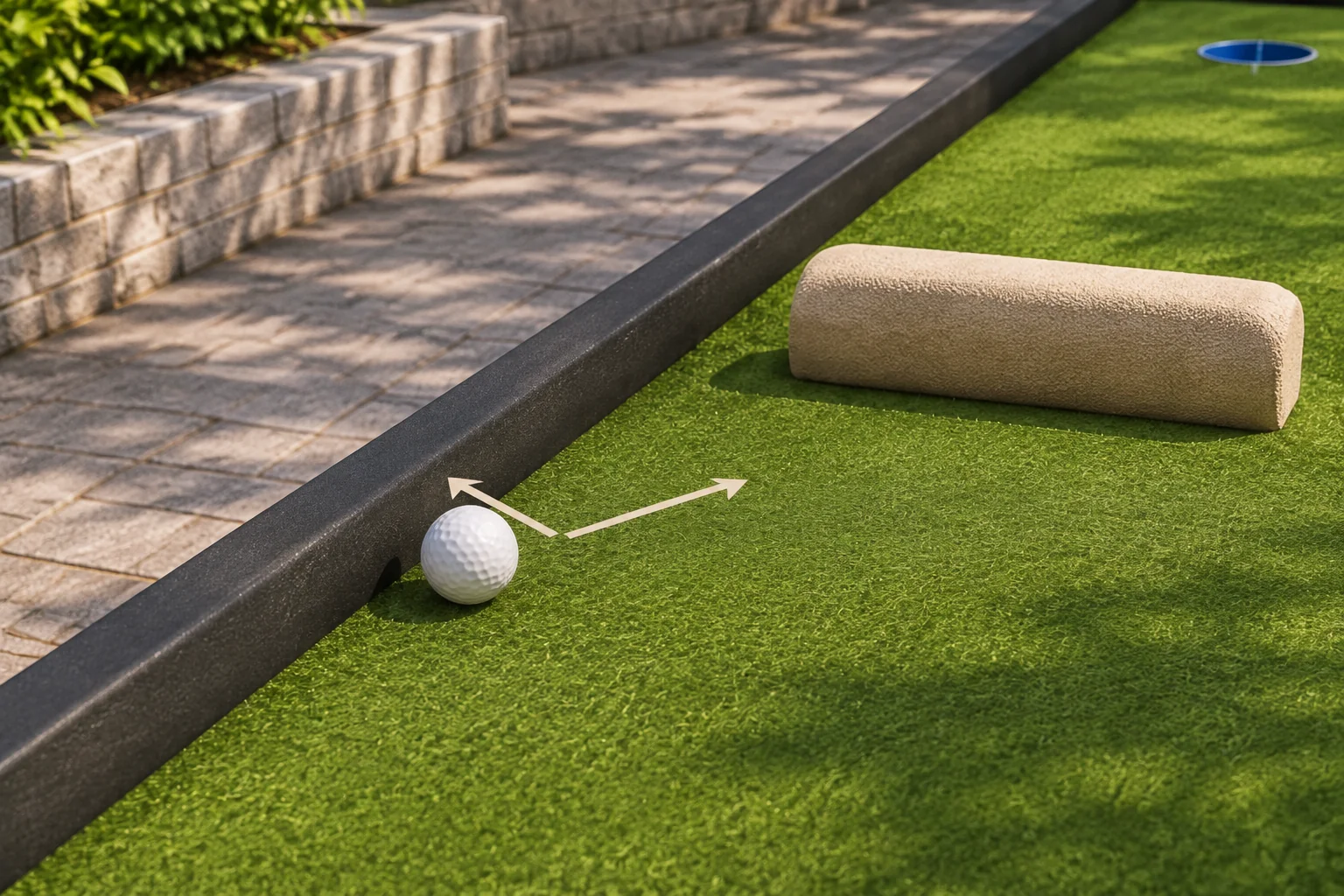
Run the rail check before spending power. The ball should appear on the new tile with its reflected heading and one point less. If it stops on the rail or jumps through it, inspect when the heading changes and which tile the collision check uses.
Try four shots from the same tee
Reset the ball to (2, 2) before each trial. A northeast shot adds one to both coordinates until it meets the north rail. From (4, 4), its next step would go out of bounds. Flip the vertical component, keep the horizontal direction, and land at (5, 3) for the bank step.
| Aim and power | Tile sequence after launch | Expected result |
|---|---|---|
| East, 4 | (3, 2), then blocked by (4, 2) | Stops at (3, 2) |
| Northeast, 3 | (3, 3), (4, 4), (5, 3) | Stops one step short of the cup |
| Northeast, 4 | (3, 3), (4, 4), (5, 3), (6, 2) | Cups with zero power left |
| Northeast, 5 | (3, 3), (4, 4), (5, 3), (6, 2), (7, 1) | Passes the cup with one point left and stops beyond it |
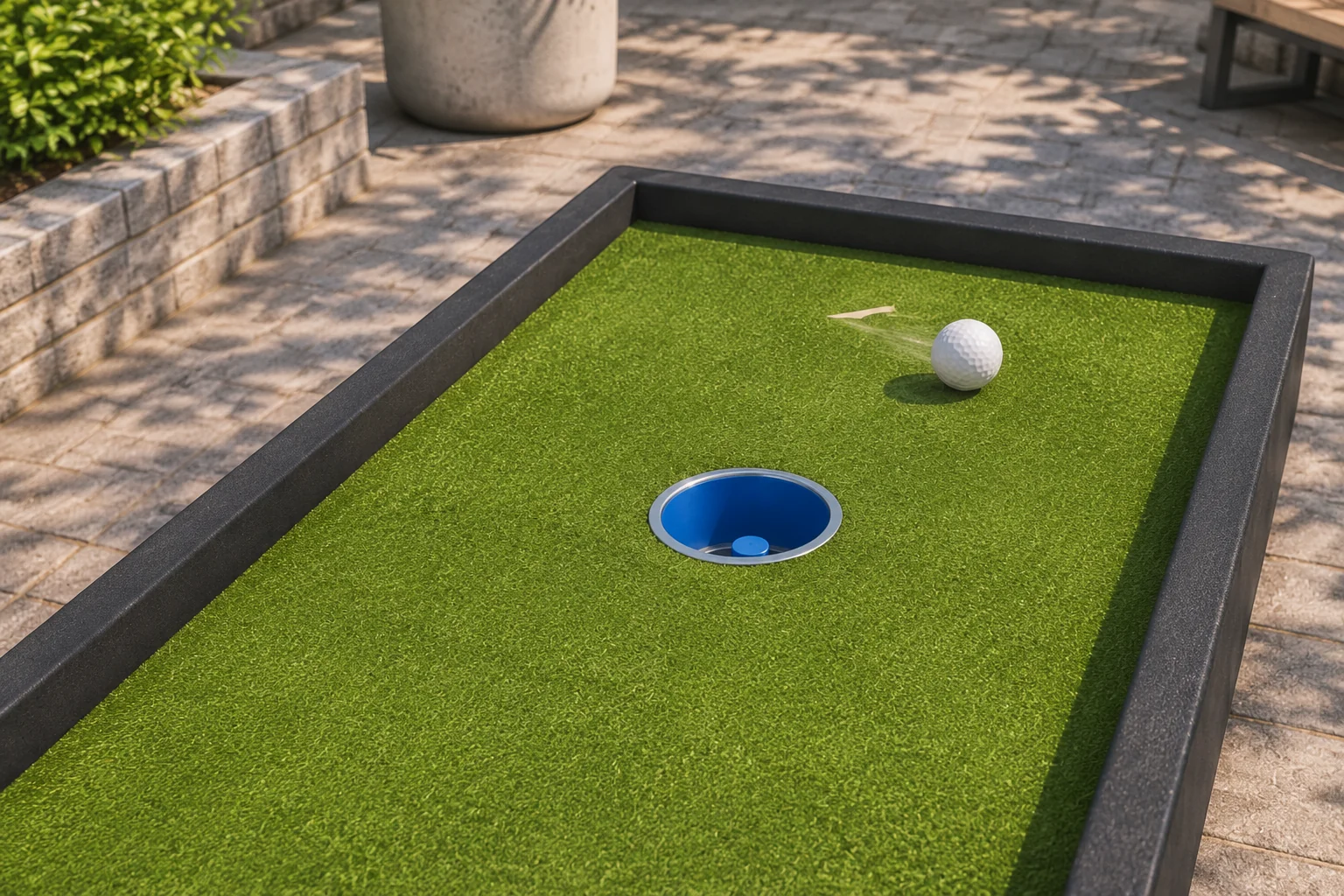
Keep the short stop, blocked shot, and roll-through distinct in the feedback. A blocked ball stops before it enters the obstacle. A short shot runs out of power. A roll-through reaches the cup tile but still has movement left under this model’s capture rule. Showing where the ball stopped helps the player tell these outcomes apart.
Give AI one hole and a way to inspect it
SEELE’s 3D game maker offers a starting point for a compact browser prototype with one visible goal. Give it the course layout and shot rules. You can leave the courtyard materials open and keep the movement and capture rules fixed. Ask for a debug view that makes each step easy to check.
Build one browser mini-golf hole with a 7-by-4 debug grid.
Count x from 1 eastward and y from 1 northward. Start the ball
at (2, 2). Put a blocker at (4, 2) and the cup at (6, 2).
Allow eight compass headings and integer power from 1 to 5.

On each step calculate the next tile. If it would go outside the
grid, flip the offending heading component, or both at a corner,
and calculate the tile again. Keep that reflected heading.

If the next tile is blocked, stop at the current tile and clear
the power. Otherwise move to the tile and spend one point. After
spending it, cup the ball if it entered (6, 2) with zero power.
With power left, continue. At zero elsewhere, stop.

Count one stroke per accepted launch. Ignore shot inputs while
the ball is moving. Finish on capture and show the total strokes.
Restart restores the ball, zero strokes, and the unfinished state.
Add a debug readout for tile, heading, power, and stroke count.
Check the direct shot first. Then try all three northeast powers from the tee and compare the visited tiles with the table. During a longer shot, press the launch control again and check that the count remains at one. After a cup, try the control once more and verify that the hole stays finished. Restart should restore the tee and zero strokes. The guide to checking an AI game in small steps shows how to isolate a follow-up request if one rule fails.
Change how much power the cup will accept
Try letting the cup capture a ball with one point left as well as zero. Keep the rail, blocker, aim, and movement cost fixed. The northeast power-five shot now drops on step four, when it reaches (6, 2) with one point left. Power four still drops. Power three still stops at (5, 3), and the straight shot still hits the blocker.
The worksheet now has two successful power settings for that heading instead of one. In a built version, watch whether a player notices the difference between a short stop and a roll-through. Count how many of each occur before you decide whether to keep the broader capture rule.
Make the first hole readable before adding a course
Build one obstacle, one bank, and one cup. Use the same tee and aim to check how power changes the stop. If players can see what changed from one stroke to the next, you can add another obstacle with a clear purpose. Start your mini-golf prototype with SEELE’s 3D game maker and keep the route table nearby when you check the first draft.
Frequently asked questions
Do I need continuous ball physics for the first hole?
A grid is enough to check the relationship between aim, a bank, and stop distance. Use continuous movement later if you want spin, slopes, or more gradual changes in speed. Keep the first hole available so you can see which behaviors change with the new model.
How much of the ball’s path should the aim preview show?
Start with the first direction and a readable power setting. That tells the player what they chose while leaving the stop distance for them to judge. If the bank itself is hard to see, add a short rail cue before showing the whole path to the cup.
Should a press while the ball is rolling count as a stroke?
Count a stroke when a shot actually starts. While the ball rolls, keep the launch control unavailable and leave the stroke total alone. Once it stops, make the control available again unless the ball is already in the cup. Check both outcomes with the same launch input.
When should I add another obstacle?
Add one after players can distinguish a collision from a short or long shot on the first hole. Give the new obstacle a different decision, such as whether to take a wider bank or use two shorter strokes. Retain the original hole as a simple comparison.