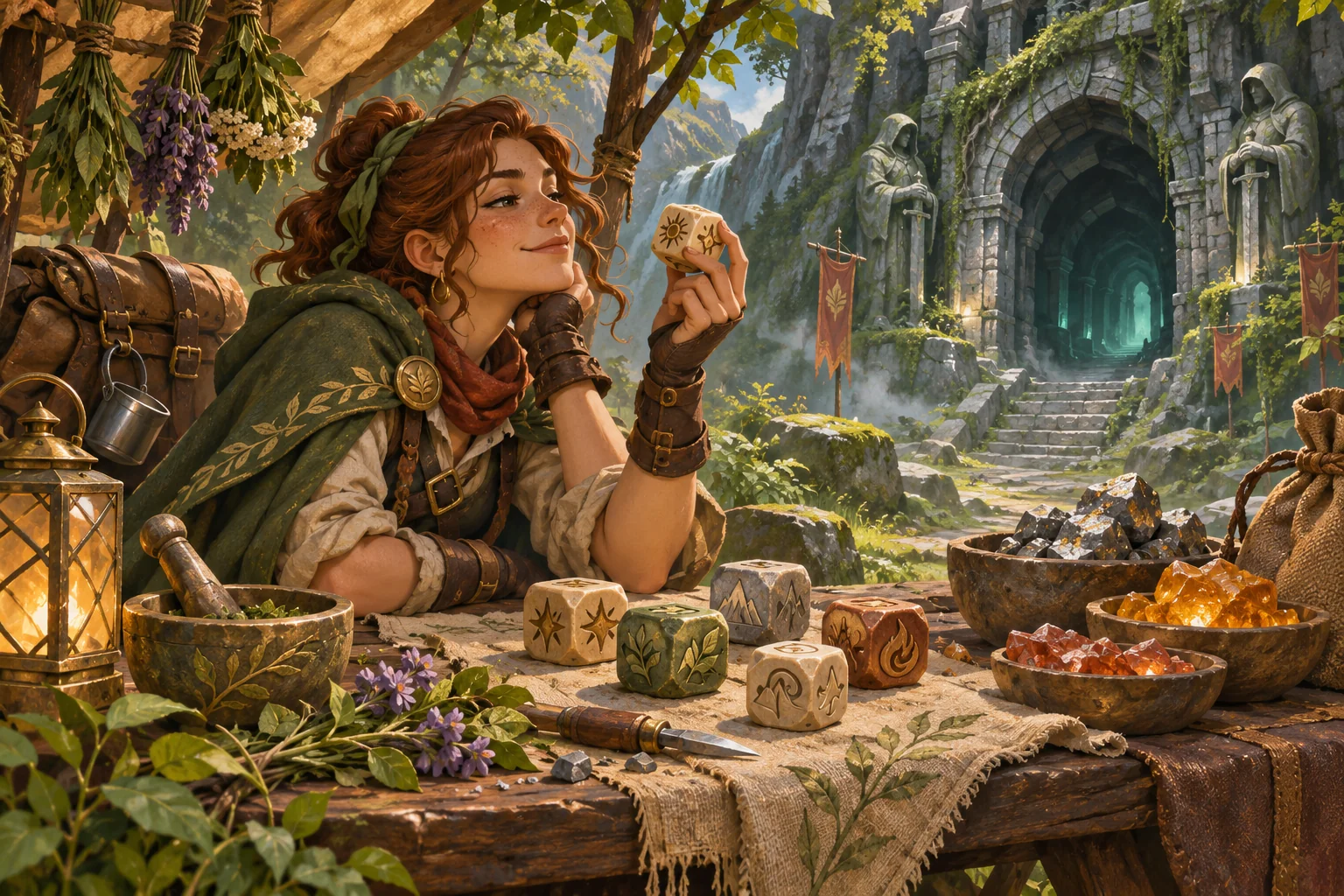
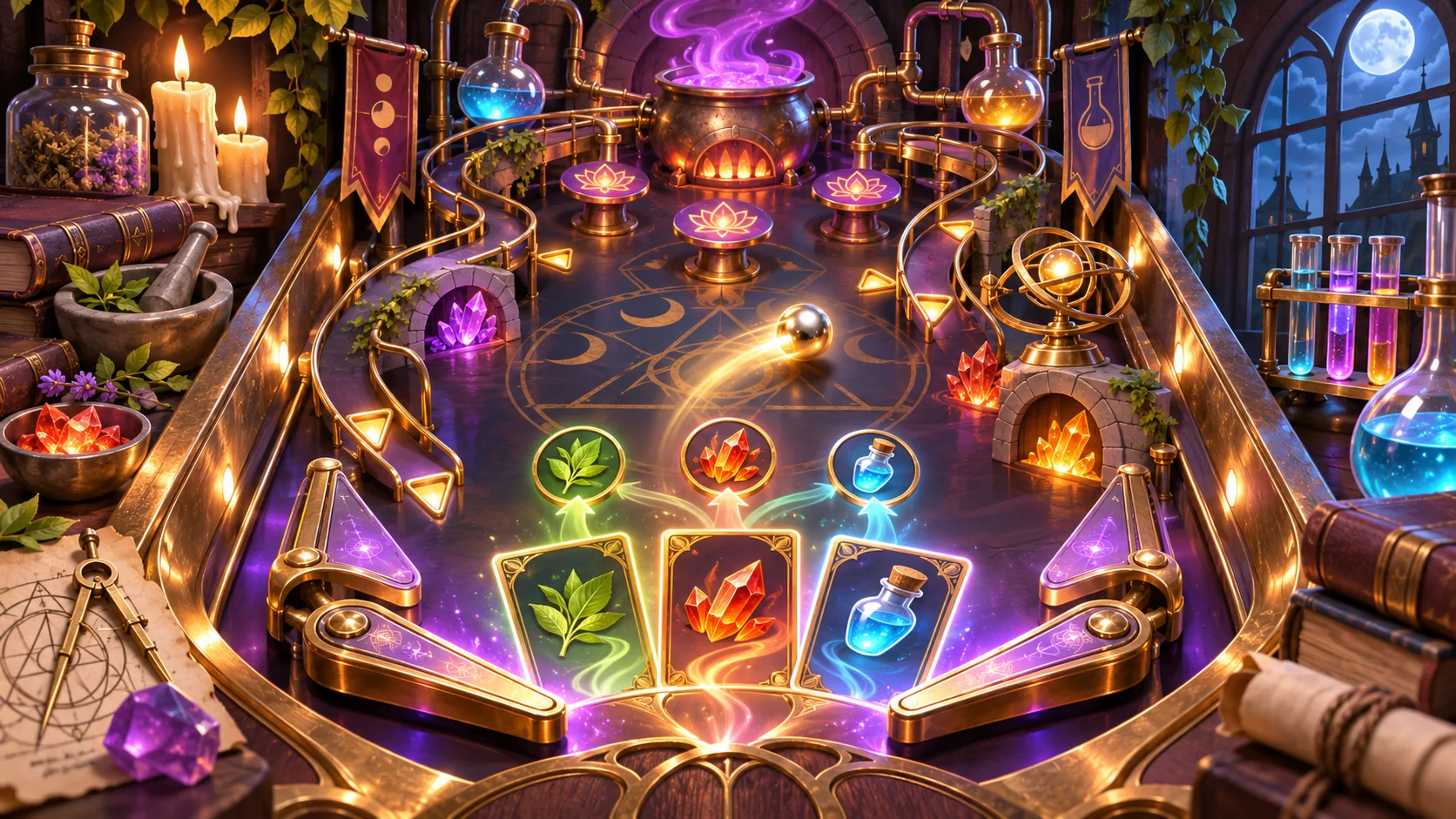
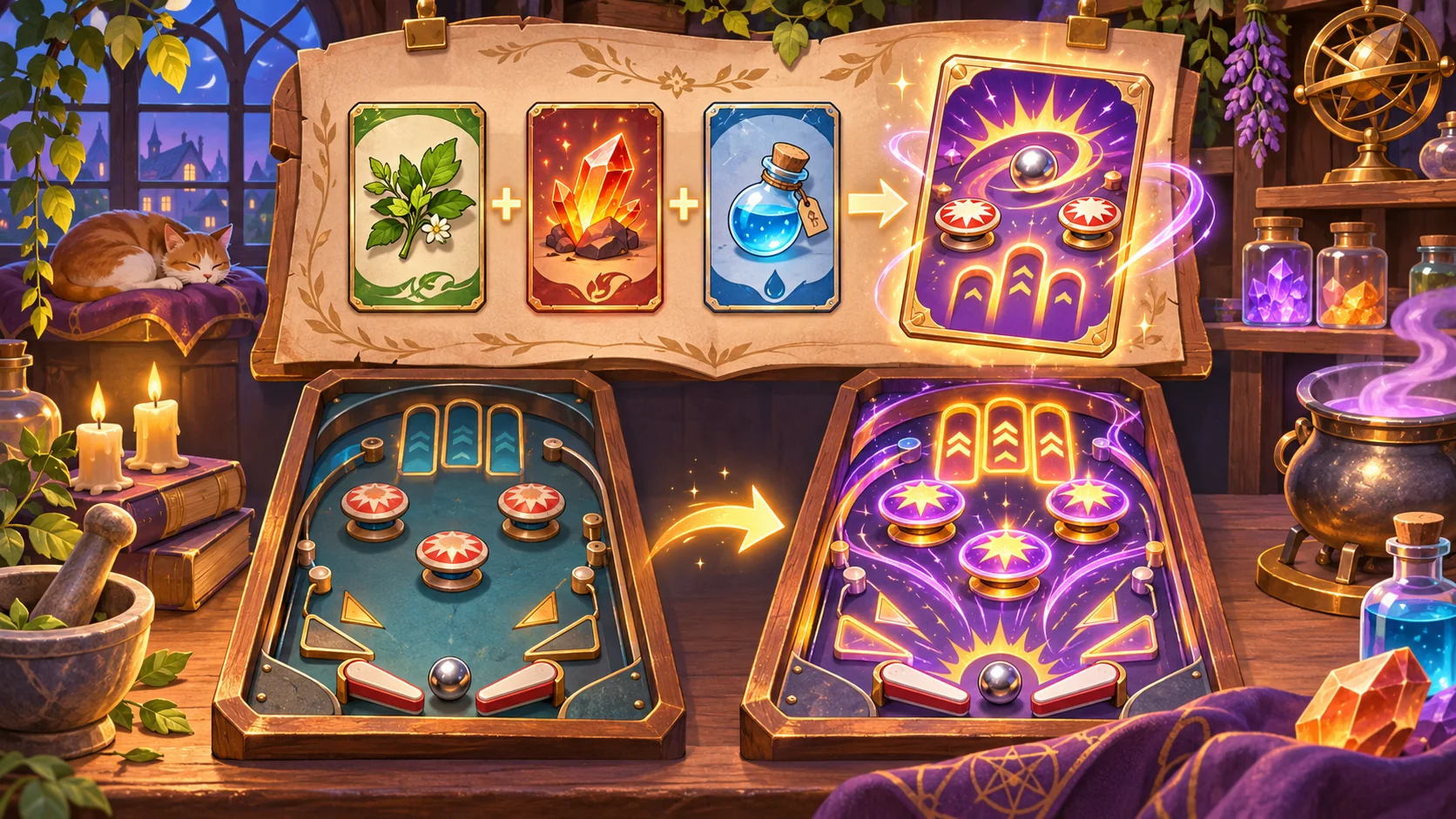
A pinball roguelike can make its deck part of the table. In Crucible Tilt, hitting marked bumpers collects Moss, Ember, or Dew. Between stages, combine two ingredients to craft a card that physically changes the next table: Verdant Bloom adds leaf bumpers, Steam Save adds a one-use drain guard, and Ember Lane adds a scoring rail. The card is built from what the player actually collected, not drawn from a generic shop.
Each stage lasts two balls, and the player needs one of two lit targets to clear it. Ingredients remain in a three-slot satchel between stages, while a crafted recipe consumes its pair. The route offers three stages and a final crucible table. The decision is whether to save a defensive recipe for later or shape the next table for more score.
Make table hits feed a crafting deck
Build a pinball run with three stages followed by a final Crucible table. Each stage has two balls and two lit targets; clear either target before the second ball drains to advance. The final table has one target and one ball. The flippers are controlled with left and right inputs; launching uses Space. Marked bumpers award one ingredient the first time they are hit per stage: Moss, Ember, or Dew. A three-slot satchel carries ingredients between stages, but duplicate ingredients still occupy separate slots. At the transition between stages, the player may craft one card by consuming exactly two ingredients. Moss + Dew makes Verdant Bloom, which adds two leaf bumpers worth 100 points each on the next table. Ember + Dew makes Steam Save, which blocks one drain and returns the ball to the launch lane; the guard is consumed when triggered. Moss + Ember makes Ember Lane, which adds a scoring rail worth 250 points when the ball crosses it. A crafted card applies to the next table only, then leaves the deck. If no recipe is crafted, unspent ingredients stay in the satchel up to its three-slot capacity. Ingredients beyond capacity are not collected. A stage transition happens only after the clear condition is met or both balls drain; an uncleared stage ends the run. The final Crucible table advances to victory when its target is hit; a drain before the target ends the run. Score is recorded but does not replace the target condition. Reset starts a new run with an empty satchel, no crafted card, stage one, and two balls. There are no random recipe effects, duplicate cards, permanent upgrades, or mid-ball crafting. Show the ingredient satchel, available recipes, current table change, balls remaining, target state, and score.
| System | Expected behavior |
|---|---|
| Run | Three stages, then final Crucible table. Each normal stage has 2 balls and 2 lit targets; clear either target. |
| Ingredients | First hit on a marked bumper per stage awards one Moss, Ember or Dew; satchel holds 3 slots. |
| Recipes | Moss+Dew: 2 leaf bumpers, 100 points each. Ember+Dew: block one drain and return ball to launch. Moss+Ember: 250-point rail. |
| Crafting | At each stage transition, consume exactly two ingredients to create one card for the next table only. |
| Overflow | Unspent ingredients persist up to 3 slots; ingredients beyond capacity are not collected. |
| Final table | One ball and one target; hit target for victory, drain first for run end. |
| Reset | Clear score, satchel, recipe, stage and ball state. |
Define recipes and persistent ingredients
On stage one, the player hits the marked Moss bumper and then the Dew bumper, adding one of each to the satchel. The first ball drains before either target lights, so the run remains on stage one with one ball left. On the second ball, the player hits a lit target and clears the stage. At the transition, craft Verdant Bloom by consuming Moss and Dew. The next table visibly receives two leaf bumpers worth 100 points each; the card then leaves the deck. Stage two starts with two balls, and hitting a marked Ember bumper adds Ember to the satchel. At the next transition, the player may save Ember for a later recipe because one ingredient alone cannot craft a card. The satchel persists across stages, and a third ingredient can complete another pair if capacity allows. This trace is a written rules check, not a playable or user test.
| Step | Expected state |
|---|---|
| Stage 1, ball 1 | Hit marked Moss bumper and Dew bumper; satchel gains one of each. |
| Drain before target | One ball remains; stage continues. |
| Ball 2 hits a lit target | Stage clears. |
| Transition craft | Spend Moss+Dew; Verdant Bloom enters next table effect. |
| Stage 2 | Add 2 leaf bumpers worth 100 points each; crafted card consumed after application. |
| Collect Ember | Marked Ember bumper adds one ingredient to persistent satchel. |
| Later transition | A single Ember cannot form a recipe; retain it for another stage if space remains. |
| Final table | Hit target with one ball for victory; otherwise run ends on drain. |
Trace a recipe into the next table
Specify the stage transition, ball count, ingredient capacity, recipe outputs, and target-based clear rules before adding visual effects. Keep crafting outside active play so the table state cannot change mid-ball.
Create a pinball roguelike prototype called Crucible Tilt with three stages and a final Crucible table. Each regular stage has 2 balls and 2 lit targets; hitting either target clears the stage. If both balls drain before a target, end the run. The final table has 1 ball and 1 target; hit the target for victory, drain first for run end. Use left/right flipper controls and Space to launch. Marked bumpers award one ingredient the first time each marked bumper is hit per stage: Moss, Ember, or Dew. Show a 3-slot satchel that persists between stages. At transitions only, let the player craft one recipe by consuming exactly two ingredients: Moss+Dew creates Verdant Bloom, which adds two 100-point leaf bumpers to the next table; Ember+Dew creates Steam Save, which blocks one drain and returns the ball to the launch lane; Moss+Ember creates Ember Lane, a scoring rail worth 250 points when crossed. A recipe changes the next table only and is then removed. If the player skips crafting, ingredients persist up to 3 slots; do not collect beyond capacity. No crafting mid-ball, random recipe output, duplicate cards, permanent upgrades, or extra target conditions. Display balls, targets, score, ingredients, legal recipes and visible table changes. Reset starts a new run with empty satchel, no recipe and stage one.Prompt AI for a bounded pinball run
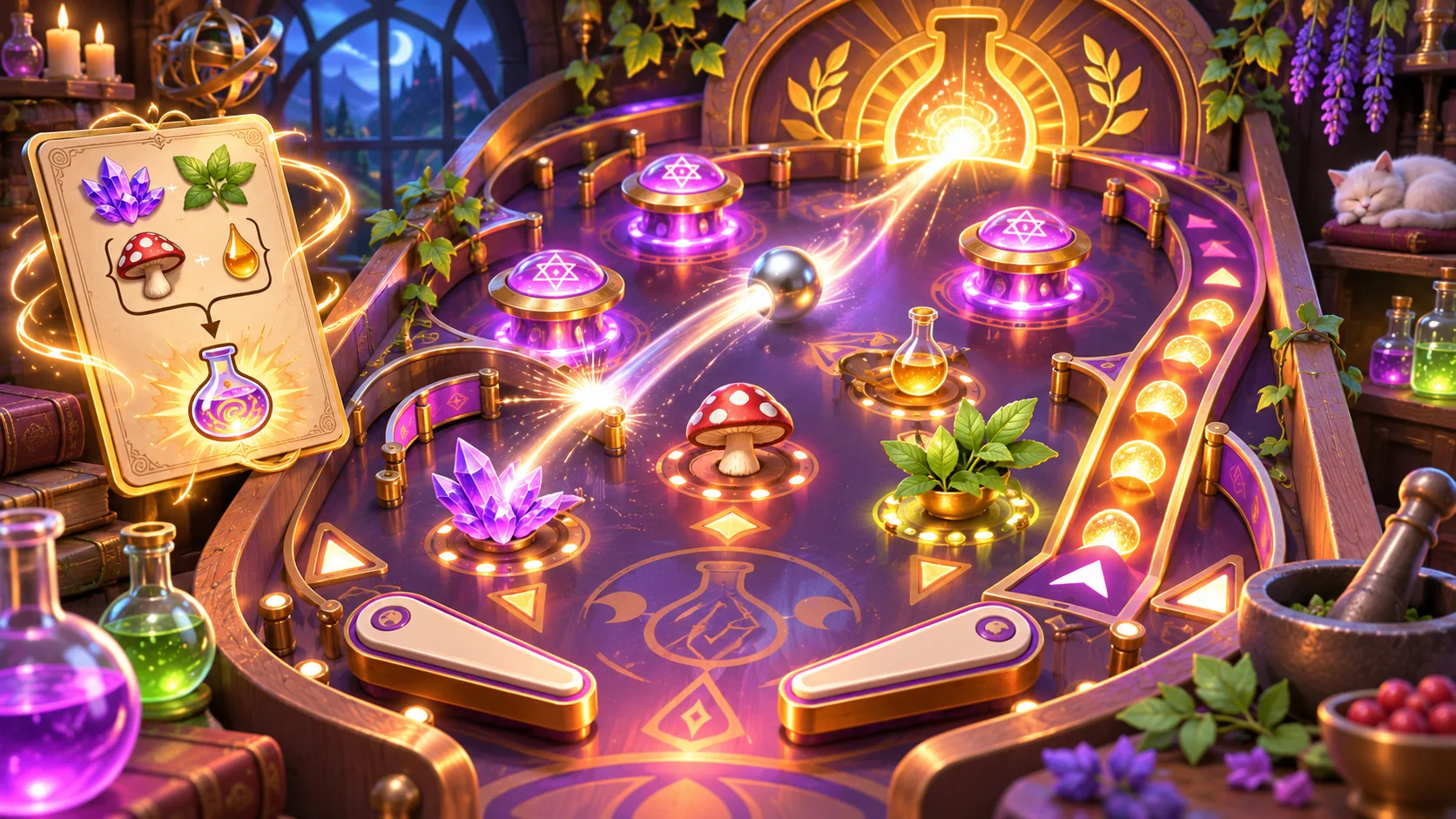
The first recipe draft granted a score bonus without changing the table, making crafting feel detached from pinball. The final cards add physical bumpers, a drain guard, or a scoring rail, so each crafted effect can be seen and tied to a future ball path.
A second pass allowed crafting during a live ball. That made table geometry change during play and obscured cause and effect. Crafting now happens only at stage transitions, after the current clear result is known.
Revise recipe timing
Prototype one table, the marked ingredient bumpers, and one transition recipe before adding a full run. Check that each recipe consumes the intended ingredients and visibly changes only the next table. The authored trace checks written rules; it is not a playable test or a balance claim.
Read the related pinball game design guide.
Try the SEELE AI game maker workflow.
Frequently asked questions
Do ingredients disappear when a stage ends?
No. Ingredients stay in the three-slot satchel unless the player crafts a recipe. Crafting consumes exactly its two named ingredients, and any unspent ingredients persist into the next stage while capacity remains. The recipes are the only way to spend ingredients, and crafting happens between stages.
Can a recipe change the active table during a ball?
No. Crafting is available only after a stage transition. The chosen card changes the next table and is removed after applying its effect, so the current ball always plays on a stable layout. The interface previews the next layout before the player launches another ball.
Check Godot's official Resource reference.
What if the satchel is full?
Ingredients beyond the three-slot capacity are not collected. The UI should show the full satchel before a marked bumper is hit, so the player can decide whether to craft at the next transition or keep the existing ingredients. The player can plan around the cap before choosing whether to craft or keep ingredients.
Has this pinball run been tested as a playable game?
No. The stage rules, ingredient pickups, recipes and transition trace are an authored local design brief. They have not been implemented as a playable game, tested with users, or verified in a browser. The values are design inputs for a later build, not observed balance.