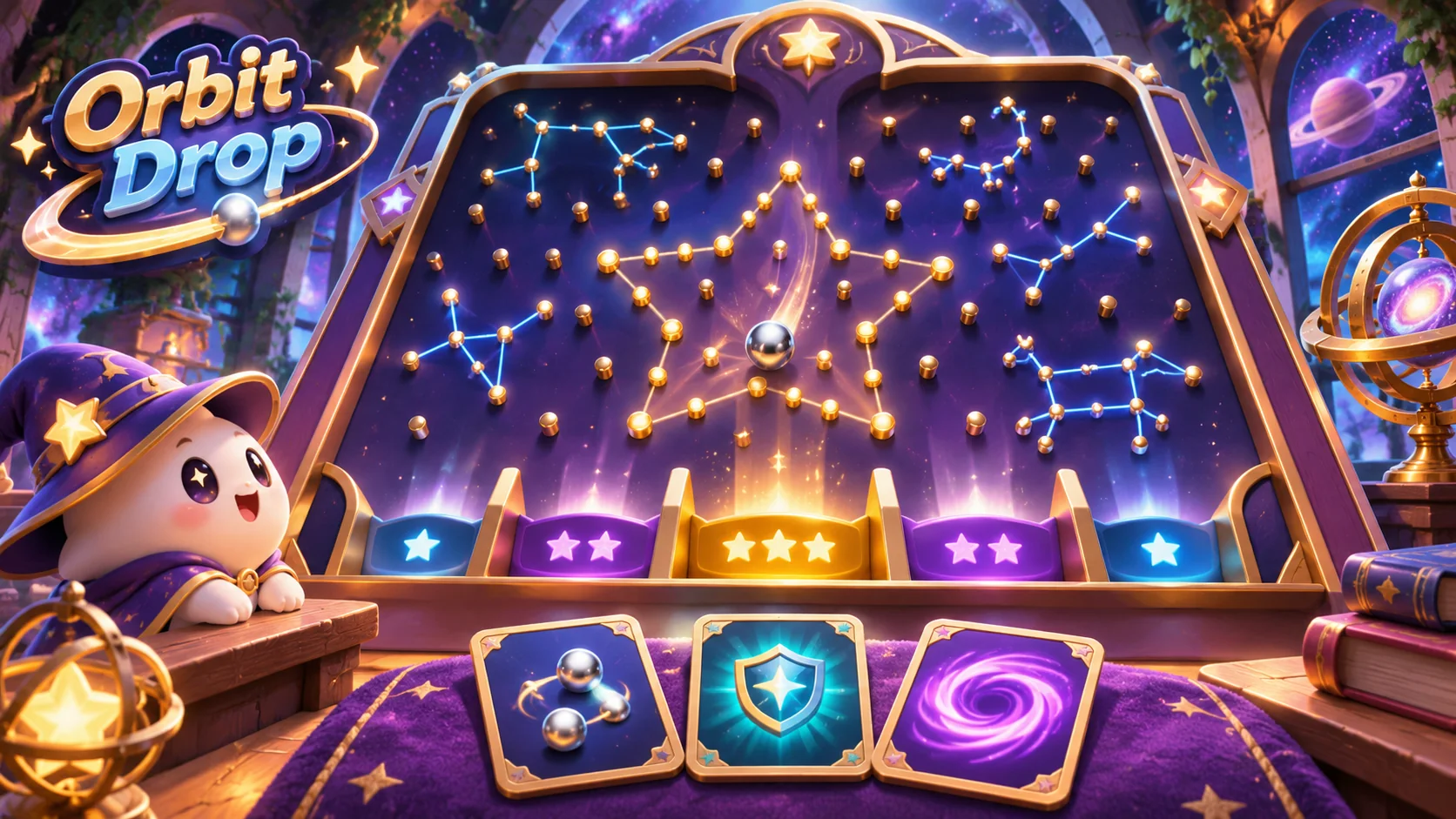
A plinko board can reward the shape of a ball's route, not only the pocket where it lands. In Orbit Drop, the player chooses a launch lane and scores the distinct pegs touched on the way down. Neighboring pegs form links, three pegs can form a right-angle corner, and pairs mirrored across the center lane form a constellation. The score log names every pattern it counted.
Each run has three boards, three balls per board, and one upgrade choice after a cleared board. The board layout stays fixed during each ball, so a player can compare which launch produced a cluster or a mirror pair. Spatial scoring creates a reason to aim for a shape instead of treating every peg hit as identical.
Turn peg positions into score patterns
Build a 5-column by 4-row pegboard. Columns are 0–4 from left to right and rows 0–3 from top to bottom; column 2 is the centerline. The player selects one of five launch lanes at the top, then the ball follows a fixed physics path for the prototype. Record the set of distinct peg coordinates touched during that ball; touching the same peg more than once counts it once. Score 100 points per distinct peg. Add 150 points for each orthogonally adjacent pair of touched pegs, counting each unordered pair once. Add 300 points for each right-angle corner triple: three distinct pegs that occupy three cells of a 2-by-2 square and include two orthogonal links meeting at one peg. A full 2-by-2 block contains four possible corner triples, each scored once. Add 400 points for each mirrored pair at the same row, where columns sum to 4; the center peg at column 2 does not form a pair with itself. Pattern bonuses are evaluated independently, so one peg may belong to several different qualifying patterns. A ball's pocket adds its printed base value after peg and pattern scoring. A run has three boards with three balls per board. Each board has a target score of 1,200 points. If the score meets the target after three balls, clear the board and choose one of three visible upgrade cards for the next board. Upgrades are: Cluster Ink adds 50 to each adjacent-pair bonus; Corner Seal adds 100 to each corner-triple bonus; Mirror Lens adds 200 to each mirrored-pair bonus. Only one copy of an upgrade can be owned, and the same type cannot be chosen twice. If the board target is missed, the run ends. The third board target completes the run. Reset clears score, upgrade cards, board index and ball count. There are no random peg layouts, hidden pattern rules, duplicate upgrade cards or bonus multipliers outside the listed upgrades. Display the touched peg set, every scored pair or triple, pocket value, board total, target and upgrade effect.
| System | Expected behavior |
|---|---|
| Board coordinates | 5 columns × 4 rows; columns 0–4, rows 0–3; centerline is column 2. |
| Per peg | 100 points per distinct peg touched in one ball; repeated contact with the same peg counts once. |
| Adjacent pair | +150 for every distinct orthogonal pair in the touched set; unordered pairs count once. |
| Corner triple | +300 for each 3-peg right-angle corner contained in a 2×2 square; all four triples in a full square count separately. |
| Mirror pair | +400 for distinct touched pegs in the same row with columns summing to 4; center peg cannot pair with itself. |
| Run | 3 boards, 3 balls each, target 1,200 per board; miss target and run ends. |
| Upgrade | After a cleared board choose one unique card: +50 adjacent, +100 corner, or +200 mirror bonus. |
| Reset | Clear run score, upgrades, board and balls. |
Define adjacency, corners and mirror pairs
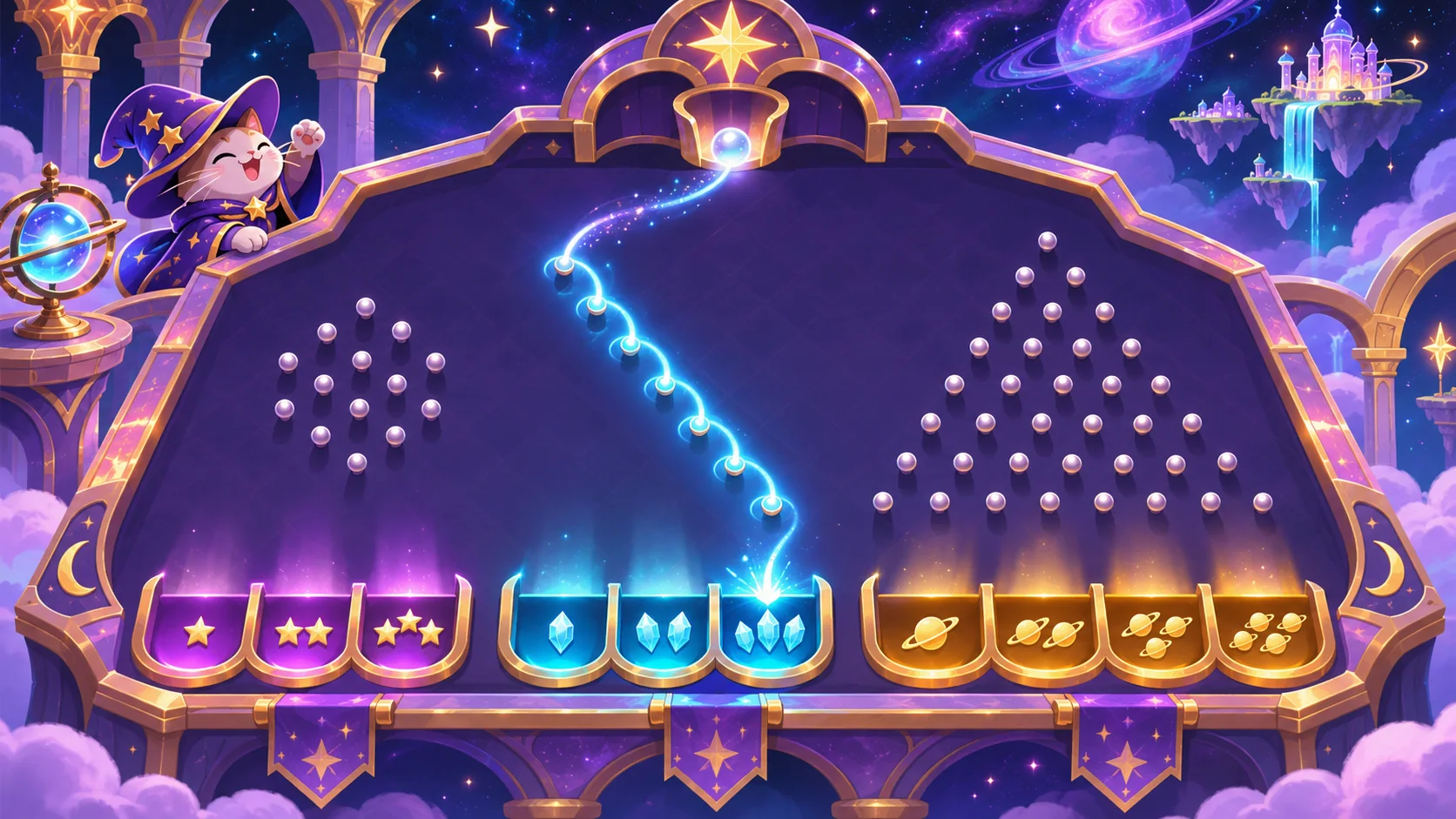
On board one, the first ball touches pegs at (1,1), (2,1), and (2,2), then lands in a pocket worth 100. The distinct-peg subtotal is 300. Two orthogonal pairs qualify: (1,1)–(2,1) and (2,1)–(2,2), adding 300. Those three pegs form one right-angle corner triple in a 2×2 square, adding 300. There is no mirrored pair. The ball scores 1,000 total including its pocket. The score log lists the three pegs, two links, one corner, and pocket value. A second ball touches (0,2) and (4,2); these are mirrored across column 2, so it earns 200 peg points and 400 mirror points before pocket value. If the board reaches 1,200 after the third ball, the player chooses one unique upgrade. Choosing Mirror Lens makes future mirrored pairs worth 600 total rather than 400. The run trace is an authored calculation, not a playable or user test.
| Event | Score resolution |
|---|---|
| Ball 1 touches (1,1), (2,1), (2,2) | 3 distinct pegs = 300. |
| Adjacent links | Two orthogonal pairs = 2 × 150 = 300. |
| Corner pattern | One right-angle triple = 300. |
| Printed pocket value = 100. | |
| Ball 1 total | 1,000 points; show all four scoring components. |
| Ball 2 touches (0,2), (4,2) | 2 pegs = 200; one mirrored pair = 400, plus pocket value. |
| Board clear | At 1,200 after 3 balls, select one unique upgrade. |
| Mirror Lens | Future mirror bonus becomes 600; existing score is not recalculated. |
Trace a cluster into its total score
Give the scoring system coordinates and deduplication rules. Tell the generator when to evaluate patterns, how overlapping patterns work, and which numbers an upgrade changes.
Create a plinko roguelike called Orbit Drop on a fixed board with 5 columns (0–4) and 4 rows (0–3); centerline is column 2. Player chooses one of five launch lanes, then the ball follows a deterministic path. For each ball, record distinct pegs touched; repeat contact with one peg scores it once. Score 100 per distinct peg. Add 150 per unordered orthogonally adjacent peg pair. Add 300 per right-angle corner triple: three pegs occupying three cells of a 2×2 square with two orthogonal links meeting at one peg. In a full 2×2 block, count all four corner triples. Add 400 per distinct same-row mirrored pair whose columns sum to 4; column 2 cannot mirror with itself. Pattern categories are independent and may overlap. Add the landing pocket's printed base value. Run 3 boards with 3 balls each and a 1,200-point target per board. If the target is met after ball 3, offer three visible upgrades and let player choose one unique type: Cluster Ink adds 50 per adjacent pair; Corner Seal adds 100 per corner triple; Mirror Lens adds 200 per mirror pair. Do not allow duplicate upgrade types. If target is missed, end the run. Clear board three to win. Show the hit peg coordinates, each pattern counted, pocket value, running score, target and upgrade. Reset clears all run state. Do not use random peg layouts or hidden score rules.Prompt AI for a reproducible plinko board
An early scoring draft counted peg contacts, so a ball that bounced repeatedly on one peg could inflate its score. The final rule scores a distinct coordinate once per ball. This leaves spatial combinations as the source of pattern bonuses.
The corner rule was also ambiguous about a full 2-by-2 block. The revised rule counts each of its four possible three-peg corners once, while a mirrored pair counts only distinct pegs on the same row. The authored trace checks a simple L and a mirrored pair separately.
Revise one ambiguous pattern rule
Start with the fixed coordinate board and display the touched set after each ball. Verify the adjacent-pair, corner-triple and mirror-pair calculations on small examples before adding upgrades. The authored totals are design arithmetic only; they are not observed game balance or a playable test.
Read the related plinko roguelike design guide.
Try the SEELE AI game maker workflow.
Frequently asked questions
Can one peg count more than once in a ball?
No. The score uses the set of distinct peg coordinates touched during one ball. Repeated contact with the same peg adds no extra base points, though that peg can still participate in different spatial patterns such as an adjacent pair and a corner triple.
Do overlapping patterns stack?
Yes. Adjacent pairs, right-angle triples and mirrored pairs are scored as separate categories. One peg may belong to multiple valid patterns, and a full 2-by-2 square contains four different corner triples. Each pair or triple is counted once under its own rule.
Check Godot's official Resource reference.
How does Mirror Lens change the score?
Mirror Lens adds 200 to the listed 400-point mirror bonus, making each qualifying pair worth 600 on later boards. It does not recalculate earlier scores, and the player cannot own a second Mirror Lens in the same run. Only future-board scoring changes.
Has this scoring system been tested in a playable game?
No. The peg coordinates, pattern definitions and score arithmetic form an authored local design trace. They have not been implemented as a playable game, tested with users, or verified in a browser. The values are prototype inputs rather than observed balance results.