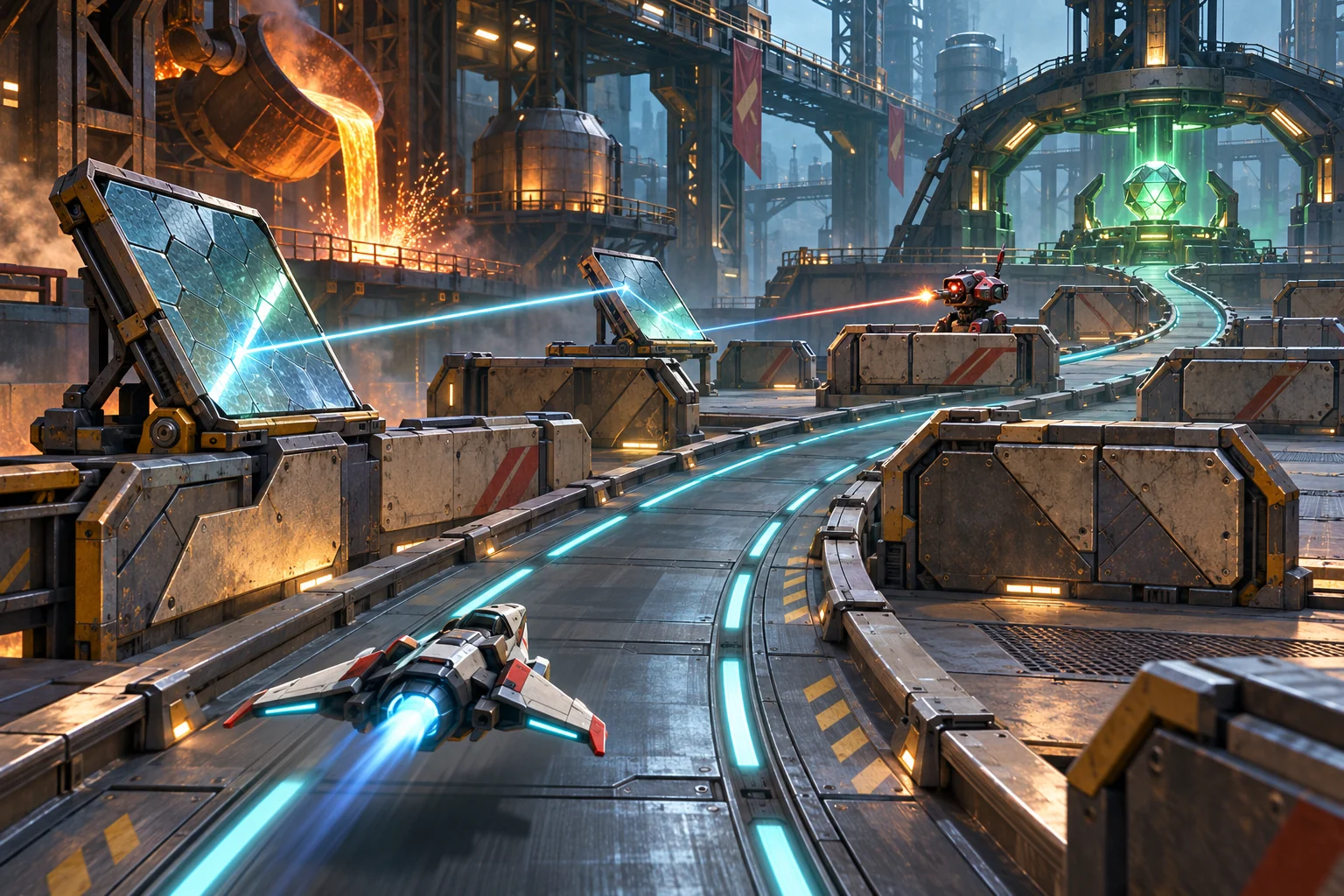
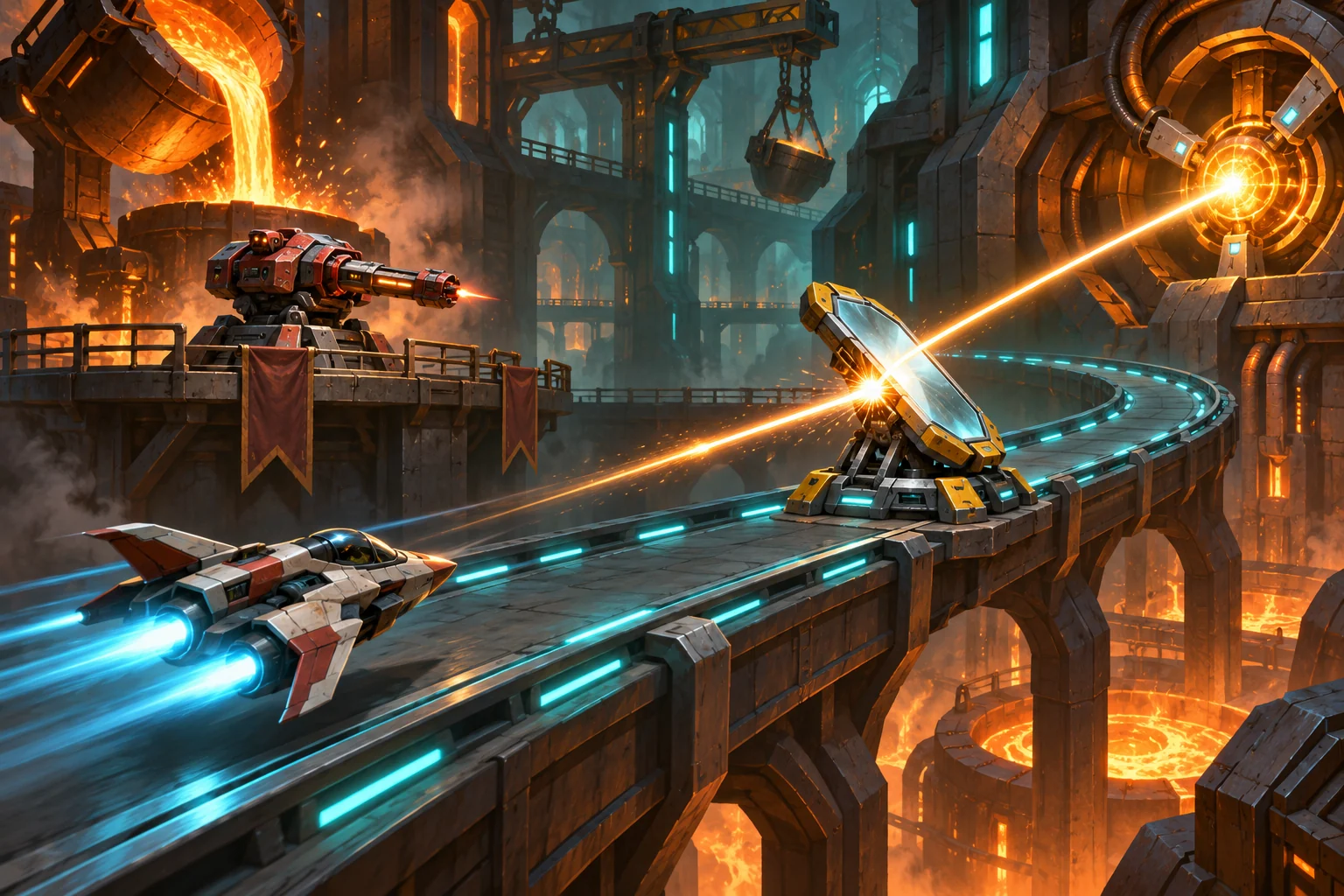
A rail shooter can keep its camera route fixed while letting players reshape the arena around that route. In the fictional game Skyfoundry, the ship crosses the same foundry corridor each pass, but players place one construction module during a short build window between waves. A cover plate blocks a projectile; an angled reflector can redirect one into an exposed power node.
The construction should change what happens on the next pass, not just decorate the background. Start with one scripted gunner, a visible firing sequence and a build slot. Compare the arena with no module against a reflector placed where the second shot crosses its surface. Count hits and confirm whether the reflected shot changes the remaining attack window.
Keep the rail route fixed while the arena changes around it
Use a short, deterministic camera path through a foundry corridor. The ship passes one gunner and one exposed power node on every run. Between waves, pause for a six-second construction window and let the player place one module on a marked anchor. Keep the camera route, ship speed and gunner firing schedule identical between replays so construction is the variable under test.
Give each module a clear spatial rule. A cover plate absorbs one projectile but blocks the player’s line of sight while it remains in place. A reflector redirects one projectile that hits its angled face toward the nearest exposed node. Show the module footprint and projected projectile path before placement. The arena becomes part of the combat plan because geometry changes both protection and target access.
Make the build window a short tactical decision
Limit construction to the pause between waves. Offer a cover plate, a reflector and a dismantle action; each run can place or reposition only one module. Keep module anchors beside the known firing lanes, but do not snap the reflector automatically to a perfect angle. The player should read the upcoming pattern and choose where to shape the next pass.
Signal the next attack before the ship moves: the gunner fires three shots at one-second intervals, and the power node is exposed during the second shot. The warning gives the player time to align a reflector without turning construction into an unbounded editor. After placement, show the predicted bounce and which target the redirected shot can reach.
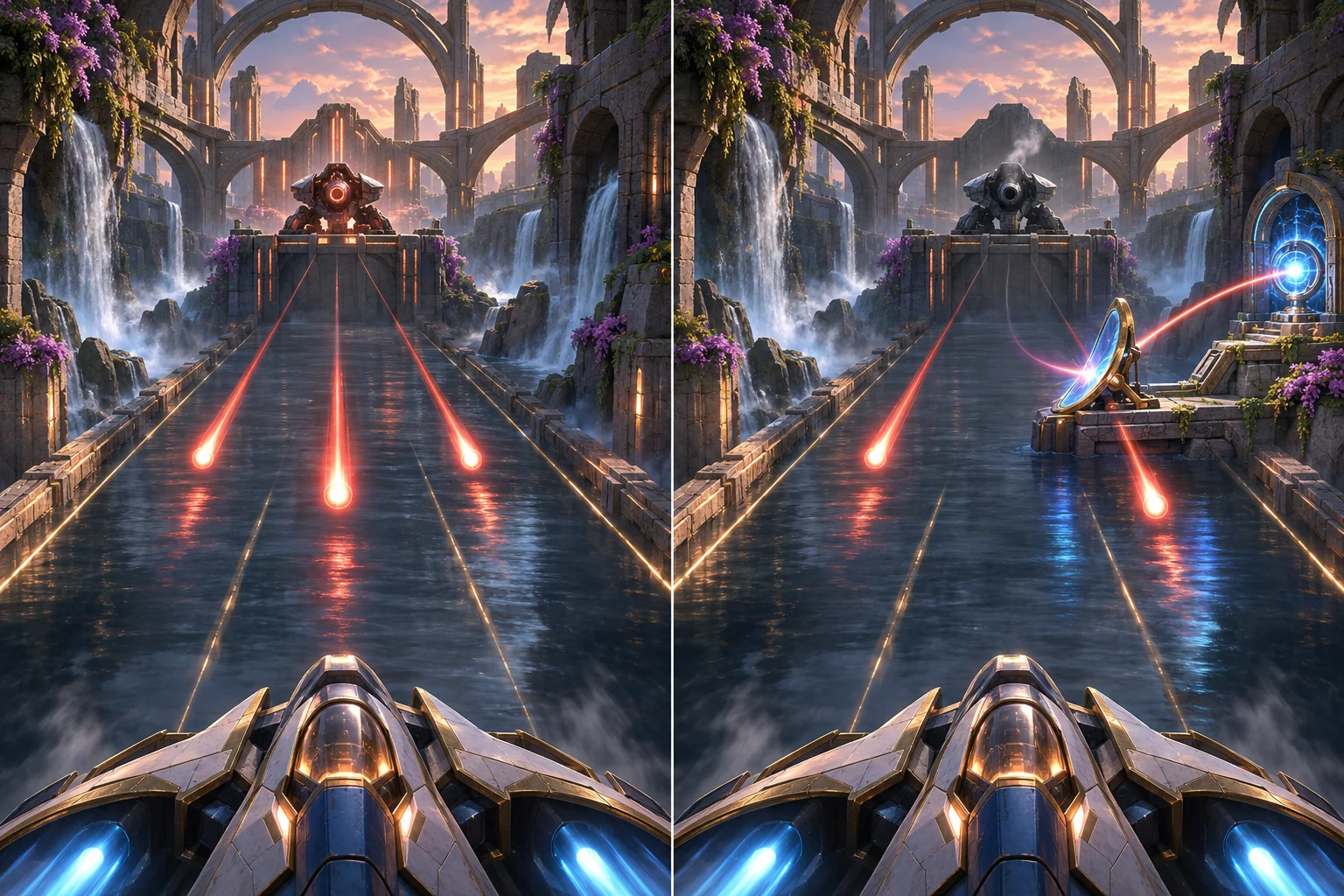
Compare the same three-shot volley with and without a reflector
Run the corridor with no construction module. The gunner fires at seconds one, two and three; all three shots follow the ship’s rail lane. If the ship does not dodge, it takes three hits. Record the volley as the baseline before changing the arena.
Reset the same pass and place a reflector on the second shot’s path. That shot turns toward the exposed power node and disables the gunner before its third shot. The ship takes the first shot, the reflected shot misses it, and the final shot never fires: one hit instead of three. This is a paper-simulated example, not a built-game measurement. Track ship hits, successful reflections and time with the gunner disabled. If one placement always solves the pass, move the anchor or make the node’s exposure window shorter.
Prototype the geometry and shot preview before adding waves
Build the rail path, construction pause, module anchors, projectile collision and shot preview first. Add one resettable volley with the exact same timing on every run. Once players can predict why the reflector changes the attack, expand the arena with more anchors or additional enemy patterns.
Create a compact rail shooter prototype called Skyfoundry. The ship follows the same fixed camera path through a foundry corridor each pass. Between waves, pause for a six-second build window and let the player place one module on a marked anchor: a cover plate absorbs one projectile but blocks line of sight, a reflector redirects one projectile that strikes its angled face toward the nearest exposed power node, or the player can dismantle a module. A gunner fires three shots at one-second intervals; the power node is exposed during shot two. Show projectile paths and predicted bounces before confirming construction. Add a resettable comparison with no module versus a reflector placed in shot two’s path. The reflected shot disables the gunner before shot three. Track ship hits, successful reflections and disabled time.
SEELE's official AI Game Maker page describes creating a playable first version from a prompt, testing it in a browser and refining it with follow-up prompts. Use that general workflow to inspect the route, construction preview and projectile timing; Skyfoundry and its rules are fictional design guidance.
Build the player-constructed rail shooter in SEELE
Frequently asked questions
How can construction change a rail shooter arena?
Let players place geometry between scripted passes that changes projectile paths, cover or sight lines. A reflector can redirect one timed shot toward a node, while a cover plate blocks damage and hides a target. Show the footprint and trajectory before placement.
How do I keep a fixed rail route strategic?
Keep the camera path consistent but let construction change the encounter around it. Give players a short build window, a visible upcoming attack and a few modules with distinct spatial effects. Then compare the same route before and after one placement.
What should I measure in a construction test?
Replay the same firing pattern and record hits taken, successful reflections and time an enemy stays disabled. Change one anchor or module at a time. If a build always removes all danger, adjust the exposure window or make its placement less automatic.