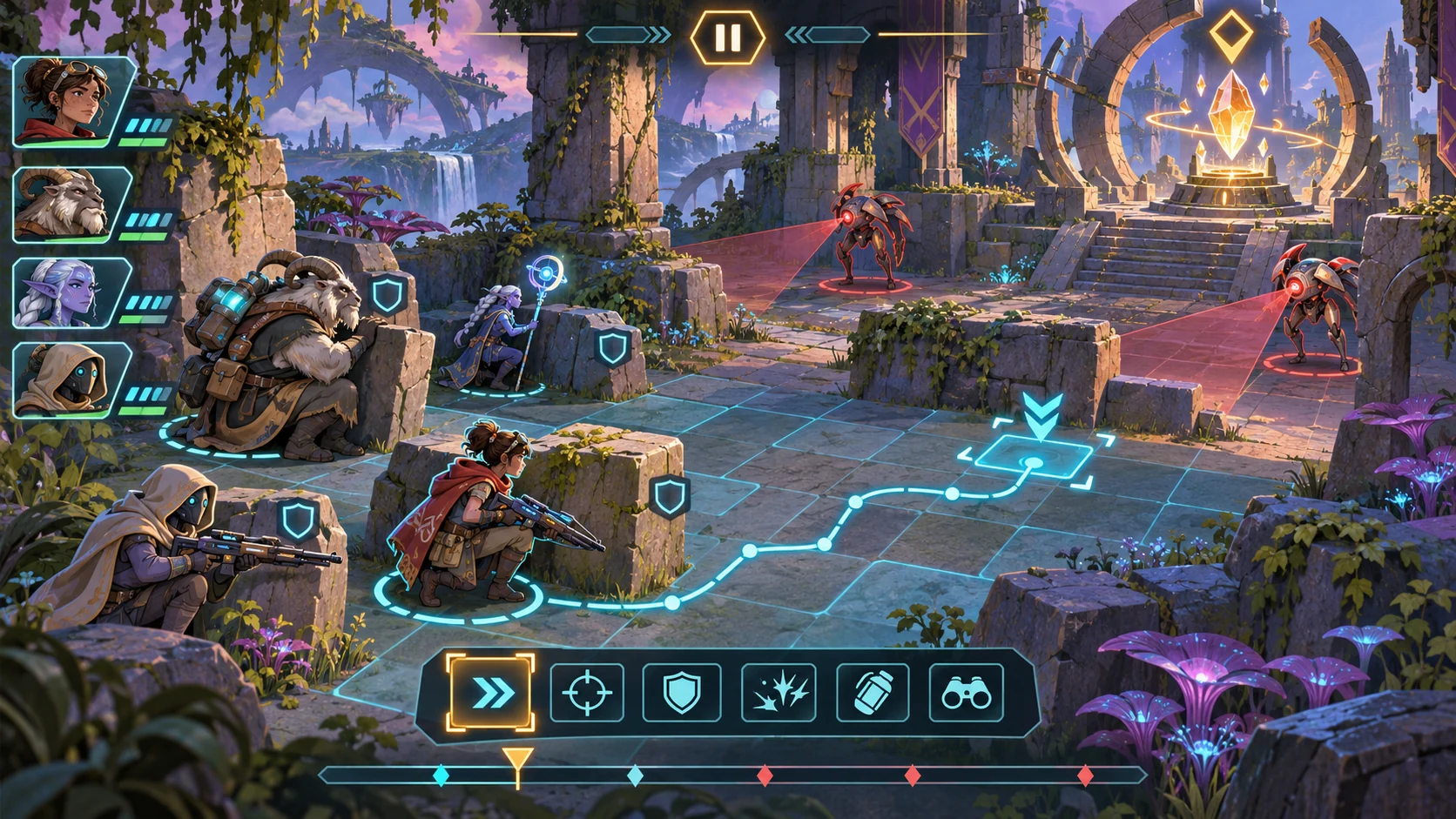
A real-time tactics game can make victory mean getting people out safely. In Lantern Run, a three-unit squad enters a night market to escort three civilians from a clinic to an extraction pad. Two patrols threaten the route, but the mission does not ask the player to destroy them. Suppression creates a short opening; scouting finds a safer lane; the rescue counter changes only when civilians reach the pad.
The distinction keeps the objective honest. A rescue interaction begins a timed action, but does not award progress by itself. Civilians follow a rescuer at reduced speed and occupy a limited follower capacity. The player must manage who is carrying whom, choose a route through the market, and reach extraction before the 120-second clock ends. Eliminating every patrol is not a shortcut to victory; moving the entire squad to the pad without the civilians is not a rescue either.

Make evacuation the only victory counter
Use a 9×7 night-market map. The clinic is at (7,5), extraction at (1,5), and the central patrol crosses (4,3). Scout, Guard, and Medic each move two map cells per second when unladen. A rescued civilian follows its assigned rescuer at half speed; each rescuer can lead up to two civilians. A rescue order works from an adjacent cell and takes two seconds per person. The Medic can rescue two civilians in sequence; Scout can take the third. Civilians never take damage in this first slice. If their rescuer is incapacitated, they stop at the last safe waypoint and can be reassigned by an adjacent rescuer with a two-second regroup action. Guard's nonlethal suppression interrupts a patrol for four seconds, deals no damage, and does not remove the patrol. The scenario timer starts at 120 seconds. Each civilian counts once only when its follower group and rescuer enter the extraction pad. Victory requires all three civilians extracted before time expires. The mission fails at zero seconds or when all three rescuers are incapacitated. Patrol elimination alone is neither victory nor progress. If the follower capacity is full, a new rescue order is unavailable until a civilian reaches extraction or another rescuer takes the group. Reset restores the clock, unit positions, patrol routes, civilian locations, followers, and rescue counter.
| System | Expected behavior |
|---|---|
| Map and squad | 9×7 market; clinic (7,5), extraction (1,5), patrol crossing (4,3); Scout, Guard, Medic. |
| Movement speed | Unladen rescuers move two cells per second; followers move at one cell per second. |
| Rescue action | Interact from an adjacent cell; two seconds per civilian; rescue progress is not awarded yet. |
| Followers | A civilian follows its assigned rescuer at half speed; maximum two followers per rescuer. |
| Extraction | Count a civilian once only when its group and rescuer enter the pad; all three are required to win. |
| Patrol response | Guard suppression interrupts one patrol for four seconds, deals no damage, and leaves it active. |
| Timer and failure | 120 seconds; lose when time reaches zero or all rescuers are incapacitated. Patrol elimination is not a win. |
| Reassign and reset | A nearby rescuer regroups civilians from the last safe waypoint in two seconds; reset restores all state and routes. |

Define rescue time, follow capacity, and patrol pressure
Start the 120-second clock with three civilians at clinic (7,5), extraction at (1,5), and the patrol crossing at (4,3). Scout spends one second moving two cells along the east awning and revealing the upper lane. Medic rescues civilian A in two seconds and civilian B in another two; the two-person group now fills capacity. The shortest safe route follows (7,5) to (7,3), then across to (1,3), then down to (1,5), ten cells at one cell per second for followers. As the group reaches the central crossing at about t=10, Guard suppresses that patrol for four seconds; the civilians pass without taking damage and the patrol remains active. Medic arrives at the pad at t=15, where the counter changes from zero to two. Scout returns to the clinic in five seconds at unladen speed, rescues civilian C in two seconds, and escorts the final follower to extraction in ten seconds; the whole authored route completes at about t=32, well before the 120-second clock. A completed interaction at the clinic does not count, and clearing a patrol does not count. This is a hand-authored timing trace, not a playable test.
| Check | Expected result |
|---|---|
| Medic starts a rescue beside civilian A | After two seconds, A follows Medic; rescue counter stays at zero. |
| Medic rescues civilian B | After another two seconds, Medic reaches its two-person follower cap. |
| Guard suppresses the crossing patrol | Patrol pauses for four seconds, takes no damage, then resumes its route. |
| Medic and followers enter extraction | Count A and B once each; counter changes from zero to two. |
| Scout rescues civilian C | C follows Scout; no rescue credit until the group reaches the pad. |
| Rescuer is incapacitated | Followers stop at their last safe waypoint and await a two-second regroup order. |
| Timer ends or patrols are cleared | Time zero is a loss; clearing patrols alone does not satisfy the rescue objective. |
| Reset the encounter | Restore civilians, rescuers, patrol routes, timer and zero rescue credit. |
Trace two groups through the extraction route
Ask SEELE to build a real-time escort mission with the rescue counter bound to extraction arrival. Keep patrol suppression temporary and nonlethal, and display each civilian's follower group so the player can see whether the squad can carry everyone.
Create a local real-time tactics prototype called Lantern Run on a 9-by-7 night-market map. Put three civilians at a clinic at (7,5), an extraction pad at (1,5), and a patrol crossing at (4,3). The player controls Scout, Guard, and Medic. Each unladen rescuer moves two map cells per second; a civilian follower moves at half speed. A rescuer can lead at most two civilians. Rescue from an adjacent cell takes two seconds per person and does not increment the objective. Civilians never take damage in this first slice. Guard can use nonlethal suppression to interrupt a patrol for four seconds without damage or elimination. Start a 120-second timer. Count each civilian exactly once only when its follower group and rescuer enter the extraction pad. Win only after all three civilians are extracted before time expires. Lose if the timer reaches zero or all three rescuers are incapacitated. Clearing every patrol is not a win condition. If a rescuer is incapacitated, followers stop at the last safe waypoint and another adjacent rescuer can regroup them in two seconds. If capacity is full, reject a new rescue order until room is available. Show the clock, rescue count, each civilian's current rescuer, follower capacity, route, patrol state, and extraction arrival event. Reset civilian positions, unit positions, patrol routes, followers, timer and objective counter. Trace Medic rescuing A and B, escorting them to extraction, then Scout rescuing and escorting C. Do not claim the authored timing trace was tested in a running game.Ask AI to track each civilian until arrival
The first draft incremented rescue progress as soon as a civilian accepted an interaction. That allowed the squad to finish the objective while leaving people at the clinic. Keep a separate rescued-follower state and extraction counter; increment only when the unit group enters the pad. This correction comes from a written rules trace, not a running-game test.
Replay the two-person Medic group and the final Scout escort. Check the two-second interaction, half-speed followers, capacity limit, nonlethal four-second suppression, last-safe-waypoint regroup, timer, and one-time counting. If a civilian is still on the route, the counter must stay below three, regardless of how many patrols are cleared.

Revise the rescue counter before adding combat
Keep the first mission to three civilians, three rescuers, two patrols, one extraction pad, and a 120-second clock. Make rescue progress follow the people rather than the number of interactions. Add a second extraction route or a new follower behavior only after regroup, capacity, and reset remain understandable under the timer.
Read the grid tactics design guide.
Explore SEELE's campaign strategy workflow.
Frequently asked questions
When should a civilian count as rescued?
Count the civilian only after the assigned rescuer and follower group enter the extraction pad. Starting or completing an interaction at the clinic changes follower state, not mission progress. This keeps the win condition tied to evacuation. This keeps every objective state clear.
How many civilians can one unit escort?
In this first slice, each rescuer can lead up to two followers, and each follower moves at half the rescuer's speed. Show the group and available capacity so players know whether another rescue order can begin. This keeps every objective state clear.
Read Godot's 2D navigation overview.
Do players have to defeat every patrol?
No. Patrols are route hazards that can be avoided or briefly interrupted with a nonlethal suppression action. Clearing them does not increase the rescue counter or trigger victory. The mission is about reaching extraction before the timer. This keeps every objective state clear.
What if a rescuer is incapacitated on the way?
Stop its followers at the last safe waypoint instead of counting or removing them. Another rescuer can regroup them with a short interaction. The civilians remain part of the objective until they arrive at extraction. This keeps every objective state clear.