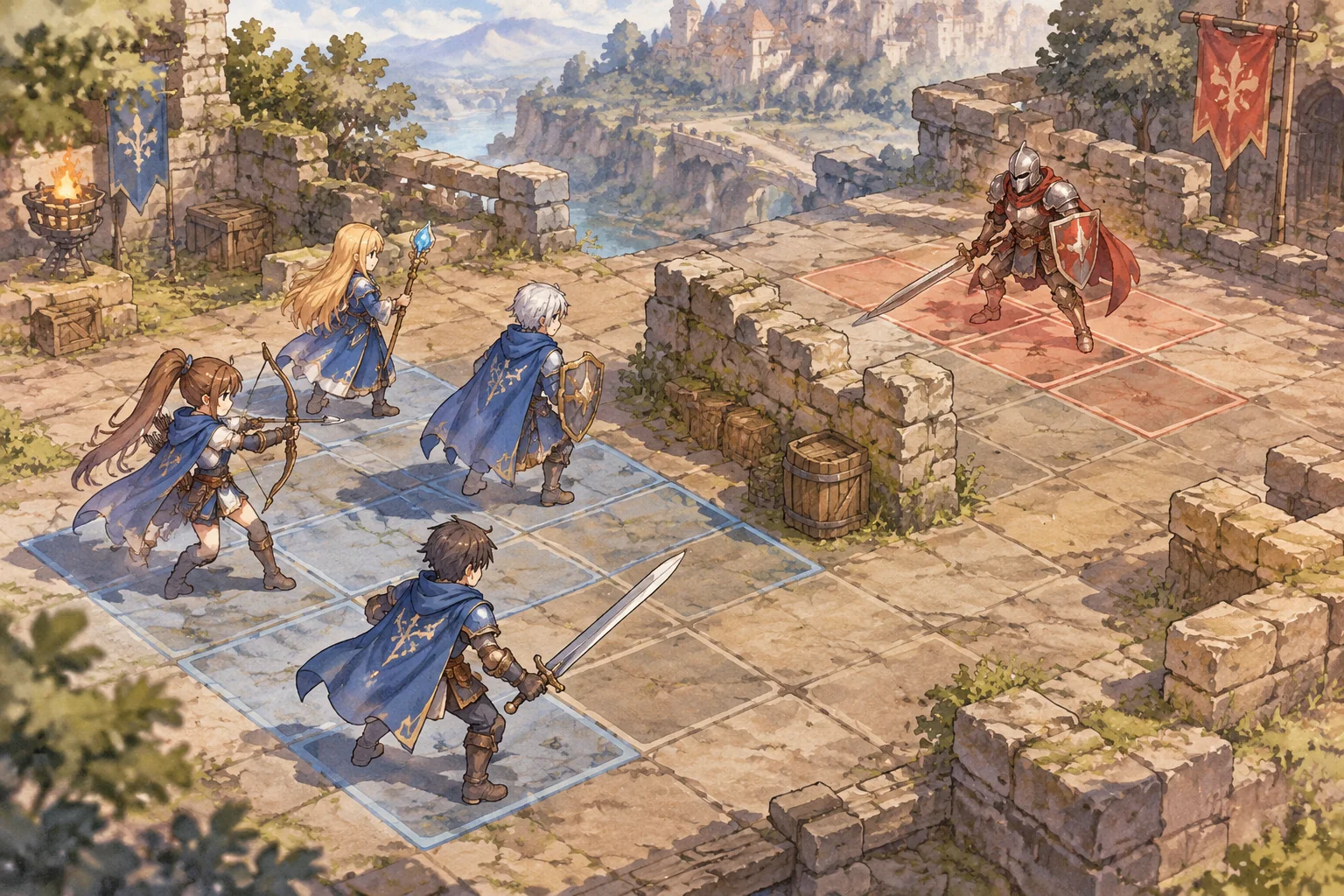
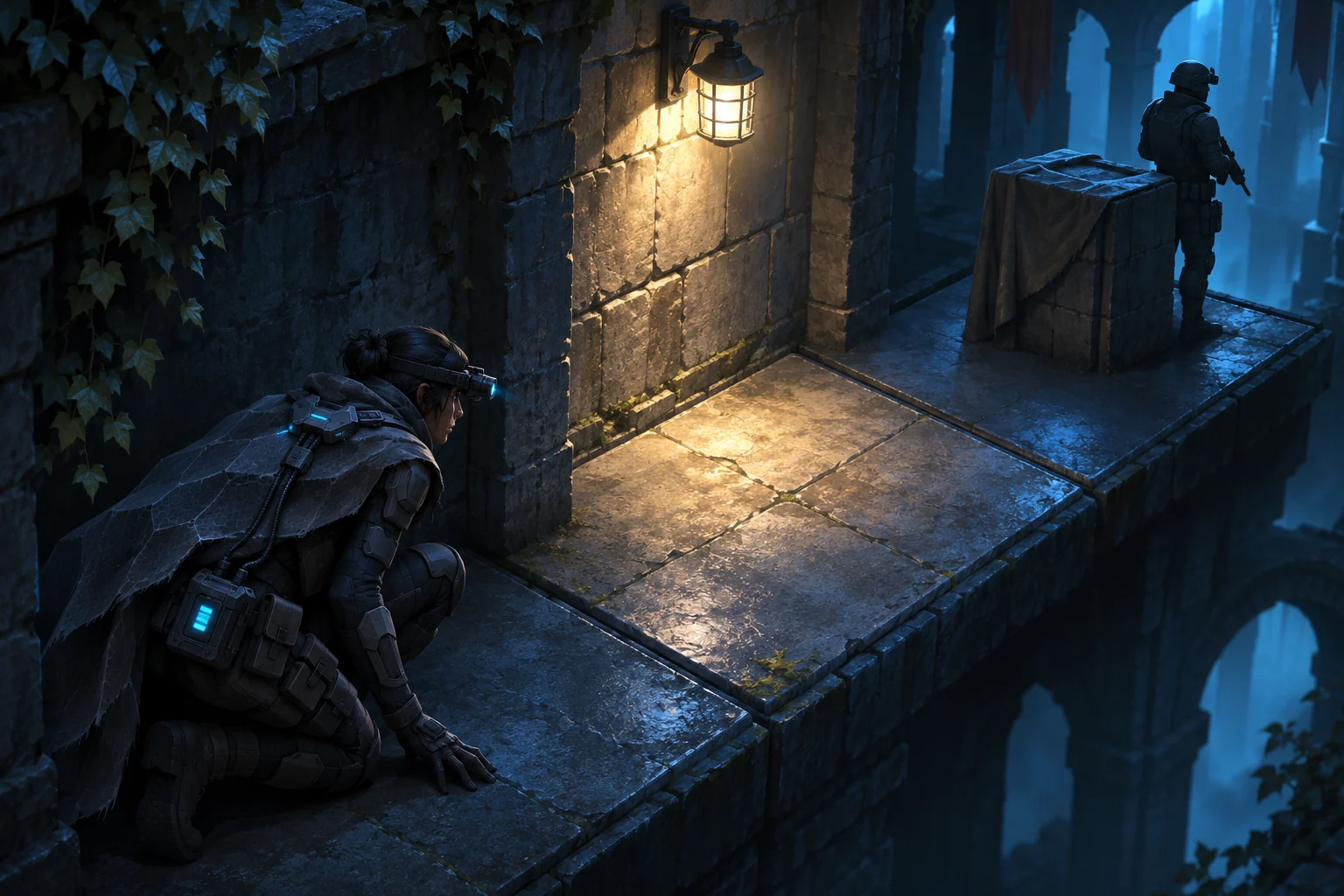
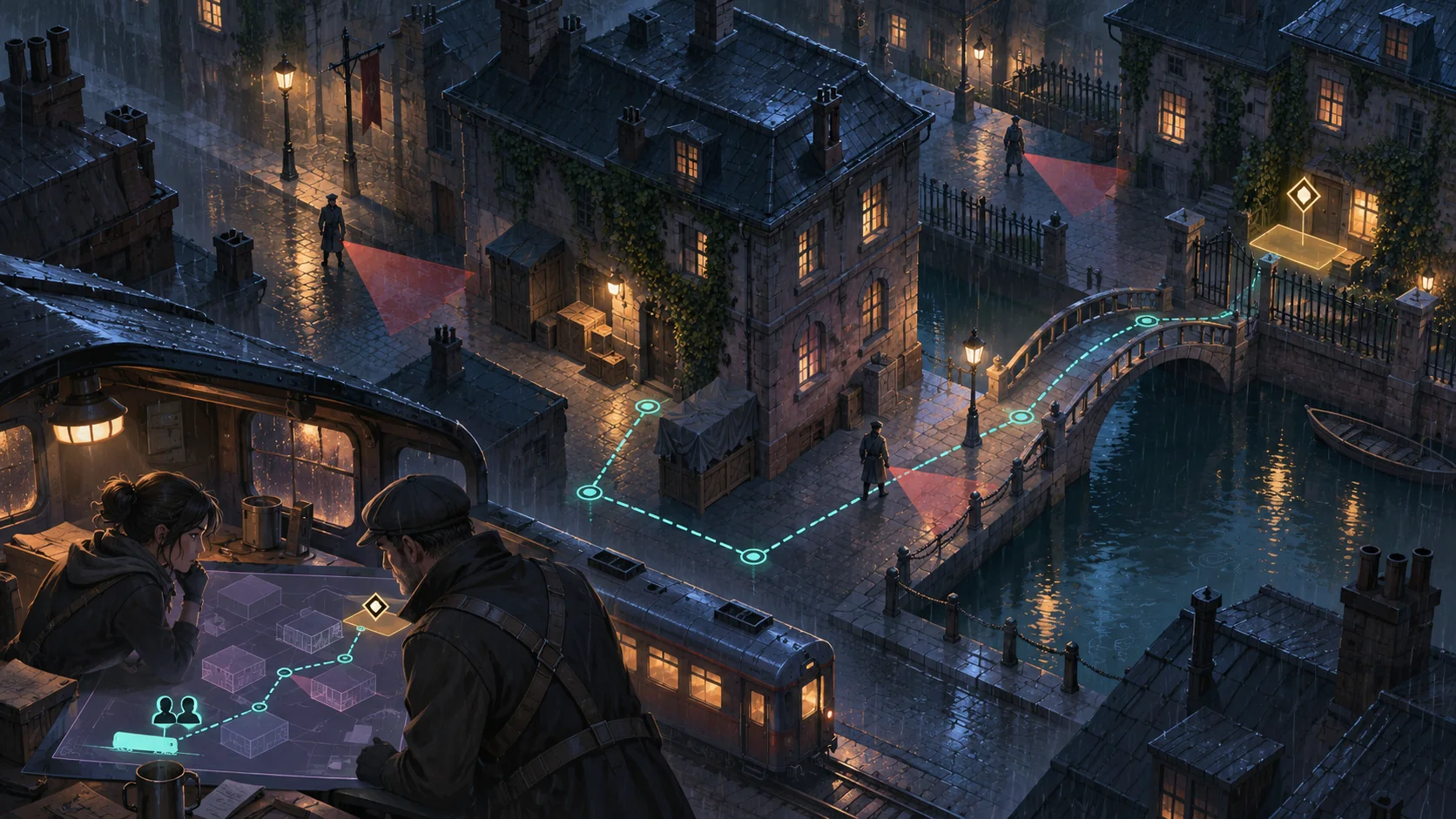
In Night Relay, the mobile headquarters changes the mission map instead of waiting off-screen. The team begins at a rail siding, studies a fixed patrol loop and chooses a route to an evidence cache. At the end of each turn, the rail-car moves to its next stop, so the extraction point shifts while the crew is still inside. Players must plan both a quiet approach and a route back to the headquarters’ next position.
Every operative gets two action points each turn. Movement, hiding and searching use visible costs; guards move after the team and check their forward sight line. Noise raises a shared alert meter. The crew has four turns to recover a ledger and reach the moving rail-car before three alerts trigger lockdown. The result is a compact planning puzzle where staying unseen and predicting the base’s movement are equally important.
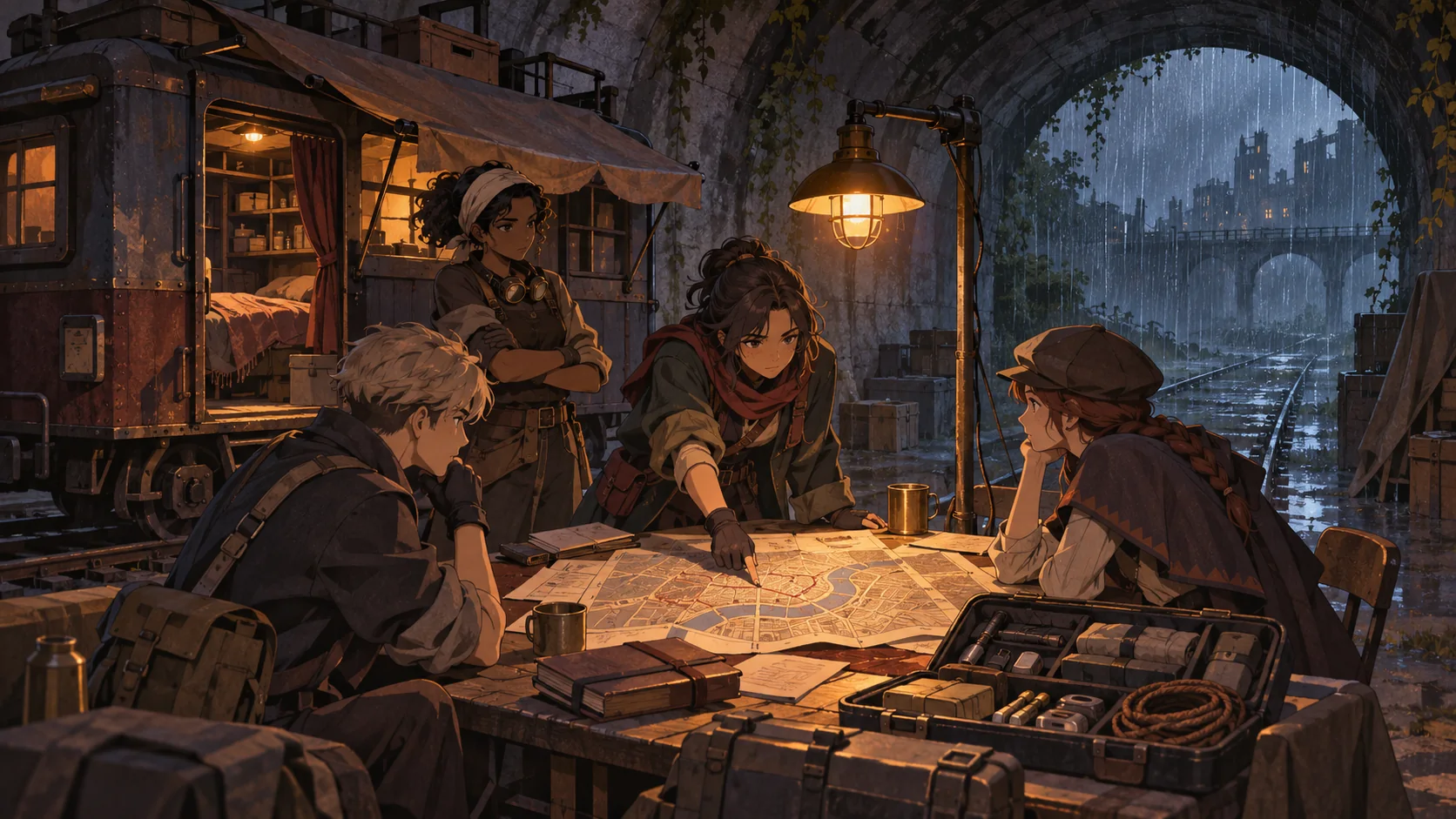
Make the rail-car part of the stealth loop
Create Night Relay as a turn-based stealth prototype on a 7-column by 5-row grid. Coordinates use x=0–6 from left to right and y=0–4 from top to bottom. The team has three operatives at (1,1), (1,2) and (1,3), each with 2 action points per turn. One orthogonal tile of movement costs 1 AP; Hide costs 1 AP and protects an operative from guard sight until that operative moves; Search costs 1 AP and collects the evidence cache at (5,2). The cache is the only mission objective. The mobile rail-car headquarters is the extraction point and cycles among sidings (0,2), (3,0), (6,2), and (3,4), then repeats. It begins at (0,2) and advances one stop clockwise after every guard phase. An operative extracts by ending a player action on the rail-car’s current siding after the cache is collected. Each guard has a facing arrow and a fixed route of four nodes. After the player spends actions for all three operatives or ends the turn, each guard moves one node along its route, then checks visibility. A guard sees up to 3 orthogonal tiles in its facing direction; walls block sight, cover tiles block sight, and a hidden operative is not visible until moving. If any guard sees an operative, add 1 shared alert, but resolve the detection once per guard phase even if several operatives are visible. At 3 alert, lockdown ends the mission. A noisy action such as forcing a door also adds 1 alert immediately. The team may spend up to four turns to collect the cache and extract. Show AP, guard positions and facings, visible tiles, alert, cache status, HQ siding and extraction status after every phase. Use fixed map, guards and route cycling; no random patrols, invisible walls or instant fail on the first sighting.
| System | Prototype rule |
|---|---|
| Map | 7 × 5 grid; x=0–6, y=0–4; fixed geometry and cover tiles. |
| Operatives | 3 operatives start at (1,1), (1,2), (1,3); each gets 2 AP per turn. |
| Actions | Move one orthogonal tile = 1 AP; Hide = 1 AP; Search cache = 1 AP; end turn when all AP are spent or player chooses. |
| Hide | Hidden operative is not seen until moving; Hide lasts only through the next guard phase. |
| Guard phase | Each guard moves one node on its fixed route, then checks its current forward sight line. |
| Visibility | Guard sees at most 3 orthogonal tiles; walls and cover block sight; detection is resolved once per guard per phase. |
| Alert | A guard spotting any operative adds 1 shared alert; noisy forced door adds 1 immediately; 3 alert triggers lockdown. |
| Objective | Search the evidence cache at (5,2), then extract at the rail-car's current siding. |
| Moving headquarters | Siding cycle: (0,2) → (3,0) → (6,2) → (3,4) → repeat; advances after each guard phase. |
| Mission limit | Collect the cache and extract within 4 turns; lockdown or turn limit before extraction is failure. |
Define turns, patrols and visibility
Turn 1 begins with the rail-car at (0,2), guards at their first route nodes and alert 0. Operative A moves from (1,2) to (2,2), then hides using the second AP. Operative B moves from (1,1) to (2,1) and then (3,1); Operative C stays under cover. The guards advance and check sight after the team phase. A is hidden, B's line is blocked, and alert remains 0. The rail-car advances to (3,0). On turn 2, A moves to (3,2) and then (4,2); B moves from (3,1) back through (2,1) to (2,2). On turn 3, A enters the cache at (5,2) and spends the second AP to search it. B moves through (2,3) to (3,3), preparing to reach the next siding. The guards act, then the rail-car advances from (6,2) to (3,4). On turn 4, B moves from (3,3) through (3,4) and ends an action there to extract the team after the cache is collected. The example assumes the stated path tiles are walkable and that the fixed cover layout prevents detection in these phases; those map conditions must be encoded in the prototype. This authored trace illustrates that the extraction target shifts with the base; it is design material, not a playable or user test.
| Event | State result |
|---|---|
| Turn 1: A moves to (2,2), then hides | A is hidden; B's line is blocked; alert remains 0 in this authored example. |
| Turn 1: guard phase | Guards move one fixed route node; walls, cover and Hide are checked; alert stays 0 in this authored example. |
| After guard phase 1 | B moves from (3,1) back through (2,1) to (2,2), while A reaches (4,2); cache not yet collected. |
| Turn 2: B moves two tiles to (4,1); A moves to (4,2) | A enters (5,2) and searches; B moves via (2,3) to (3,3); objective becomes complete. |
| After guard phase 3 | HQ advances from (6,2) to (3,4), the next extraction siding. |
| Turn 4: B reaches current siding and ends action there | After cache collection, B reaches the current HQ tile (3,4) and extracts the team. |
| Turn 4: A reaches current siding and ends action there | After cache collection, reaching the current HQ tile completes extraction. |
| Lockdown check | If alert reaches 3 before extraction, end mission as failure. |
Trace an extraction as the HQ moves
Ask for the mission state to remain inspectable. Specify when guards move, when visibility is checked, how Hide expires, and when the rail-car changes siding so players can reason about extraction.
Create a small turn-based stealth tactics prototype called Night Relay on a fixed 7-by-5 grid with coordinates x=0–6 and y=0–4. Three operatives start at (1,1), (1,2), and (1,3); each has 2 action points per turn. Moving one orthogonal tile costs 1 AP. Hide costs 1 AP and protects the operative from the next guard visibility check until that operative moves. The evidence cache is at (5,2); an operative must enter that tile, then spend 1 AP to search it. Each turn, the player uses actions for any operatives, then each guard moves one node along its fixed four-node route and checks its facing. A guard sees up to 3 orthogonal tiles in front; walls and cover block sight. Resolve a guard's detection once in that guard phase even if it sees multiple operatives. Each guard that sees at least one operative adds 1 to shared alert. Forcing a door adds 1 alert immediately. At 3 alert, lockdown ends the mission. The mobile rail-car is the extraction point and advances after each guard phase through sidings (0,2), (3,0), (6,2), (3,4), then repeats. After collecting the cache, an operative extracts by ending a player action on the current siding. Finish within four turns. Display each operative's AP and position, guard positions and facings, visible tiles, alert, cache state and current HQ siding after every phase. Use fixed patrols, cover and routes; no random guard behavior, hidden rules, or first-sighting instant failure. Include a state log that explains each detection and HQ move. This is a design specification, not evidence of a playable test.Prompt AI for a readable mission prototype
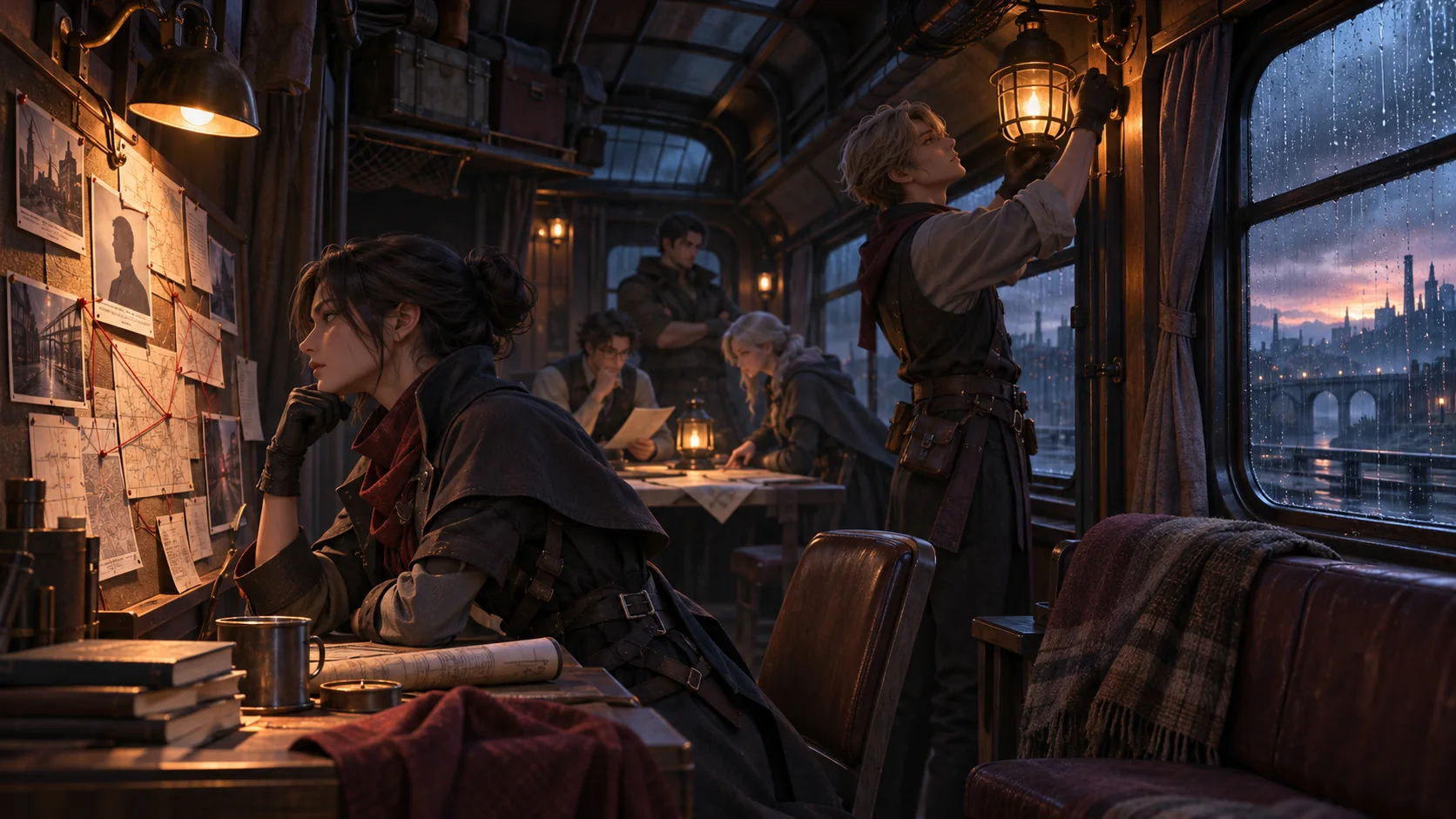
The first detection draft added alert for every visible operative. That could create several alert points from one guard’s single sweep, so the revised rule resolves a guard once per phase: if it sees one or more operatives, it adds exactly one alert. Multiple guards can still each contribute once.
The extraction rule also needed a clear timing point. The HQ advances only after guards move and check visibility, so the player can predict its next stop from the current turn. Extraction is checked after the player spends an action on the new siding, and only after the evidence cache is collected.
Revise an ambiguous detection rule
Start with the fixed grid, one patrol route and the four-siding cycle. Log each guard phase before adding more routes. Check sight blockers, Hide expiry, the one-alert-per-guard rule and HQ movement timing with the trace above. These values are authored prototype inputs; no playable game, observed balance result or user test is claimed.
Read the related turn-based stealth rules guide.
Try the SEELE AI game maker workflow.
Frequently asked questions
What makes the headquarters mobile during a mission?
The rail-car moves to the next siding after every guard phase. Its current tile becomes the extraction target, so the crew must account for the next stop while planning its route back. The interface should display the next siding after each enemy phase, even before the evidence is collected.
Does one guard add alert for every operative it sees?
No. Each guard adds at most one alert in its visibility phase, even if it sees several operatives. Different guards may each add one alert, and a noisy forced door adds one immediately. The alert log should identify which guard caused the increase and show whether its sight check occurred before or after the rail-car moved.
Check Godot's official 2D navigation overview.
How long does Hide last?
Hide protects the operative from the next guard visibility check. It ends as soon as that operative moves, so the player needs to account for the full enemy phase before using the action. The status panel should make this expiration visible so players can plan around the next guard phase rather than assume Hide is permanent.
Was Night Relay tested as a playable game?
No. Night Relay, its patrol routes, map, alert values and extraction trace are authored design material. This package does not claim a playable build, browser test, user test or measured balance result. The patrol paths, grid layout, cover placement and balance still need implementation and real playtesting before they can be evaluated.