In fictional Afterbeat, a music object remembers the lane and beat where it appeared during the previous measure. The game runs at 100 BPM in four-beat measures across left, center, and right lanes. In measure one, the solid object visits left on beat 1, center on beat 2, and right on beat 4. In measure two, ghost notes replay those positions while the solid object moves center on beat 1, right on beat 2, and left on beat 4. Those new positions become the next memory. Taps within 50 milliseconds of an echo score 100; misses score zero but do not erase memory. Report echoes, hits, score, and the measure-three pattern. Use scripted input only, not microphone recognition.
Record object positions against a fixed beat clock
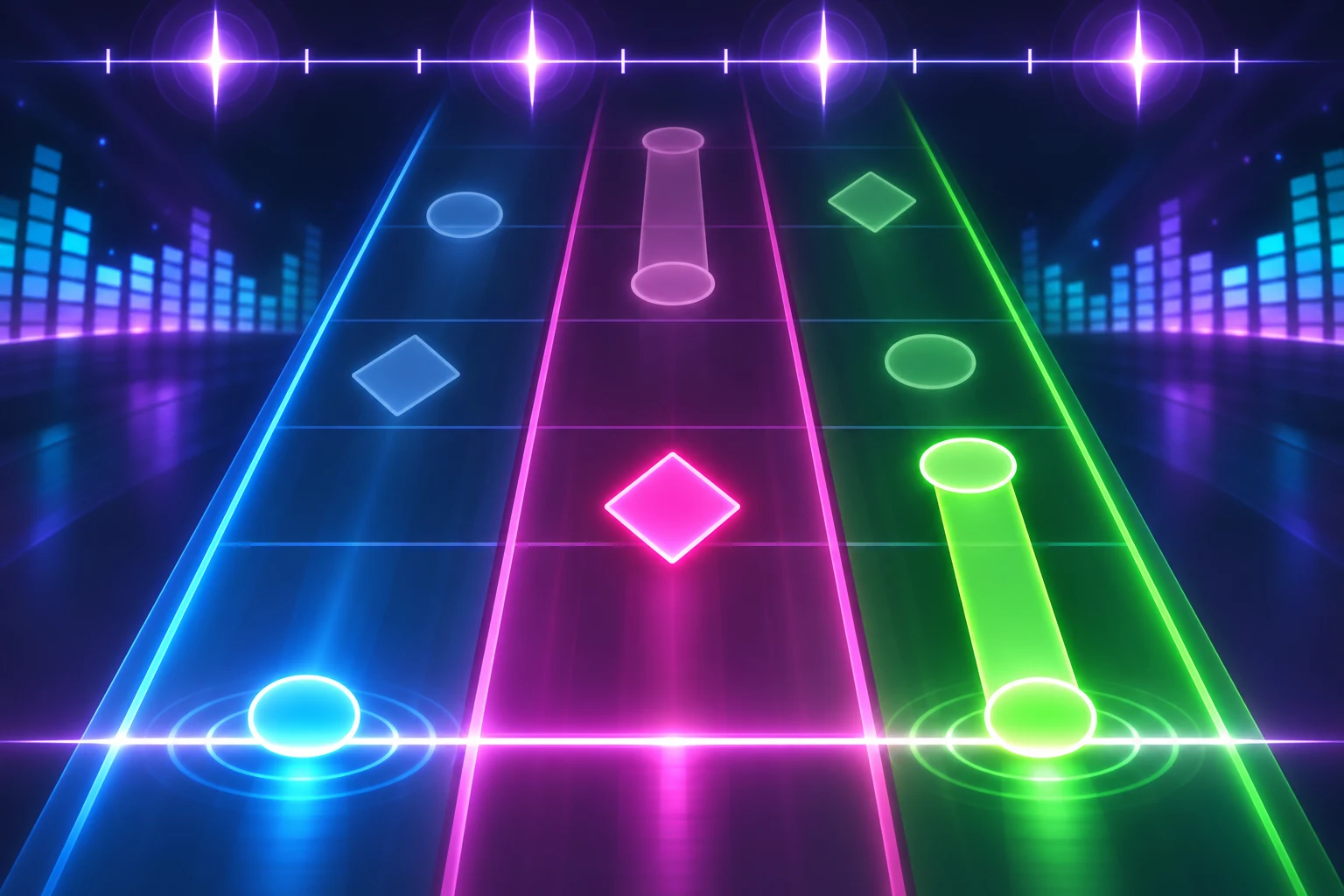
Set the tempo to 100 BPM, so each beat lasts 600 milliseconds, and use a four-beat measure. Give the playfield three lanes: left, center, and right. During measure one, the solid object appears left on beat 1, center on beat 2, and right on beat 4. Store each event as a lane plus beat index; do not infer its location from an animation after the measure ends.
Keep measure-one positions fixed as the reference pattern. Beat 3 has no object event. Show the current measure, lane labels, and beat pulse clearly. This makes the stored pattern inspectable and lets a tester reproduce taps without a microphone, speech recognition, or freeform timing interpretation.

Replay the previous measure as tappable ghost notes
In measure two, display an echo at each remembered position: left on beat 1, center on beat 2, and right on beat 4. The solid object simultaneously follows its new route, center on beat 1, right on beat 2, and left on beat 4. Keep echoes visually distinct so players know which timed events accept input. The solid object’s new lane-and-beat pairs replace the memory for the next measure.
Score an echo tap only when it lands within plus or minus 50 milliseconds of the beat: 100 points for a hit and zero for a miss. A missed echo remains in memory, so the next measure repeats the same stored pattern. Do not let a player’s score or miss rewrite the object history; the sequence changes only when the solid object completes a new measure.
Verify the next echo pattern and score ledger
When measure two ends, the stored positions are center on beat 1, right on beat 2, and left on beat 4. Measure three should replay exactly those three events as echoes. With scripted taps on all three echoes in measure two and measure three, each measure earns 300 points and a three-hit echo chain. A missed tap reduces that measure’s score by 100 but does not change the following pattern.
Report the memory before and after each measure, expected echo lane/beat pairs, tap timestamps, hit-window result, score, and chain length. This deterministic test separates object history from player performance. Afterbeat and all timings are fictional; the prototype check validates only the specified beat grid, memory update, and scoring rules.

Give the AI a fixed object-memory rhythm test
Create a rhythm game in fictional Afterbeat at 100 BPM with four-beat measures and left, center, right lanes. Measure one solid positions: left beat 1, center beat 2, right beat 4. In measure two, replay those lane/beat pairs as tappable ghost notes while the solid object visits center beat 1, right beat 2, left beat 4; store that new pattern for measure three. Taps within ±50 ms score 100, misses score 0 without changing memory. Use scripted input, no microphone. Report pattern, taps, score, and chain.
Verify one beat is 600 ms. Measure two echoes are left/1, center/2, right/4; the live object writes center/1, right/2, left/4 for the next memory. Three on-time echo taps earn 300 points; a miss scores zero for that event but leaves the next pattern unchanged. Measure three must echo the measure-two live positions.
FAQ
How can a rhythm-game object remember its previous position?
Store each event as a lane and beat index when the measure plays. On the next measure, replay those pairs as separate ghost notes. Keeping the memory data explicit makes the pattern testable and prevents an animation or missed input from silently changing the object history.
How do I keep remembered notes fair to hit?
Use a fixed tempo and a stated timing window around each beat. Distinguish echo notes from the live object with separate visual cues, then score each tap using the same window. This lets players learn the repeated pattern without guessing which visual event accepts input.
What should a rhythm prototype report?
List the stored lane-and-beat pairs before and after each measure, the expected echoes, tap times, hit results, score, and combo length. Include a missed-tap control. The ledger shows whether object memory updates independently from player accuracy. rather than shifting when a player makes an error.