In fictional Bellmarket, a tea shopkeeper can accept a rival’s offer to buy the tea shop, then make an offer for a neighboring bakery. Each deal changes who owns a business, not how many shops exist. A useful prototype needs clear prices, an acceptance choice, and a ledger that distinguishes sale proceeds from future shop income. This guide keeps customer demand, starting cash, inventory, and a seven-day window fixed so a small test can reveal whether acquisition decisions update the city consistently.
Show ownership across a small city map
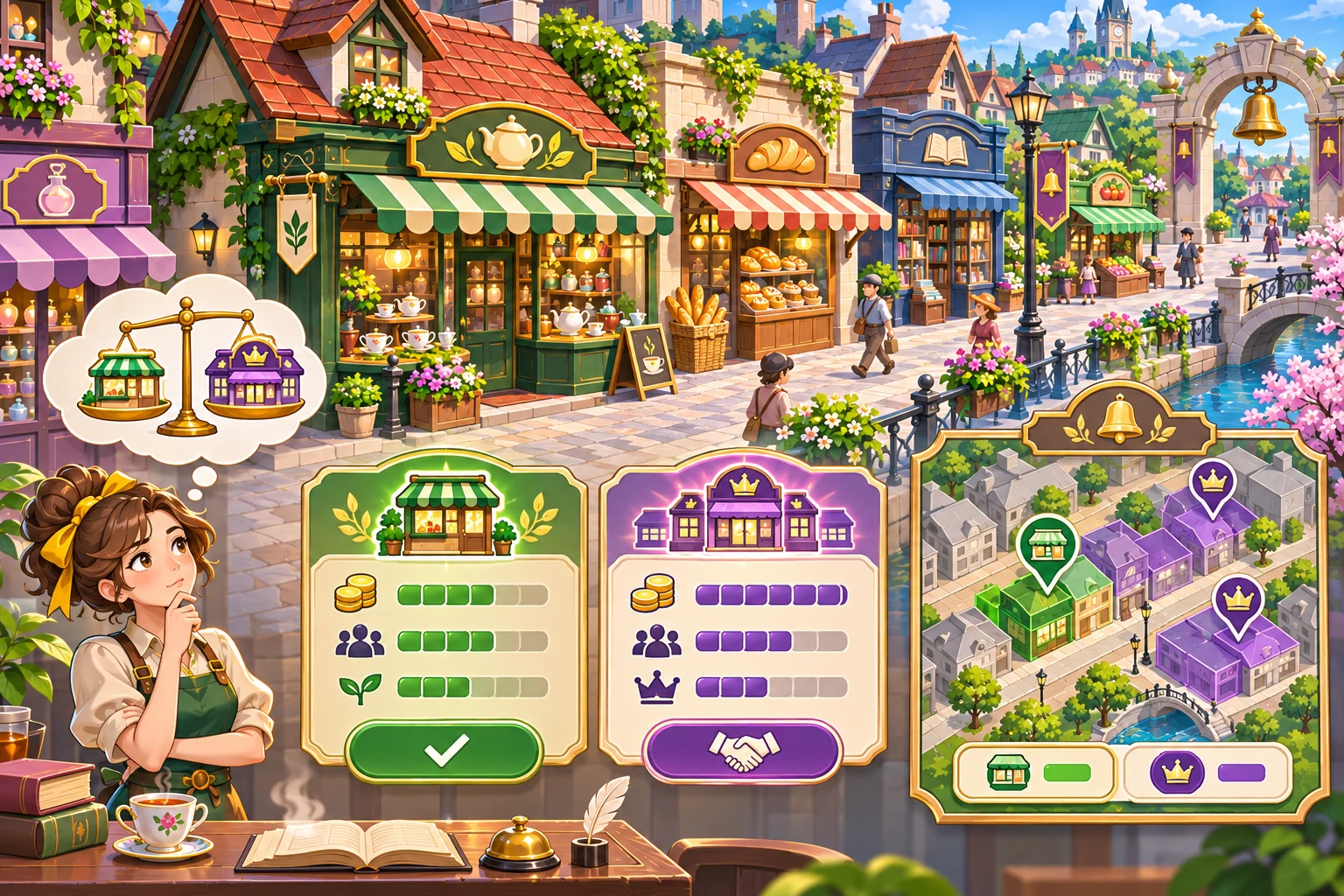
Start with three shops in Bellmarket: the player’s tea shop and herb stall, plus a rival’s bakery. Give each storefront an owner badge and a simple seven-day cash-flow estimate. The city map should make it obvious that the shops belong to separate merchants, while a shop detail panel shows stock, daily sales, and the current owner. The map and store list must refer to the same shop records.
Keep customer demand, prices, inventory, and the seven-day test window constant. In this fictional fixture, the tea shop produces 10 coins per day and the bakery produces 8. These values help check the ownership system; they are not real business benchmarks. Showing the expected income before an offer gives both merchants a reason to value the same shop differently.
Make acquisition offers visible and affordable
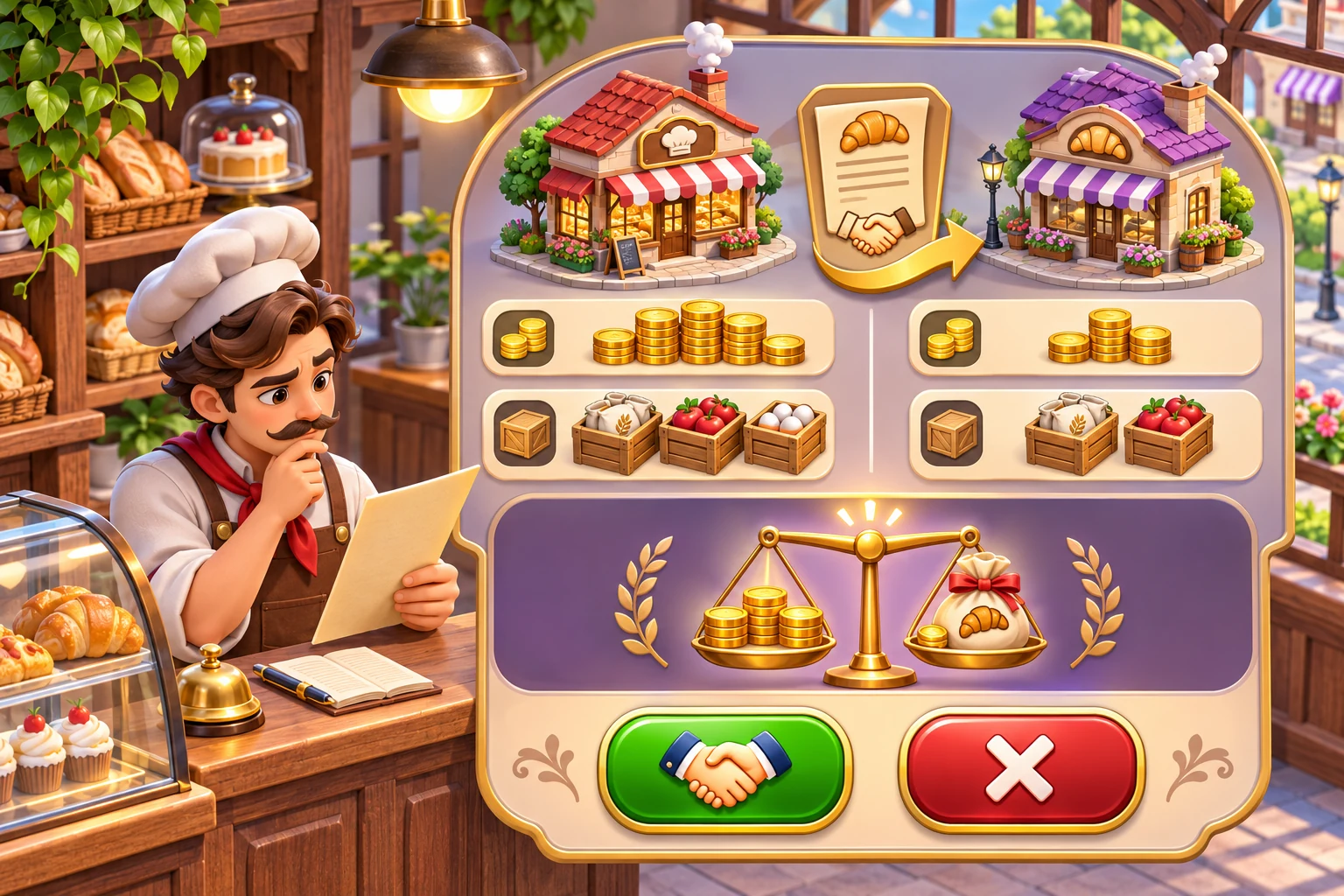
Let a rival offer 80 coins for the tea shop. The player can accept or keep the shop, with the offer screen showing the tea shop’s expected 70 coins of seven-day income. The player can also offer 60 coins for the bakery, whose fixed seven-day income is 56. Show the offer, expected income, current inventory, and available cash before either merchant confirms. The numbers create a deterministic test fixture, not a universal pricing formula.
When a sale is accepted, transfer the shop’s owner ID exactly once. Subtract the offer from the buyer’s cash and add it to the seller’s cash; do not create a second storefront or copy the target’s inventory into a new shop. After the transfer, daily income goes to the new owner. A Godot Resource can hold authored shop or offer settings, while the active owner and cash remain in game state.
Replay the week and reconcile the city ledger
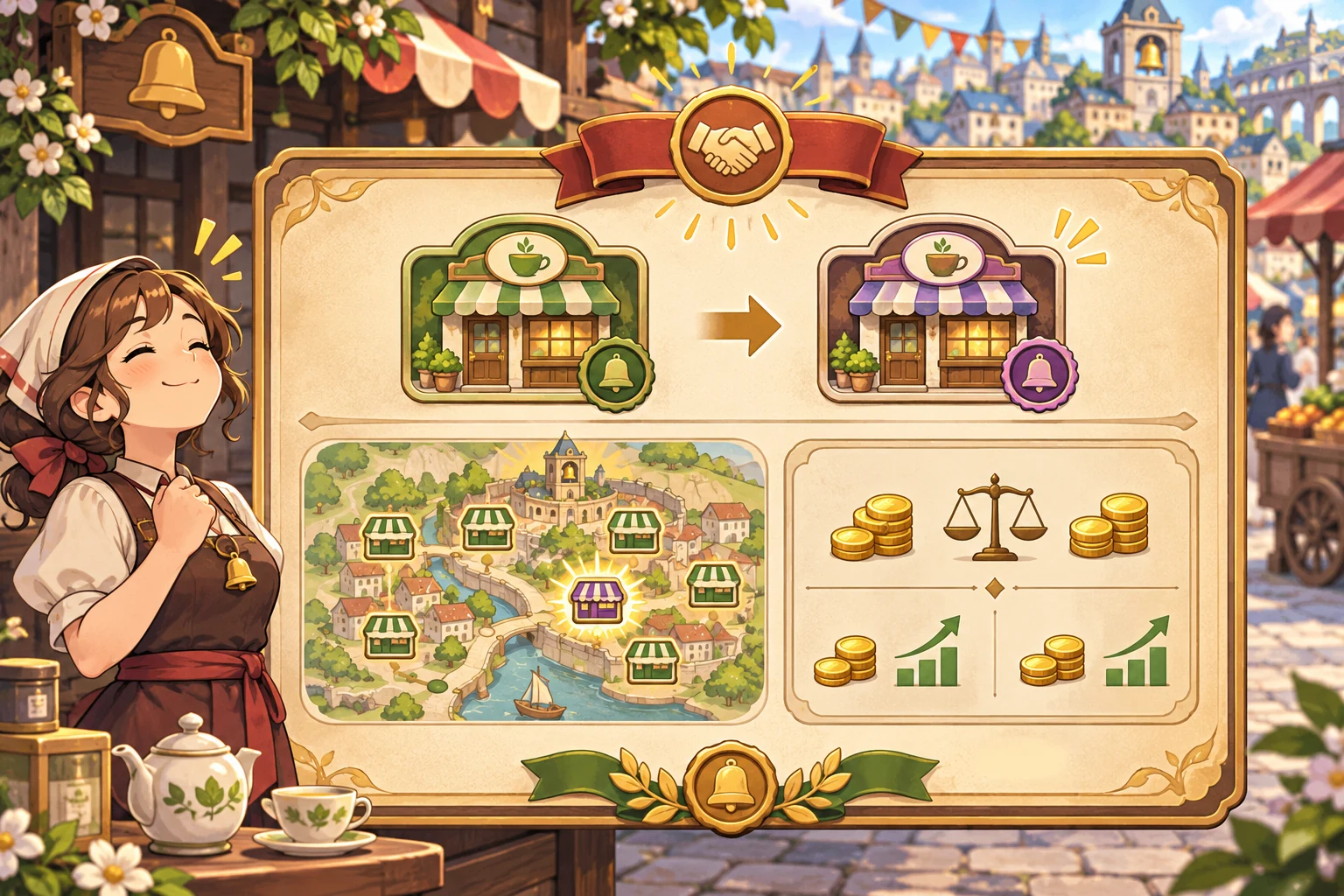
Run a no-deal baseline and a two-way acquisition scenario with the same three shops and seven days. In the deal scenario, the rival buys the player’s tea shop for 80 coins and the player buys the rival’s bakery for 60. The player then owns the herb stall and bakery; the rival owns the tea shop. Shop count stays at three. Report accepted offers, final owners, total shop count, and each merchant’s ending cash as separate values.
With starting cash of 100 coins per merchant and the fixed daily income, the deal scenario ends with 176 coins for the player and 150 for the rival. The 326-coin combined total equals the original 200 plus 126 coins of seven-day shop income. Transaction payments cancel between merchants, so cash cannot appear or disappear during ownership transfer. The test checks bookkeeping and ownership changes only; it does not model taxes, debt, or a full economy.
Give the AI a fixed shop acquisition test
Create a shopkeeper simulation in fictional Bellmarket with three stores: the player owns a tea shop and herb stall, and a rival owns a bakery. Keep customer demand, inventory, starting cash of 100 coins per merchant, and a seven-day test window fixed. The tea shop earns 10 coins per day and the bakery earns 8. Let the rival offer 80 coins for the tea shop, and let the player offer 60 for the bakery. Support accept or decline choices, transfer each store owner exactly once, and route future income to the new owner. Keep the total shop count at three. Report accepted offers, final owners, shop count, and ending cash for each merchant. Reconcile combined ending cash to starting cash plus seven days of shop income.
If a transfer duplicates a shop, changes demand or inventory, or creates or removes cash, restore the same three-store fixture and rerun. Confirm final owners are player: bakery and herb stall; rival: tea shop; total shops: three; ending cash: player 176 and rival 150.
FAQ
How can rival shops buy each other in a game?
Give each shop a stable identity and owner, then let a merchant make an offer against that existing shop. On acceptance, update its owner once and transfer the payment between the two cash balances. Keep the same store record so the city map, stock, and income all continue to refer to one business.
How should a shop acquisition price be tested?
For an early prototype, show expected income, inventory, and available cash beside a fixed offer. Use deterministic test values and make the offer decision visible. This checks whether players can understand the trade and whether the buyer can afford it; it does not establish a realistic valuation formula for every business.
What should a shopkeeper acquisition prototype measure?
Track accepted offers, the owner of every store, total store count, and each merchant’s ending cash. Also reconcile the combined cash total against starting balances and income earned during the test. These checks can catch duplicated shops or missing payments before adding debt, taxes, or a larger city economy.