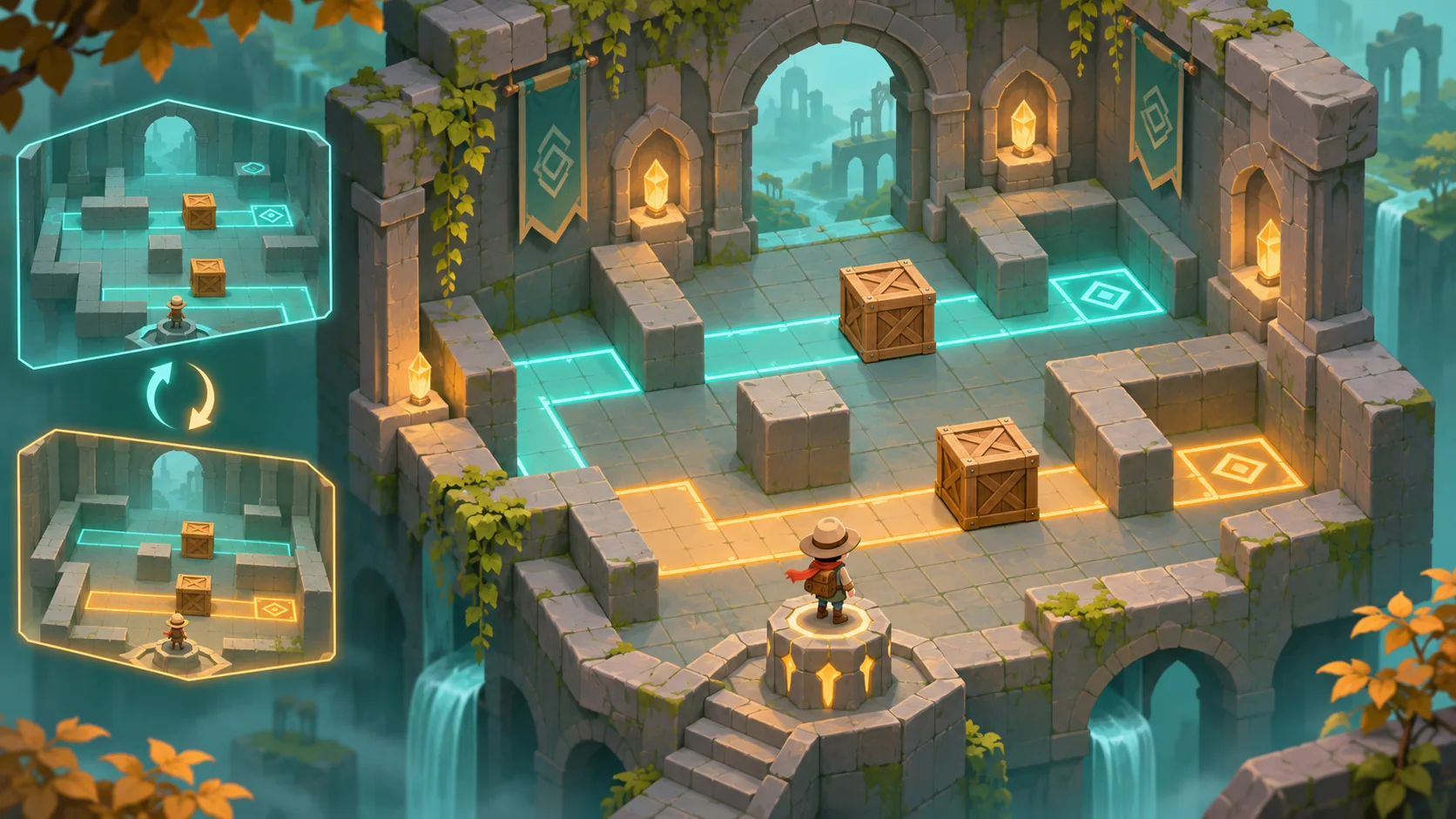
In Parallax Rooms, changing the viewpoint changes which corridor exists. The explorer looks north or south from a marked pedestal; one view opens the left crate lane, while the other opens the right. Crates, goals and the explorer keep their grid coordinates as the wall pattern changes, so every switch must leave occupied cells safe.
The room is a compact Sokoban puzzle: walk one tile, push one crate, never pull. The left crate reaches its goal in the north view. After the explorer returns to the pedestal, the south view opens the right corridor and the second crate can be pushed home. The camera choice is therefore part of the route plan, not a cosmetic toggle.
Make viewpoint changes alter the room layout
Create Parallax Rooms as a 5-by-5 Sokoban puzzle with coordinates x=0–4 and y=0–4. Each move walks one orthogonal tile. If a crate is directly ahead, the move pushes it one tile; crates cannot be pulled, pushed diagonally, or pushed through a wall or another crate. The player starts in North view at (1,4). Crate A starts at (1,3), Crate B at (3,3), and goals are at (1,1) and (3,1). A view pedestal sits at (2,4). The room uses paired wall layouts. In North view, the left corridor cells (1,2) and (1,3) are open, while (3,2) is a wall. In South view, (1,2) becomes a wall and (3,2) opens. The bottom connector cells (1,4), (2,4), (3,4), both crate start cells, and both goal cells stay walkable in both views. All other unspecified cells are walls. The player may switch view only while standing on the pedestal, and switching costs one move. Crate and player coordinates do not change during a switch. Before applying a view, validate that no player or crate would occupy a cell that becomes a wall; if so, block the switch and show the obstructing coordinate. A goal cell is always floor. The puzzle is solved when both crates occupy their matching goals. Reset restores North view, player (1,4), both crates and all wall states. There is no move limit, crate reset, undo or automatic push. Show active view, grid coordinates, crate locations, goals, pedestal, move count and the reason for each blocked move.
| System | Prototype rule |
|---|---|
| Grid | 5×5; x=0–4, y=0–4; unspecified cells are walls. |
| Movement | Walk one orthogonal tile per move; if a crate is ahead, push it one tile. |
| Crates | A at (1,3), B at (3,3); cannot pull, push diagonally, or push into walls or another crate. |
| Goals | A goal at (1,1); B goal at (3,1); both remain floor in either view. |
| North view | (1,2) and (1,3) form the open left corridor; (3,2) is wall. |
| South view | (1,2) becomes wall; (3,2) opens to form the right corridor. |
| Stable tiles | Bottom connector (1,4),(2,4),(3,4), crate starts and goals remain walkable in both views. |
| View switch | Only at pedestal (2,4); costs one move; player and crate coordinates stay fixed. |
| Switch safety | Reject a view change if a player or crate would overlap a new wall; name the blocked coordinate. |
| Win and reset | Place each crate on its matching goal; reset restores North view and starting coordinates. |
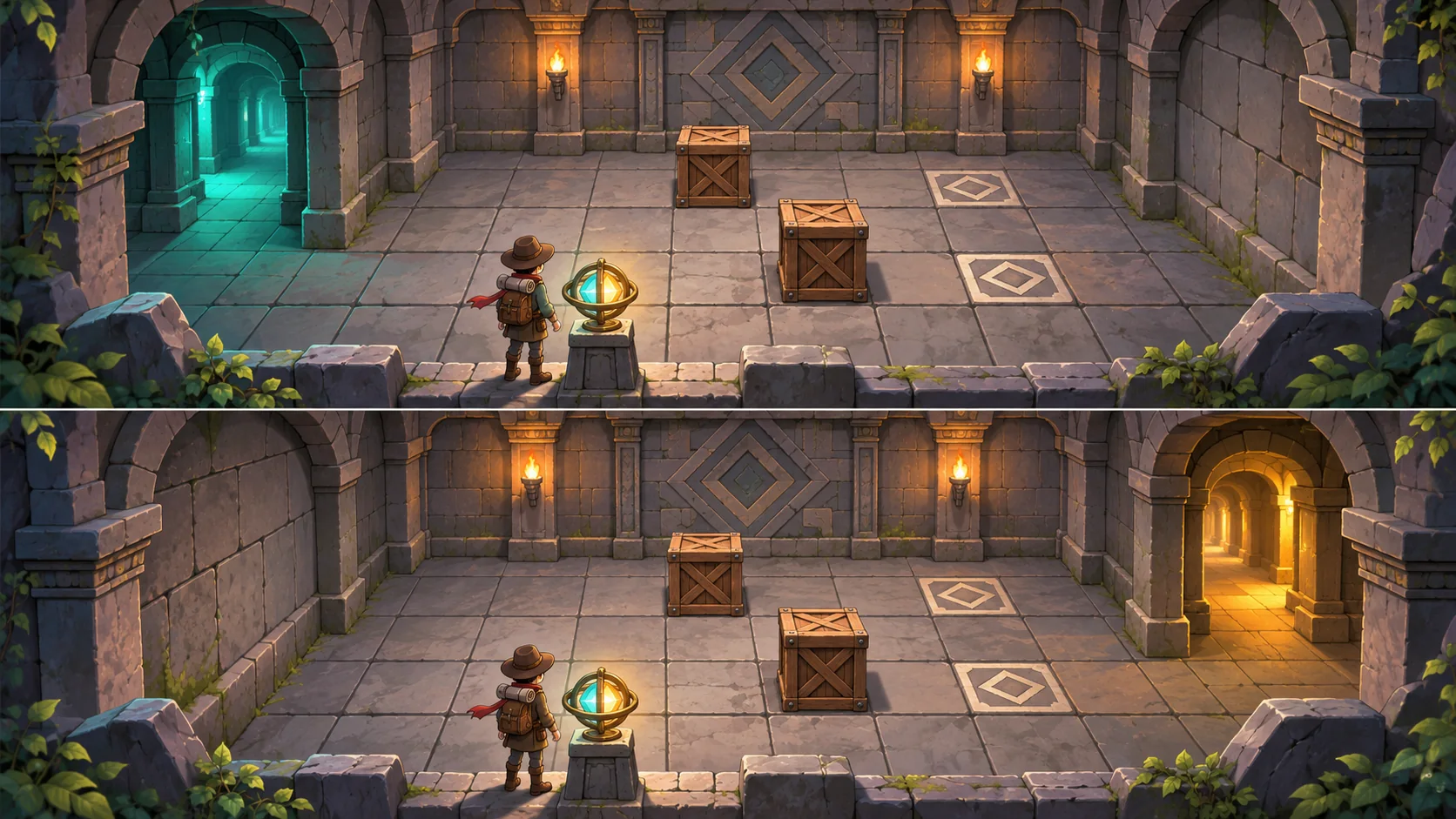
Define the grid, pushes and safe view switches
Start in North view with the explorer at (1,4), Crate A at (1,3), Crate B at (3,3), and goals at (1,1) and (3,1). Move north once: A is pushed to (1,2), and the explorer occupies its old tile at (1,3). Move north again: A reaches its goal at (1,1), and the explorer stands at (1,2). Walk south to (1,3), then (1,4), then east to the pedestal at (2,4). Switch to South view, spending one move. The explorer and A remain on safe stable tiles; the right corridor cell (3,2) opens. Walk east to (3,4), then push Crate B north from (3,3) to (3,2). Push north once more to place it on its goal at (3,1). Both crates now occupy their matching goals, so the room is solved. The trace makes the critical view transition explicit: the explorer leaves the left corridor before that corridor becomes a wall. It is an authored state trace, not a playable or user test.
| Event | Expected state |
|---|---|
| Start | North view; player (1,4); A (1,3); B (3,3); goals (1,1) and (3,1). |
| Push A north | A moves to (1,2); player moves to (1,3). |
| Push A north again | A reaches (1,1); player moves to (1,2). |
| Return to pedestal | Walk to (1,3), (1,4), then (2,4). |
| Switch to South | Costs one move; player remains (2,4); A remains safely on goal (1,1); (3,2) opens. |
| Push B north | B moves from (3,3) to (3,2); player moves to (3,3). |
| Push B north again | B reaches goal (3,1); player moves to (3,2). |
| Win | Both crates on matching goals; room is solved. |
Trace both crates onto their goals
Ask the generator to keep world coordinates separate from the active view layout. Define which corridor cells change, which cells stay safe, and when a view switch must be rejected before it can trap a crate.
Create a 5×5 Sokoban puzzle called Parallax Rooms with x and y coordinates 0–4. Start in North view with player (1,4), Crate A (1,3), Crate B (3,3), goals (1,1) and (3,1), and view pedestal (2,4). Move one orthogonal tile per action; if a crate is directly ahead, push it one tile. Never allow pulling, diagonal pushes, crate overlap or pushing into walls. In North view, cells (1,2) and (1,3) are open; (3,2) is a wall. In South view, (1,2) becomes a wall and (3,2) opens. Cells (1,4),(2,4),(3,4), crate starts and goals stay walkable in both views; all other unspecified cells are walls. Switch view only while on the pedestal and spend one move. Player and crates keep their coordinates. Before switching, test every occupied cell against the new wall set; if any is blocked, reject the switch and identify the coordinate. Walk A north twice to (1,1), return to the pedestal, switch to South, walk to (3,4), and push B north twice to (3,1). Win when both crates occupy their matching goals. Reset returns to North view and all starting positions. Show active view, grid, coordinates, move count and blocked-action reason. This is a design specification, not a playable test claim.Prompt AI to build the perspective puzzle
The first layout draft let the viewpoint switch turn a tile under a crate into a wall. That created an accidental softlock, so the final rule checks every occupied coordinate before changing views and rejects unsafe switches with a coordinate-level reason.
The puzzle also needed a clear split between what changes and what stays fixed. Only the paired corridor tile at (1,2) or (3,2) changes passability; the player, crates, goals, pedestal and bottom connector keep their positions. This makes a crate route readable across both views.
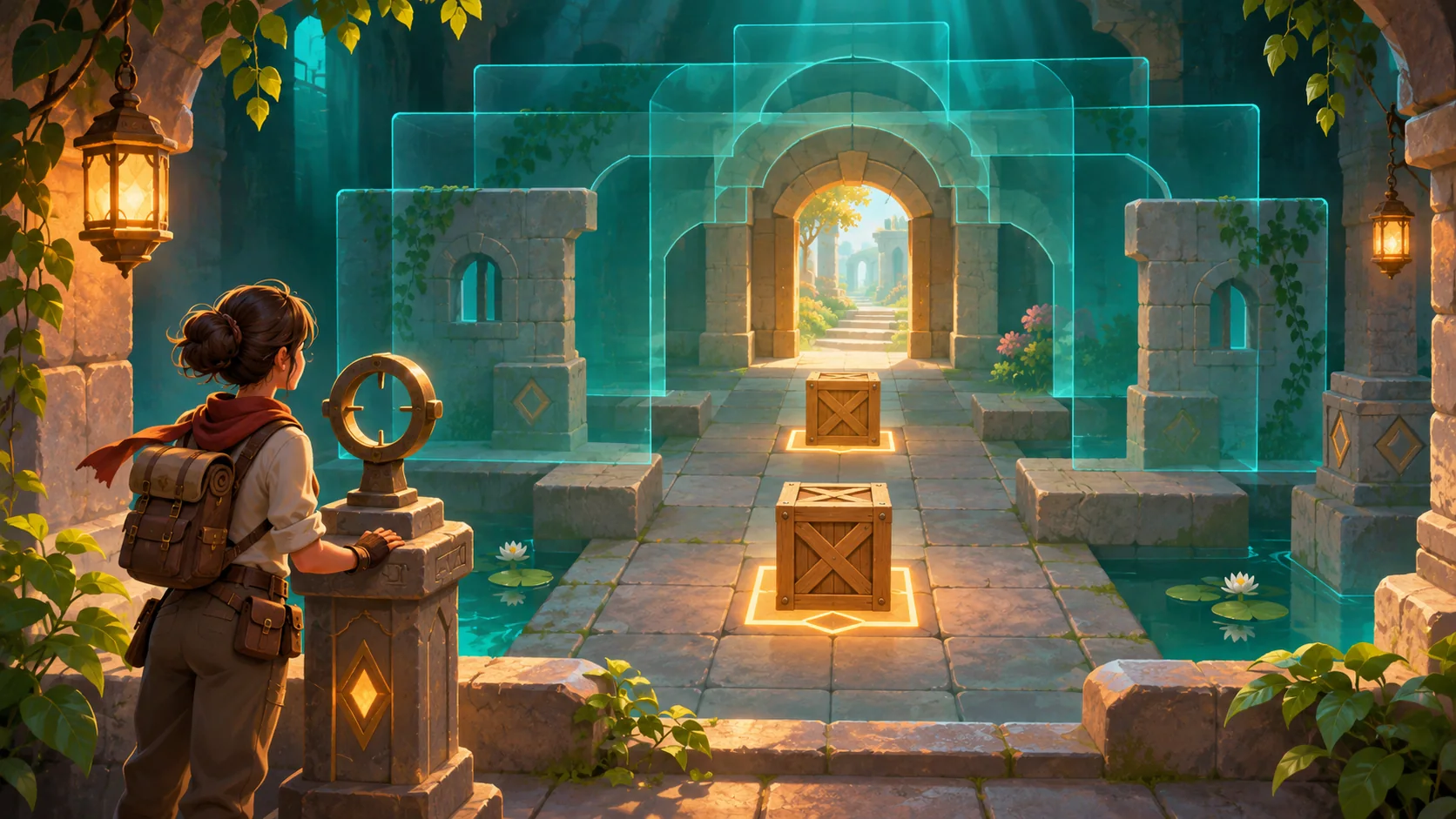
Revise an invalid layout transition
Build the grid and one-way push rule first, then add the two wall sets and the pedestal. Replay the written trace and check the occupied-cell guard before every view change. Add more rooms only after the stable connector and goal behavior remain consistent. These are authored rules, not a playable or user test.
Read the related Sokoban rules guide.
Read the perspective puzzle view guide.
Frequently asked questions
What changes when the player changes viewpoint?
The room activates a different wall and corridor layout. In this example, the north view opens the left route, while the south view opens the right route. Crates, goals and player coordinates stay in place. The view switch changes walkable cells only, and the pedestal is the only place where the player can request it.
Can a view switch trap a crate in a wall?
No. Before switching, the game checks whether the player or any crate would overlap a cell that becomes a wall. If the transition is unsafe, it is rejected and the obstructing coordinate is shown. The check runs before the layout changes, so every object and the active view remain in their current positions.
Check Godot's official TileMapLayer reference.
Can I pull a crate back if I push it the wrong way?
No. This is a Sokoban-style puzzle: crates only move when pushed from an adjacent tile, and they cannot be pulled. The reset action restores the original positions and North view if the player wants to retry. Plan each push carefully, since the prototype has no undo or automatic crate recovery.
Has Parallax Rooms been tested as a playable puzzle?
No. The paired wall layouts, crate positions, switching rule and written solution are authored prototype specifications. This package does not claim an implemented game, browser test, user test or measured puzzle difficulty. It includes a static local preview and a written state trace, neither of which demonstrates interactive play or player success.