In Starwing Relay, the pilot flies and aims independently while two wingmates answer team commands. A single 100-point capacitor powers the whole squad: Guard Link, Focus Volley and Vector Burn all draw from the same pool. Spending energy on a defensive save changes what the squad can afford when an opening appears.
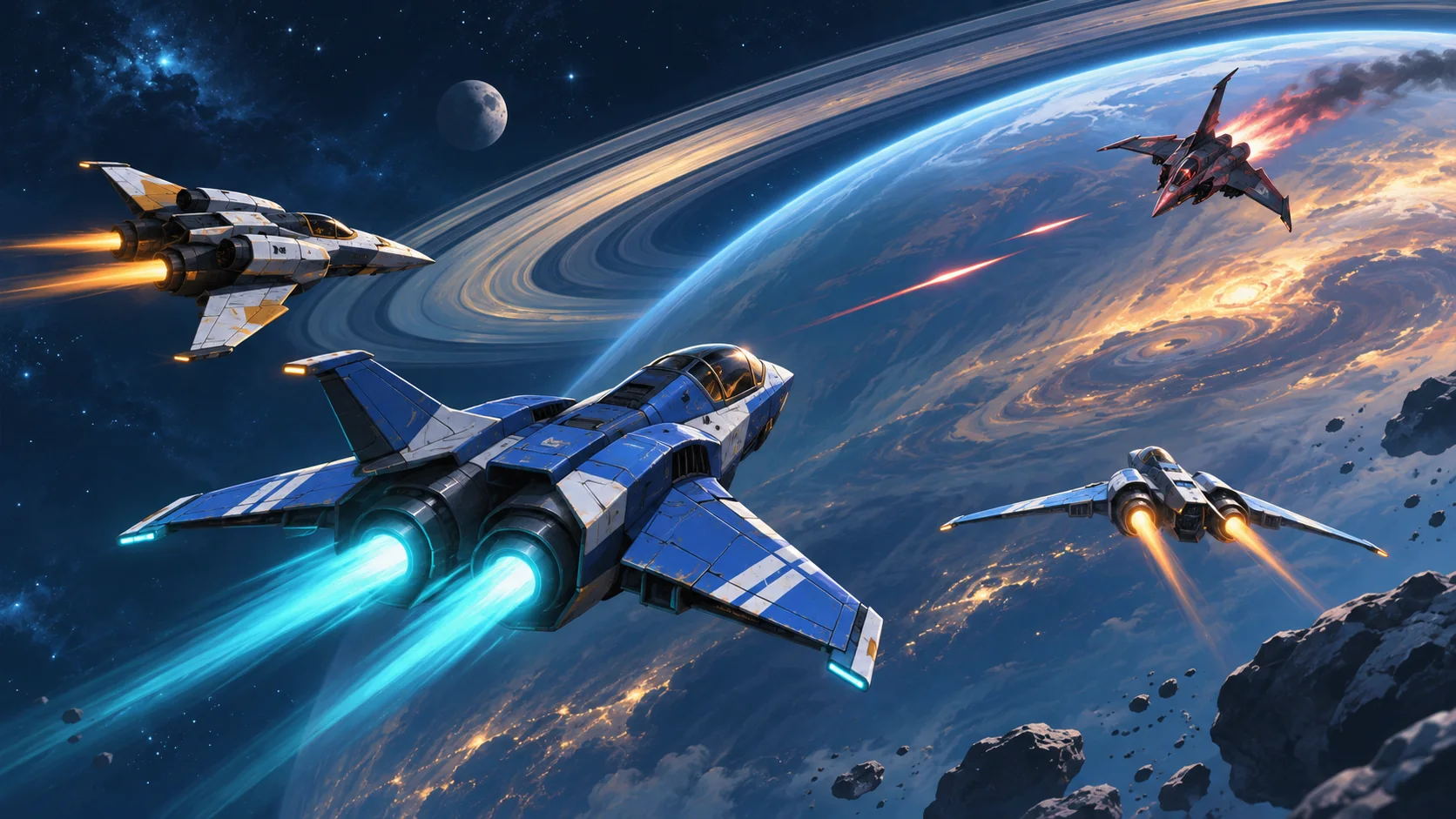
The encounter is a short dogfight against one interceptor and a bomber. Both have readable health and attack cues. The pilot can keep firing a free primary weapon, but each shared ability costs energy and has a specific tactical purpose. The authored trace shows how target selection, maneuvering and energy timing combine.
Give the squad one shared capacitor
Create Starwing Relay as a top-down real-time dogfight in a 1,600-by-900 arena. The player steers one interceptor with WASD and aims with the pointer; two wingmates follow at formation offsets. A target lock selects one visible enemy within 900 units. The squad starts with 100 energy, maximum 100. All three team abilities draw from this single pool: Guard Link costs 30 and absorbs the next hostile volley that hits an allied ship within 500 units; Focus Volley costs 25, requires a locked target within 700 units, and makes both wingmates deal 75 damage each; Vector Burn costs 20, moves the player 160 units in the aimed direction and breaks the current enemy lock. Primary fire deals 60 damage per hit, has a 0.5-second interval, and spends no team energy. Energy regenerates at 5 per second, capped at 100, whenever no team ability is active or being triggered. The encounter contains one 150-hull interceptor and one 180-hull bomber. The training bomber telegraphs one 80-damage volley at t=0 and fires it at t=2. Win by disabling both enemies before the 90-second escape timer expires. Lose if player hull reaches zero or the bomber exits. Reject an ability if its cost, target or range requirement is not met; show the exact reason and leave energy unchanged.
| System | Prototype rule |
|---|---|
| Arena | Top-down 1,600×900; real-time, 90-second escape timer. |
| Player control | WASD steers; pointer aims; primary fire is a separate input. |
| Squad | Player interceptor plus two wingmates that hold formation offsets. |
| Target lock | Select one visible enemy within 900 units; Focus Volley has a stricter 700-unit range. |
| Shared pool | One team capacitor starts at 100, holds at most 100, and is shared by player and both wingmates. |
| Guard Link | Costs 30; absorbs the next hostile volley hitting an ally within 500 units. |
| Focus Volley | Costs 25; requires a locked target within 700 units; both wingmates deal 75 damage each. |
| Vector Burn | Costs 20; moves the player 160 units along aim direction and breaks enemy lock. |
| Primary fire | 60 damage per hit every 0.5 seconds; does not use team energy. |
| Recovery | Regain 5 energy per second when no team ability is active or being triggered; cap at 100. |
| Enemies | Interceptor: 150 hull. Training bomber: 180 hull; it telegraphs one 80-damage volley at t=0 and fires at t=2. |
| Win | Disable both enemies before the bomber escapes at 90 seconds. |
| Loss and reset | Lose at zero player hull or bomber escape; reset restores full hull, 100 energy and enemy states. |
| Rejected commands | Insufficient energy, invalid target, or out-of-range command leaves the pool unchanged and displays a reason. |
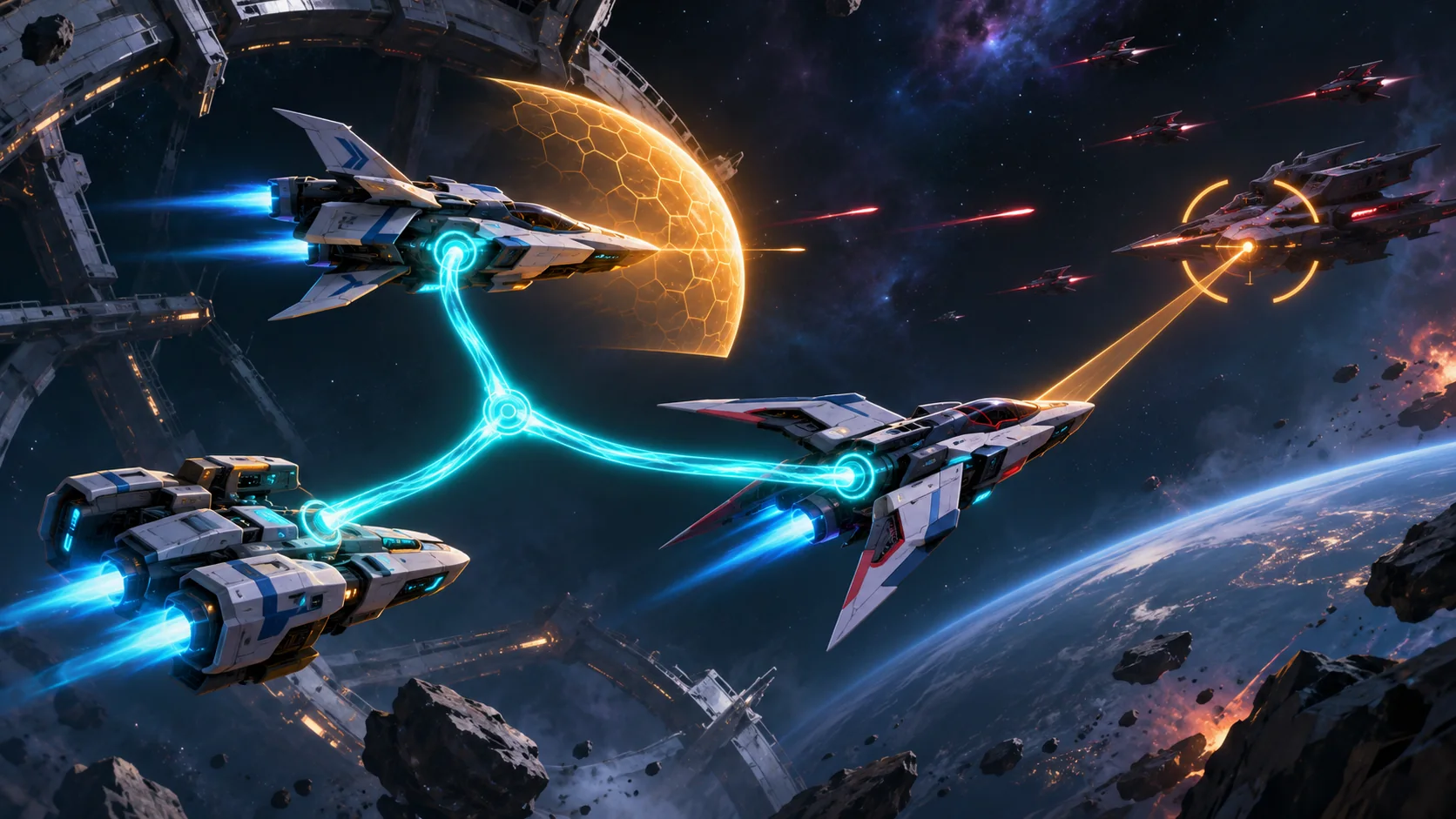
Define movement, targeting and team abilities
Start at t=0 with 100 energy, player hull 300, interceptor hull 150 and bomber hull 180. The bomber marks its single 80-damage volley for t=2. At t=1, activate Guard Link: 30 energy is spent, leaving 70; the shield absorbs the t=2 volley. Spend no team ability from t=2 to t=4; regeneration adds 10, bringing the pool to 80. At t=4, lock the interceptor and issue Focus Volley: 25 is spent, leaving 55, and the two wingmates deal 75 damage each to disable it. Fly behind the bomber while no team ability is active from t=4 to t=7; regeneration adds 15, reaching 70. At t=7, use Vector Burn to move 160 units and break the bomber’s lock: energy falls to 50. Fire three primary hits at t=7, t=7.5 and t=8; each deals 60 damage and the third disables the 180-hull bomber. No team ability is used during this one-second firing sequence, so regeneration adds 5 energy, ending at 55. Both enemies are disabled at t=8. This is an authored state trace, not a playable or user test.
| Time and action | Expected state |
|---|---|
| t=0 · Start | Energy 100; player hull 300; interceptor 150; bomber 180. |
| t=1 · Guard Link | Spend 30; energy 70; cover the bomber’s telegraphed volley. |
| t=2 · Volley arrives | Guard Link absorbs the single 80-damage volley; player hull remains 300. |
| t=2–4 · Hold formation | No team ability used; +10 energy; pool reaches 80. |
| t=4 · Focus Volley | Spend 25; pool 55; wingmates deal 150 damage and disable interceptor. |
| t=4–7 · Reposition | No team ability used; +15 energy; pool reaches 70. |
| t=7 · Vector Burn | Spend 20; pool 50; move 160 units and break bomber lock. |
| t=7–8 · Three primary hits | Three hits ×60 disable bomber; +5 regeneration while firing; pool ends at 55. |
| Clear | Both enemies disabled at t=8, before escape; energy 55. |
Trace the bomber encounter
Ask the generator to keep movement, pointer aim, target lock, primary fire and team energy as separate systems. Make the one shared pool visible beside each ability cost. Add an encounter stepper or event log so the trace can be replayed and the resource changes can be inspected.
Create a top-down real-time dogfighting prototype called Starwing Relay in a 1600×900 arena. The player steers one interceptor with WASD and aims with the pointer; two wingmates hold formation offsets. Start with player hull 300, team energy 100/100, one interceptor with 150 hull, and one bomber with 180 hull. Show a target lock on one visible enemy within 900 units. Primary fire deals 60 damage every 0.5 seconds and costs no team energy. All team abilities share the same pool: Guard Link costs 30 and absorbs the next hostile volley that hits an ally within 500 units; Focus Volley costs 25, requires a locked target within 700 units, and makes both wingmates deal 75 damage each; Vector Burn costs 20, moves the player 160 units in the aimed direction and breaks enemy lock. Regenerate energy at 5 per second, capped at 100, whenever no team ability is active or being triggered. The bomber telegraphs one 80-damage volley at t=0 and fires it at t=2. Win by disabling both enemies before 90 seconds; lose at zero player hull or bomber escape. Reject an unaffordable or invalid ability without changing energy, and display the reason. Reset restores the exact starting state. Show energy before and after each command, target range, hull, timer and the attack telegraph. Include an event log for the written trace.Prompt AI to build the dogfight
The first cost draft let Guard Link absorb a volley while Focus Volley removed the interceptor, but the 100-point pool still left enough to use every team action immediately. This weakened the choice between defense, concentrated damage and repositioning. The final costs are 30, 25 and 20, so the sample sequence spends 75 before recovery and still leaves 50 after the primary weapon clears the bomber. Keep primary fire independent of team energy so the squad resource remains legible.
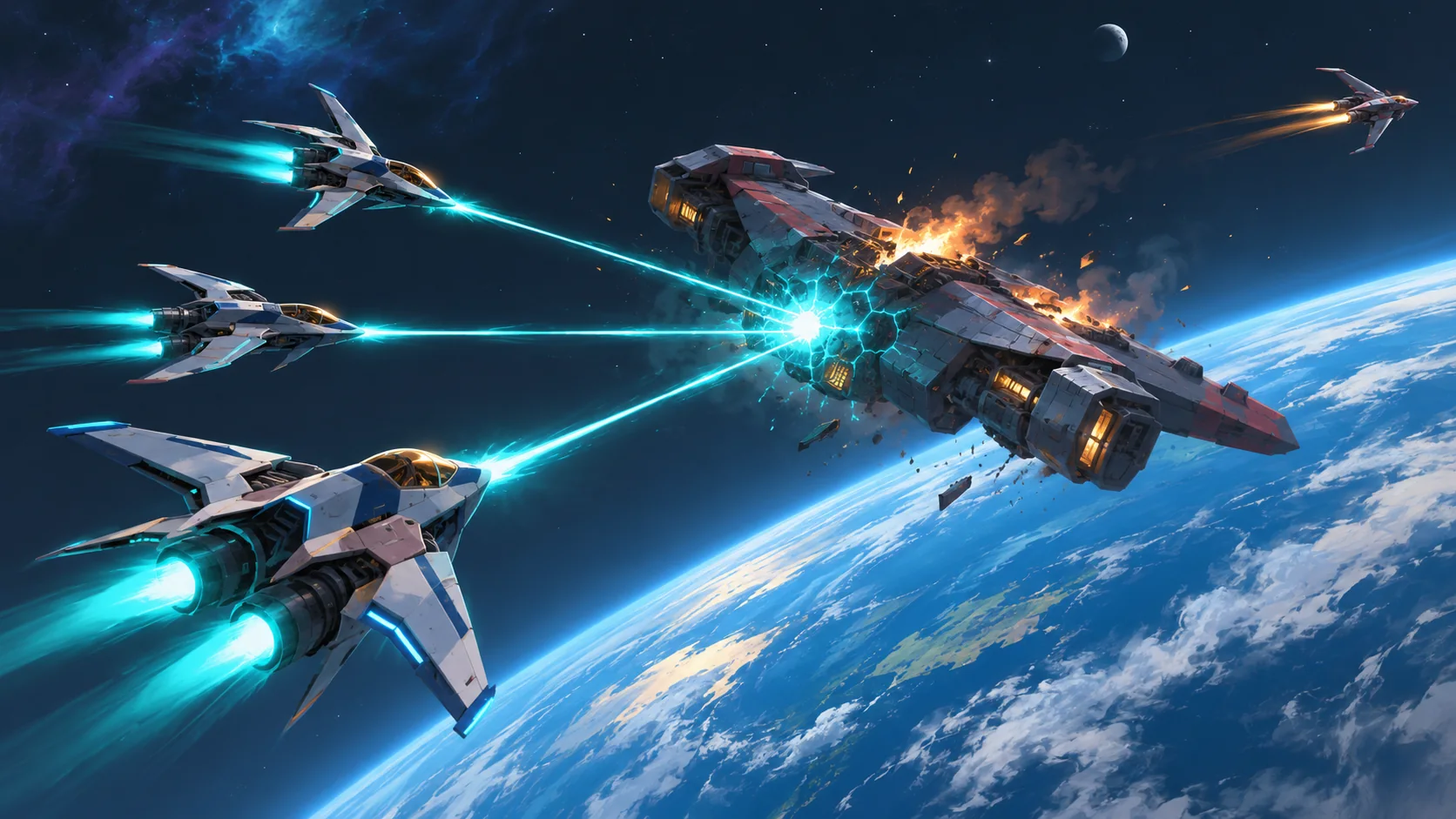
Revise energy costs after a softlock
Build movement, pointer aim and target locking first. Add the shared capacitor and one team action at a time, then replay the trace with the event log open. Check that regeneration pauses only while an ability is active or being triggered, and that rejected commands never subtract energy. Use the SEELE bullet-hell guide for readable attack warnings and the official Godot 2D movement documentation if you want an engine-specific movement reference.
Review a related SEELE shooter guide.
Explore the SEELE space shooter creator.
Frequently asked questions
Why is one energy pool shared by the whole squad?
It makes every command a team tradeoff. Guard Link can protect the formation, Focus Volley can concentrate wingmate damage, and Vector Burn can reposition the pilot, but each one reduces the same visible total. The player must choose when the squad spends instead of managing three disconnected bars.
Does primary fire consume energy?
No. The player’s primary weapon deals 60 damage every half-second without drawing from the team capacitor. The shared pool is reserved for Guard Link, Focus Volley and Vector Burn, so the cost of a squad command stays distinct from ordinary aiming and firing.
Read Godot’s official 2D movement reference.
What happens if I lack enough energy for a team ability?
The command is rejected, the energy total stays unchanged, and the interface names the shortfall or invalid condition. A target outside Focus Volley range or an ability costing more than the available pool cannot silently execute. This makes resource mistakes visible and easy to reproduce.
Has Starwing Relay been tested as a playable game?
No. The arena, ship statistics, ability costs and encounter trace are authored prototype specifications. This package does not claim an implemented game, browser test, user test or measured difficulty. Its local previews are static HTML, and the combat outcome is a written state trace rather than observed gameplay.