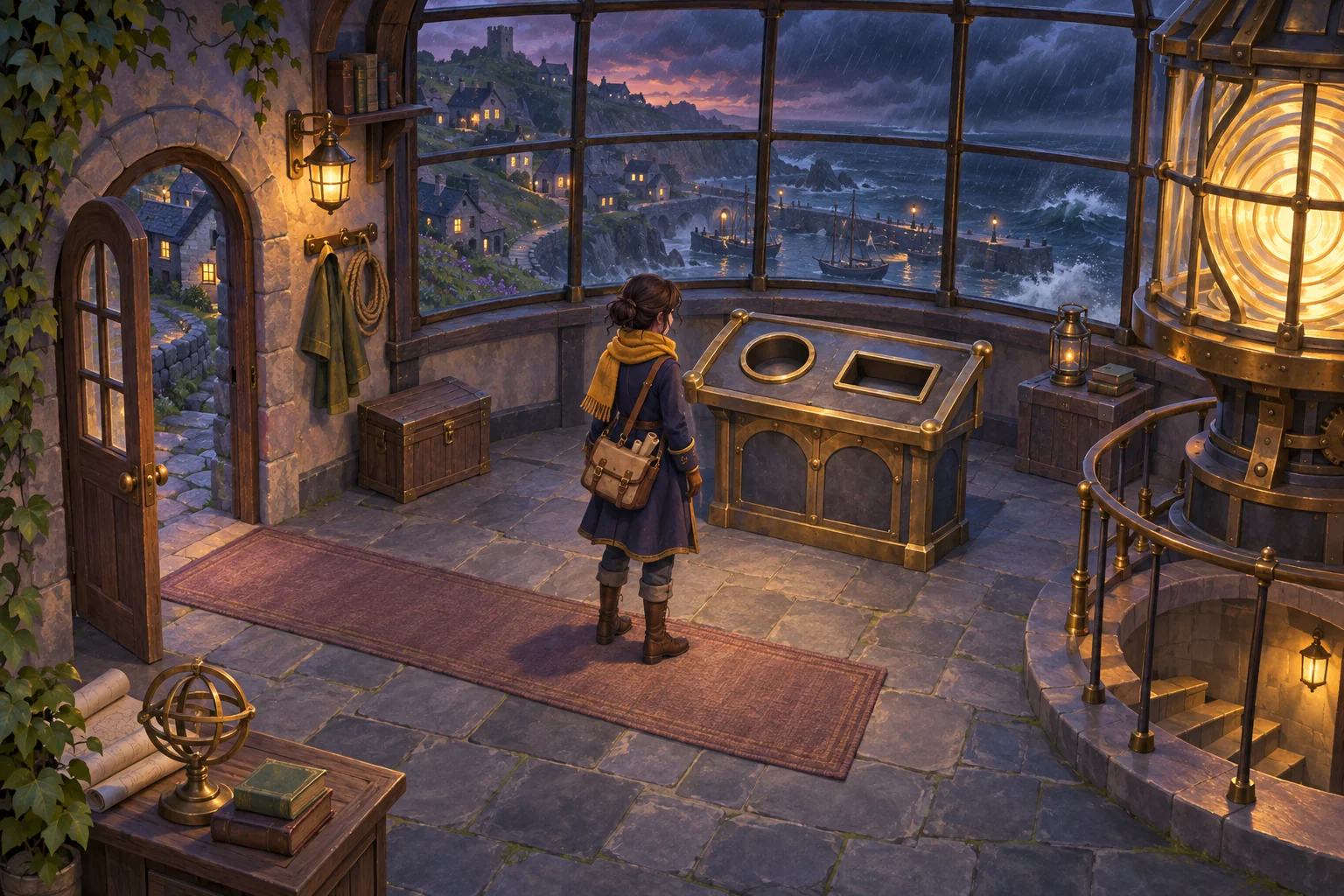
In Carryspace, every preparation room contributes to one final packing board. The player locks a module placement or orientation in an earlier level, and the campaign saves it. Those saved choices return as fixed pieces in the final room, so the last arrangement depends on what the player decided before reaching it.
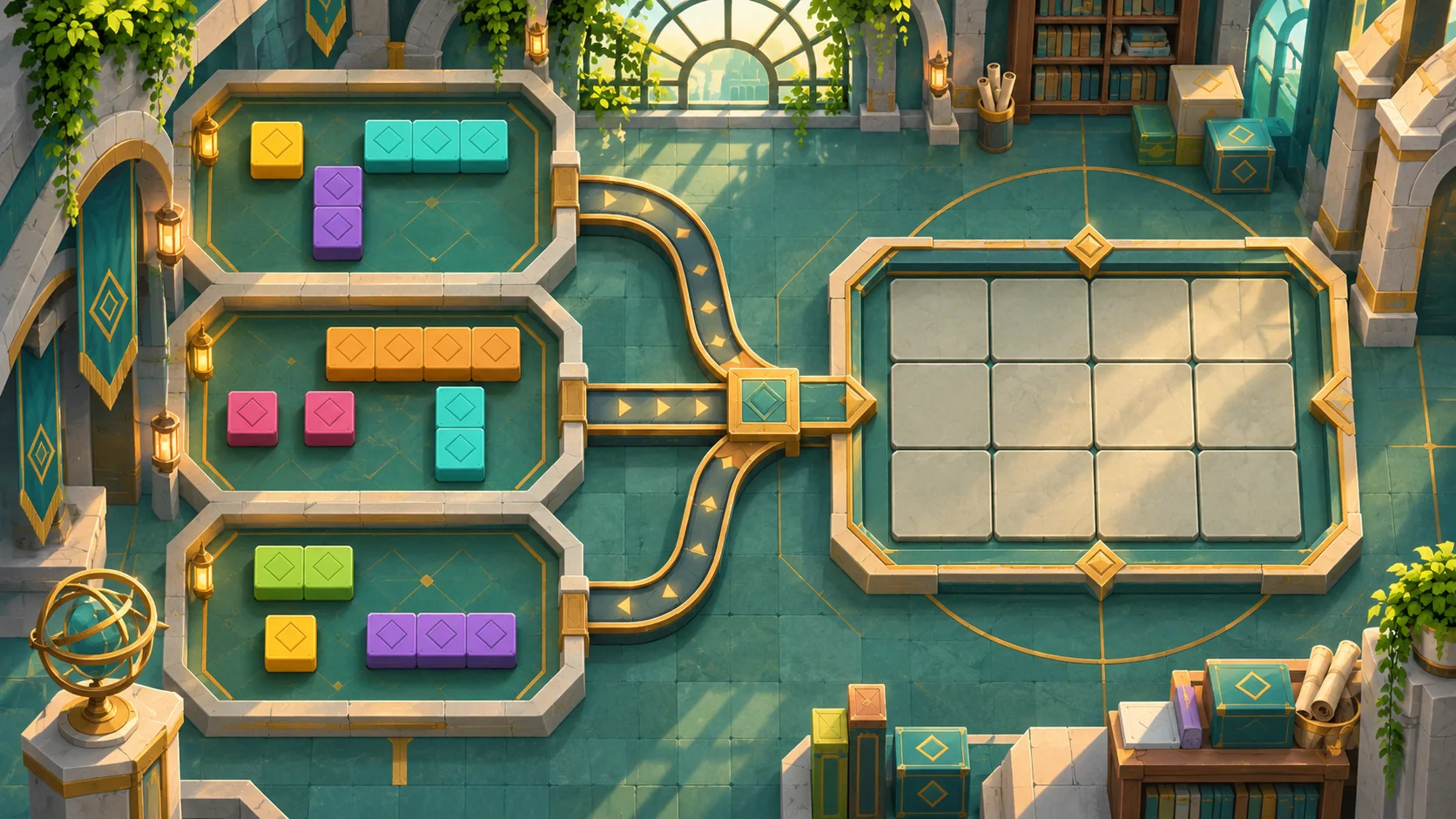
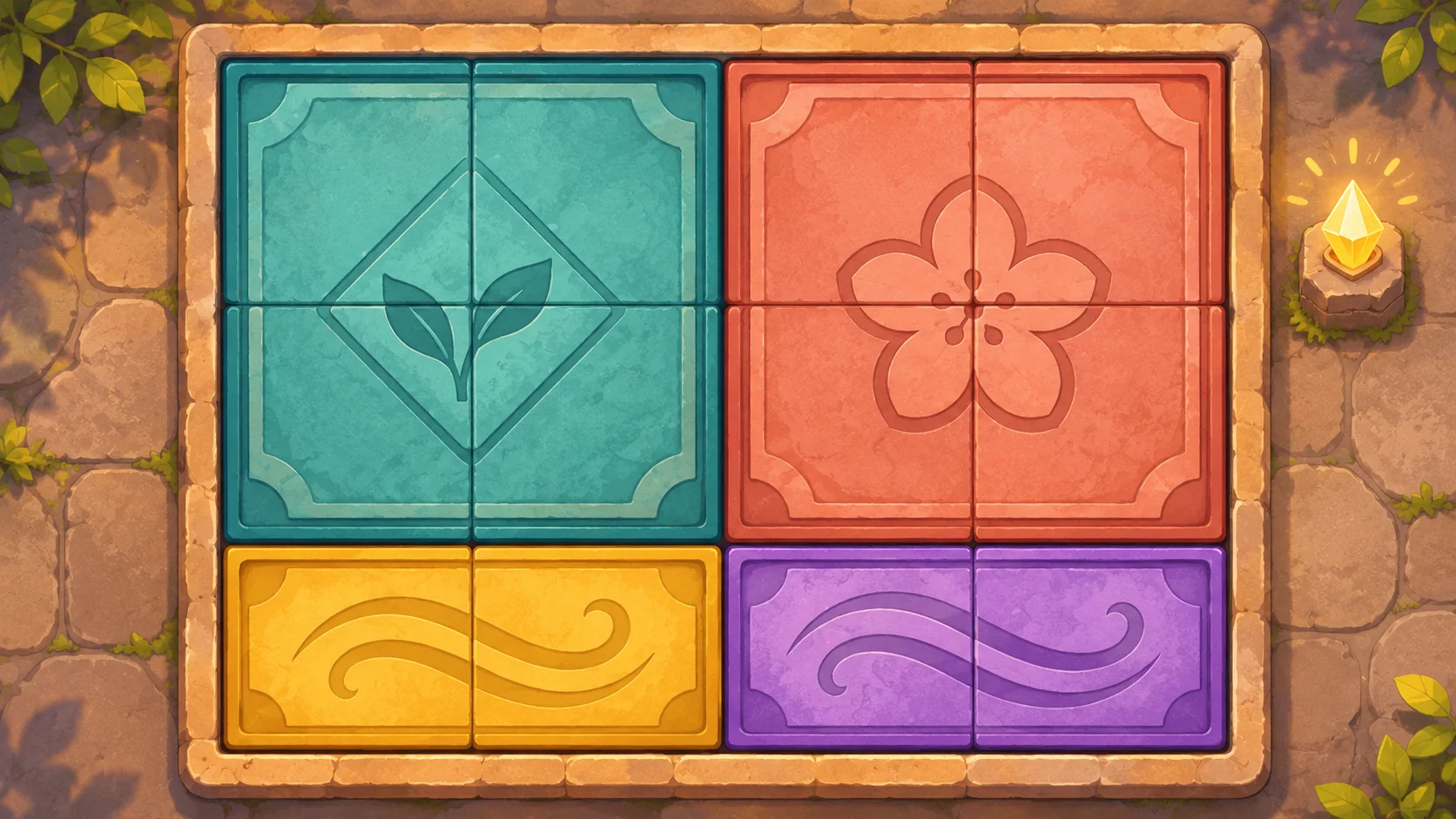
The example uses a 4-by-3 board and four pieces: two 2-by-2 squares and two 1-by-2 rails. Earlier rooms lock the squares across the top and set both rails horizontally. The final room imports that state and asks the player to fill the remaining bottom row without overlap or gaps.
Make earlier choices shape the final board
Create Carryspace as a grid-based packing puzzle with three preparation levels and one final room. The final target is 4 columns by 3 rows, coordinates x=0–3 and y=0–2. Piece A and Piece B are 2×2 square modules; Rail C and Rail D are 1×2 dominoes. In each preparation level, the player places the available module on a preview board and locks its position or orientation into a campaign blueprint. A locked choice persists unchanged in later levels and cannot be moved in the final room. The authored route locks A at origin (0,0), B at (2,0), then sets C and D to horizontal orientation. The final room imports these decisions. Place C at origin (0,2) and D at (2,2). A placement is valid only if every occupied cell stays within the 4×3 target and no cell overlaps a locked or placed module. Before accepting a new lock, run a completion check over remaining pieces; reject choices with no exact-fit completion and show the obstructing cells. Win when all 12 target cells are covered exactly once. Reset Campaign clears all earlier locks and restores the first preparation room. Show each piece footprint, origin, orientation, locked state, remaining cells and completion-check result.
| System | Prototype rule |
|---|---|
| Campaign | Three preparation rooms feed one final packing room. |
| Target board | 4 columns × 3 rows; x=0–3, y=0–2; 12 target cells. |
| Pieces A and B | Each is a 2×2 square module covering four cells. |
| Rails C and D | Each is a 1×2 domino with horizontal or vertical orientation. |
| Preparation choice | Place the available module on the preview and lock its coordinate or orientation into the campaign blueprint. |
| Persistence | A locked placement or orientation remains fixed in later rooms, including the final board. |
| Placement validity | Every occupied cell must stay within the target and avoid overlap with every locked or placed piece. |
| Completion check | Before accepting a lock, search remaining piece placements; reject a choice if no exact cover remains and identify the conflict. |
| Final authored state | A at (0,0), B at (2,0), C horizontal, D horizontal. |
| Final placements | Place C at (0,2) and D at (2,2); the two squares fill rows 0–1. |
| Win | Cover all 12 target cells exactly once with all four pieces. |
| Reset | Reset Campaign clears all saved locks and returns to the first preparation room. |
| Interface | Show footprint, origin, orientation, locked state, remaining cells and completion-check result. |
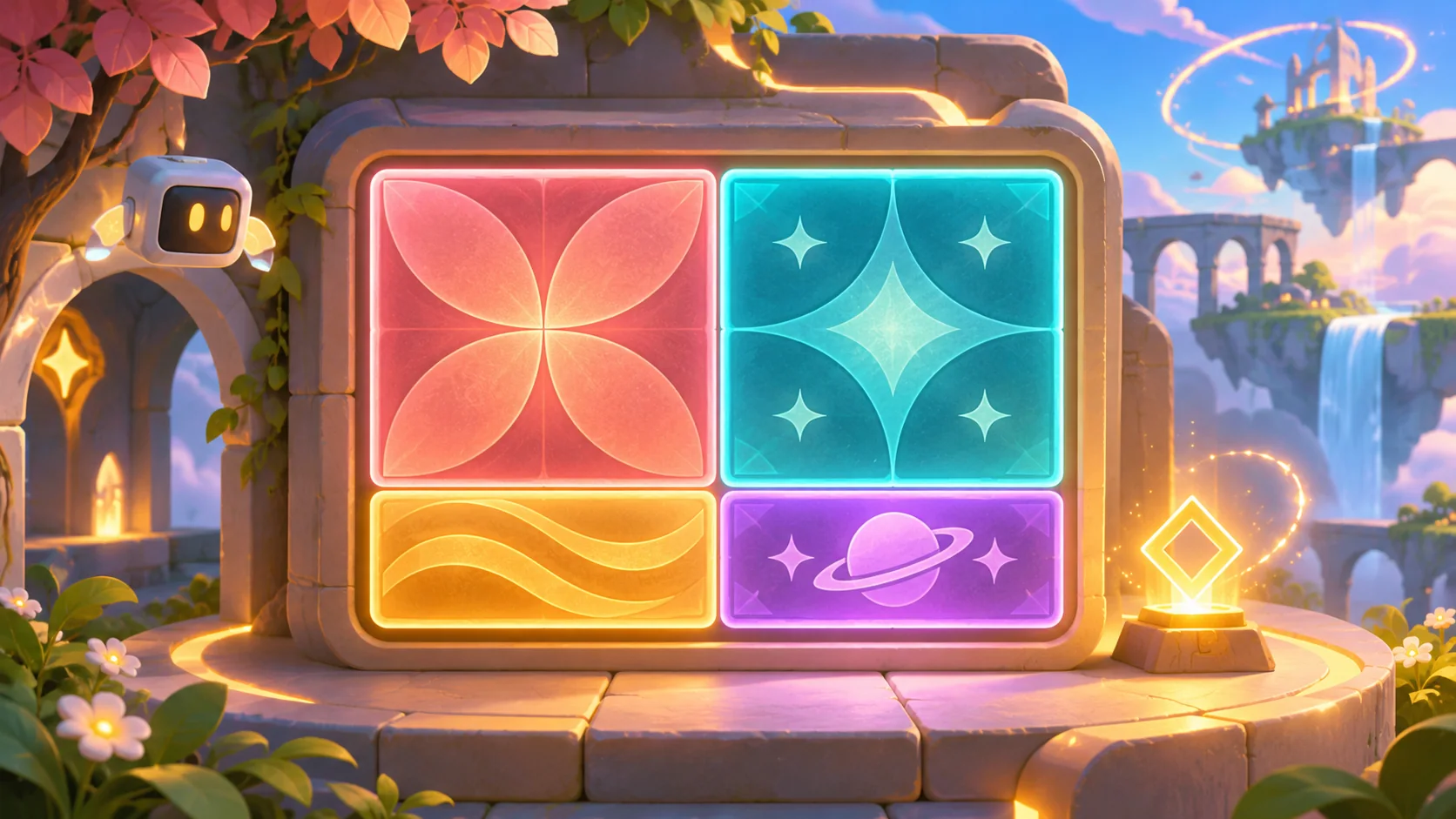
Define modules, locks and exact-fit rules
Start with an empty 4×3 target. In Preparation Room 1, lock square A at origin (0,0); it covers (0,0), (1,0), (0,1) and (1,1). In Room 2, lock square B at (2,0); it covers (2,0), (3,0), (2,1) and (3,1), leaving the bottom row open. In Room 3, set Rail C and Rail D to horizontal orientation. Entering the final room imports both square placements and both rail orientations. Place C at (0,2), covering (0,2) and (1,2), then D at (2,2), covering (2,2) and (3,2). The squares cover eight cells and the rails cover four; all 12 cells are occupied once, so the puzzle is solved. This is an authored state trace, not a playable or user test.
| Room and action | Expected state |
|---|---|
| Start | 4×3 board empty; four module footprints available across campaign. |
| Room 1 · Lock A | A is fixed at (0,0); four cells occupied. |
| Room 2 · Lock B | B is fixed at (2,0); top two rows are covered. |
| Room 3 · Set rails | C and D are locked horizontal; final bottom row remains open. |
| Enter final room | Import A, B and both rail orientations from campaign state. |
| Place C | C at (0,2) fills (0,2) and (1,2). |
| Place D | D at (2,2) fills (2,2) and (3,2). |
| Clear | 12 target cells covered exactly once; no overlap or gaps. |
Trace the carried-over packing solution
Tell the generator to store each locked module choice as campaign state instead of rebuilding the final room from defaults. Keep the preview board and completion check visible before a choice is committed. Add an event log that shows which earlier room supplied each fixed piece.
Create a grid-based spatial packing puzzle called Carryspace with three preparation rooms and one final room. The final target is 4 columns by 3 rows, x=0–3 and y=0–2. Pieces A and B are 2×2 squares; Rails C and D are 1×2 dominoes. In each preparation room, let the player place a module on a preview board and lock its coordinate or orientation into campaign state. Keep every locked choice fixed in later rooms and import it into the final room. The authored solution locks A at (0,0), B at (2,0), and both rails horizontal. In the final room place C at (0,2) and D at (2,2). Validate every occupied cell against the board boundary and overlap. Before accepting a lock, search all legal placements of remaining pieces; reject any choice with no exact-fit completion and list the conflicting cells. Win only when all 12 target cells are covered exactly once. Reset Campaign clears all saved choices. Display each piece footprint, origin, rotation, source room, lock state, remaining cells and completion-check result. Include a replay log for the authored room sequence.Prompt AI to build the packing puzzle
The first specification draft rebuilt the final room from default pieces, which erased the player’s earlier placements and made the campaign choices cosmetic. The revised state rule stores each committed coordinate and orientation in a campaign blueprint, then imports that blueprint into the final room. A completion search now warns before a lock would leave no valid packing. This is a design correction in the authored specification, not a measured playtest result.
Revise state saving before adding more rooms
Build the 4×3 target and piece footprints first, then add persistence between rooms. Replay the coordinate trace and compare occupied cells after every lock. Test boundary, overlap and no-completion rejections with authored states before expanding the campaign. See the related Sokoban rules guide and Godot’s TileMapLayer documentation for grid references, and use SEELE’s AI Puzzle Game Maker to prototype explicit rules and feedback.
Review the related SEELE Sokoban rules guide.
Read Godot’s official TileMapLayer reference.
Frequently asked questions
Why do earlier room placements stay locked?
The persistent placements make the campaign decision part of the final puzzle. If the final room recreated every module from defaults, earlier choices would be cosmetic. Carryspace saves both coordinates and orientation so the player must plan for the remaining empty cells before committing.
How does the completion check prevent an impossible final board?
Before a choice is locked, the puzzle tries legal placements for the remaining pieces within the target boundary. If no arrangement covers all remaining cells exactly, the choice is rejected and the conflicting or uncovered cells are shown. The check protects the campaign from an accidental dead end.
Open SEELE’s AI Puzzle Game Maker.
Can two pieces cover the same target cell?
No. Every occupied cell is validated against the board boundary and all saved or current placements. An overlapping placement is rejected before it is committed, and the interface identifies the conflicting coordinates so the player can choose another origin or orientation.
Has Carryspace been tested as a playable puzzle?
No. The board, piece shapes, earlier choices and final arrangement are authored prototype specifications. This package does not claim an implemented game, browser test, user test or measured difficulty. The written trace demonstrates the intended exact cover on paper, not observed player behavior.