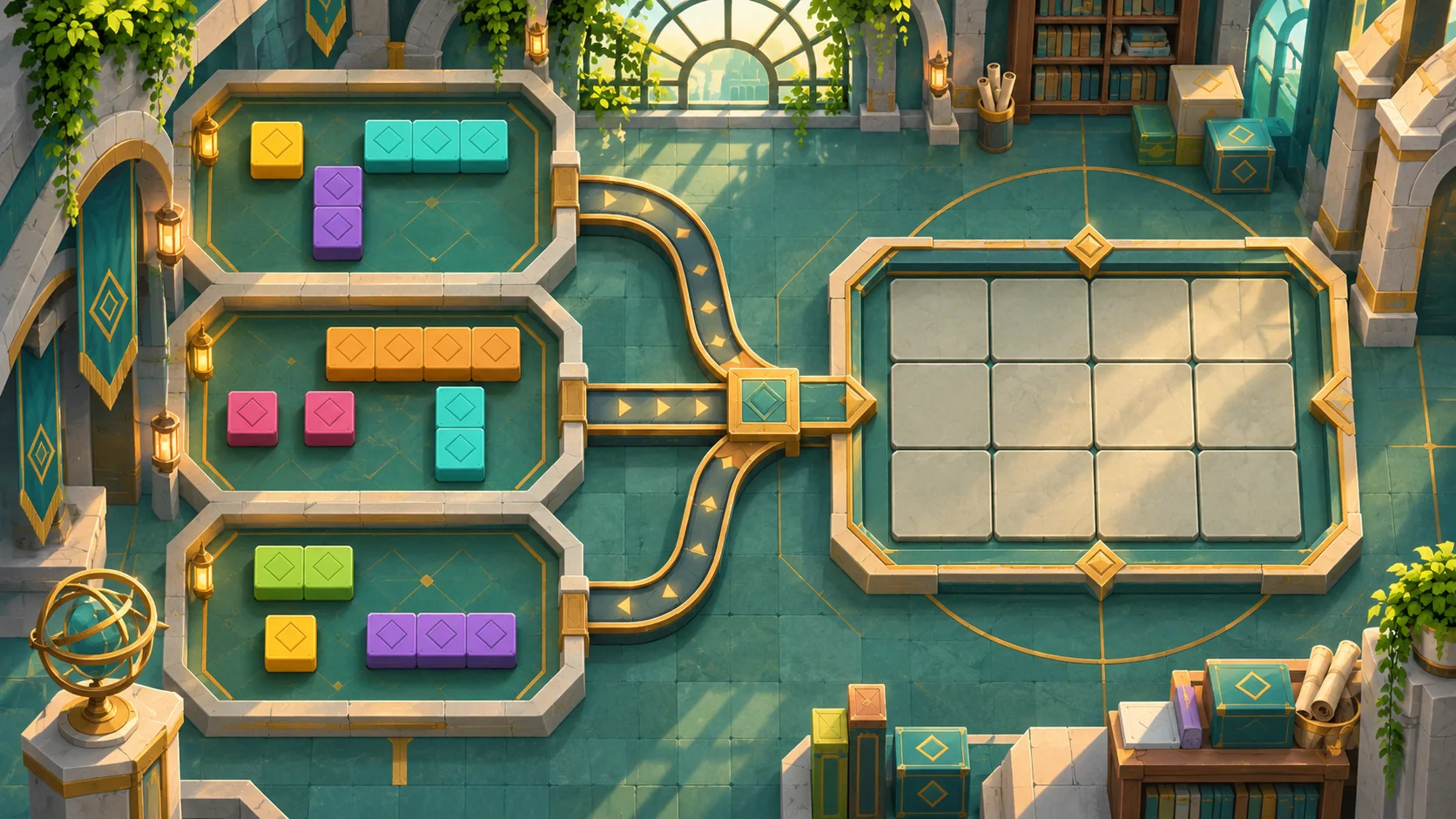
A word can do more than score points. In Cadenza Grove, each accepted word plays a note, and a short musical pattern changes which letters the player can reach. The puzzle starts in Rain with three visible rows of letter tiles. A flooded fourth row stays hidden until the words produce a C–E–G motif. The music is part of the board rule: the pattern reveals new letters rather than playing as background decoration.
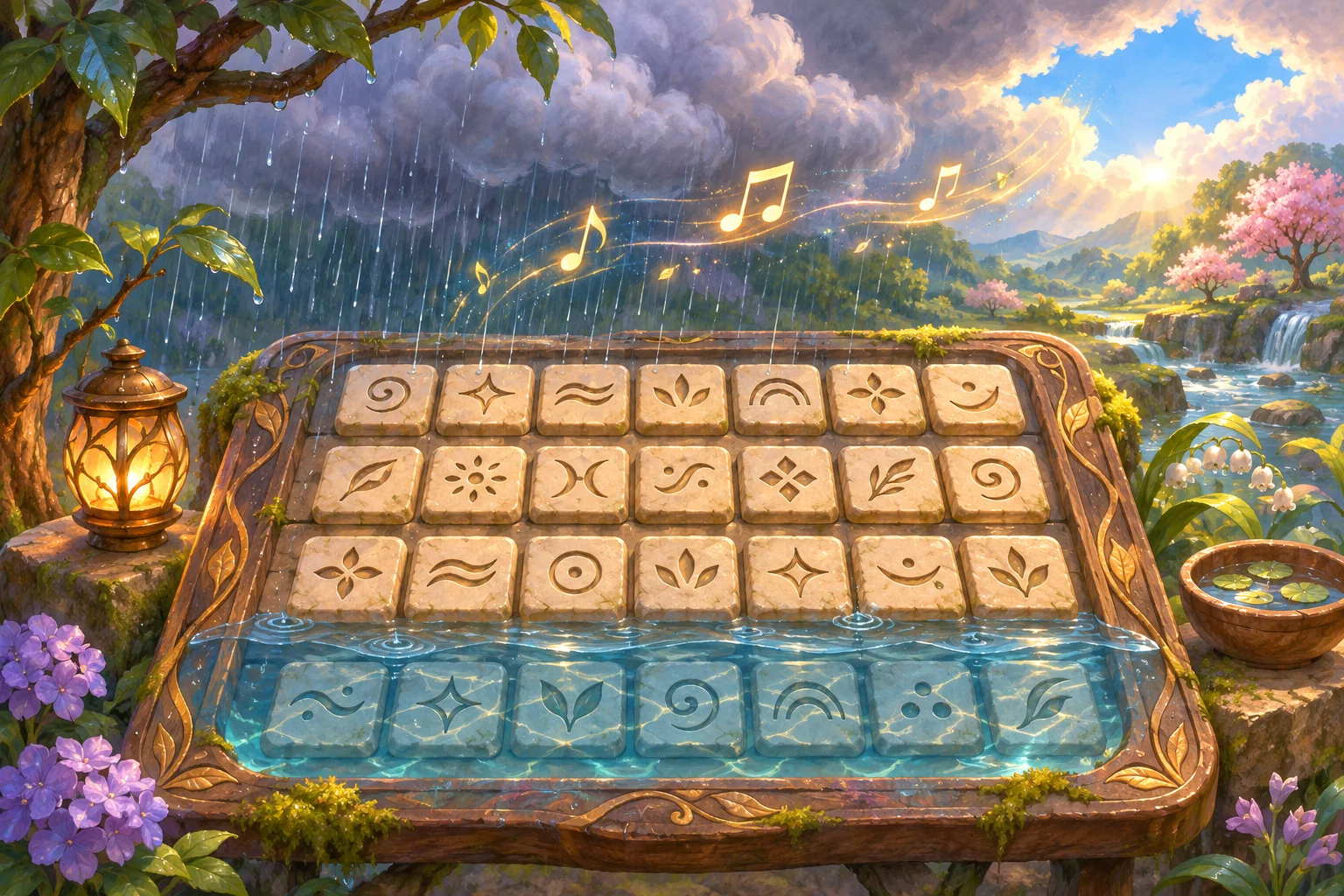
This fictional prototype uses four curated words: CART, SHIP, FROG, and MUDS. Build each word through orthogonally adjacent cells. The last vowel maps to one note: A to C, E to D, I to E, O to G, and U to A. Accepted letters lock until the environment changes. CART, SHIP, and FROG emit C, E, and G in order; the board moves from Rain to Clear, reveals MUDS, refreshes the cells, and lets the player finish with the newly available word.
Connect accepted words to a changing environment
Use a 4-by-4 grid. The visible rows begin C A R T / S H I P / F R O G; the fourth row M U D S is hidden in Rain. A word must use orthogonally adjacent cells, with no tile repeated inside that word, and match the curated list CART, SHIP, FROG, MUDS. On acceptance, lock every used tile until the environment changes. The word's last vowel emits one note: A→C, E→D, I→E, O→G, U→A. Keep the latest three accepted notes in order. When they read C–E–G, change Rain to Clear, reveal row four, and refresh the board's tiles. Invalid spellings, paths, or words leave tiles, notes, and environment unchanged. After the reveal, spell MUDS to finish. Reset restores Rain, the three visible rows, unlocked starting cells, an empty note sequence, and no win state.
| Rule | Expected result |
|---|---|
| Board | A 4×4 grid; rows one to three show CART / SHIP / FROG, and MUDS is hidden in row four during Rain. |
| Word path | Use orthogonally adjacent active cells; do not repeat a cell within a word. |
| Word list | Only CART, SHIP, FROG, and MUDS are valid in this first slice. |
| Note | Map the last vowel: A→C, E→D, I→E, O→G, U→A. |
| Tile lock | Accepted cells stay unavailable until the environment changes. |
| Motif | The latest three notes C–E–G switch Rain to Clear, reveal row four, and refresh tiles. |
| Finish and reset | Spell MUDS after the reveal. Reset restores Rain, initial rows, empty notes, and unlocked cells. |
Define letter paths and the note mapping
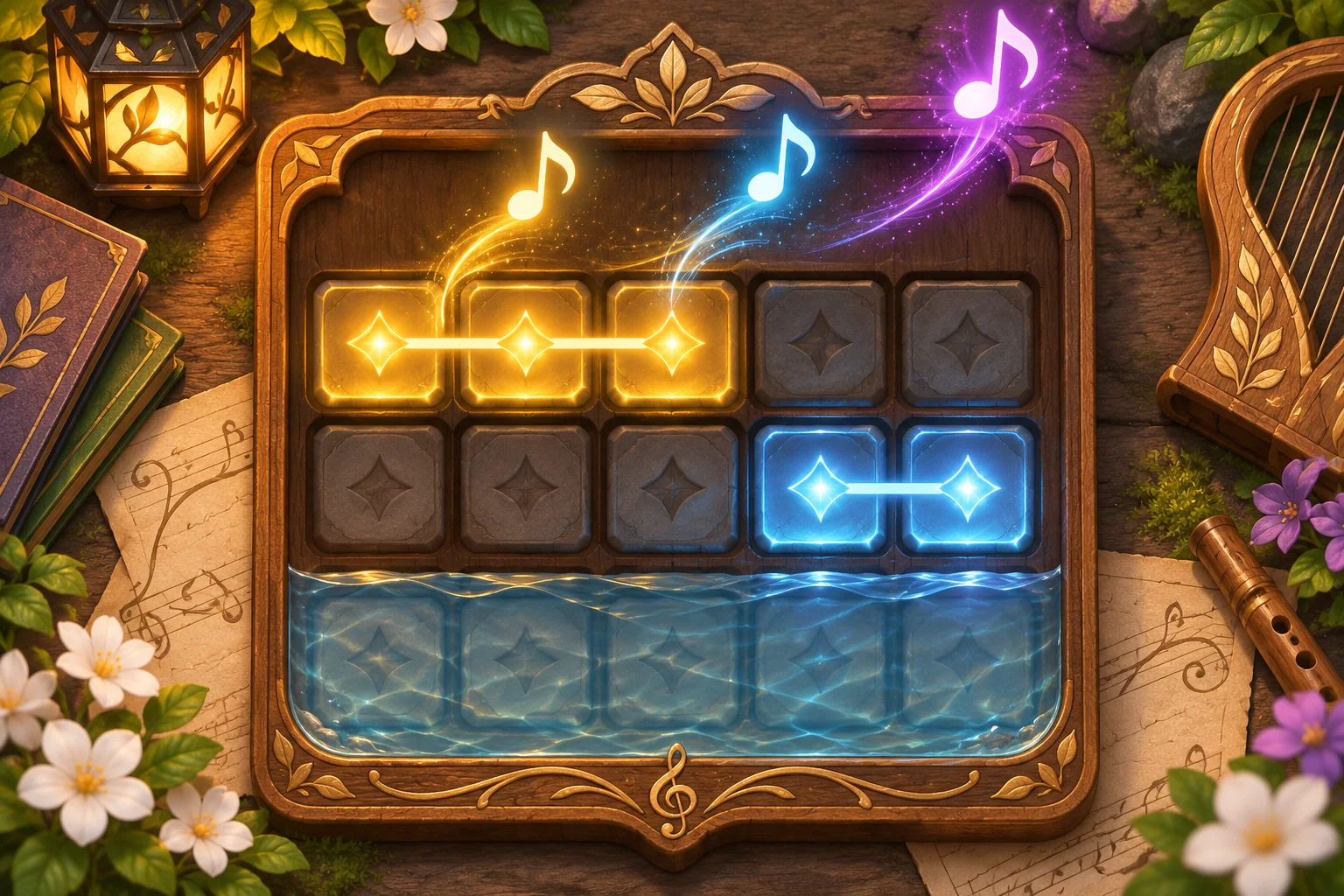
Start in Rain with three rows visible and no notes. CART uses row one and emits C because its last vowel is A; those four cells lock. SHIP uses row two and emits E from I; row two locks. FROG uses row three and emits G from O. The latest notes are now C–E–G, so the environment changes once: Rain clears, row four appears, and all tiles refresh. MUDS is now available across the new row; its last vowel U emits A, and the puzzle finishes. A word outside the list, a diagonal-only path, or a submission that tries to reuse a locked cell is rejected without changing the note sequence or board. This is a hand-authored state trace, not a playable test.
| Check | Expected result |
|---|---|
| Submit CART across row one | Accept; emit C; lock row one. |
| Submit SHIP across row two | Accept; emit E; rows one and two stay locked. |
| Submit FROG across row three | Accept; emit G; C–E–G clears Rain and reveals row four. |
| After the reveal, submit MUDS | Accept from the newly visible row; emit A; complete the puzzle. |
| Submit CART again before the environment changes | Reject because its cells remain locked; preserve notes and board. |
| Submit an unlisted word or diagonal-only path | Reject with no tile, note, or environment change. |
| Reset after completion | Hide row four, clear notes, unlock initial cells, restore Rain and clear the win state. |
Trace the C–E–G motif to the revealed row
Ask SEELE for one compact word puzzle where accepted spelling, note generation, tile use, and environment changes share a visible state. Keep the word list fixed for the first version so a failed entry can be diagnosed as a spelling, path, or tile-lock issue.
Create a local word-building puzzle called Cadenza Grove. Use a 4-by-4 letter grid. In the Rain environment, show rows C A R T / S H I P / F R O G and hide row M U D S below them. Allow words only from this list: CART, SHIP, FROG, MUDS. A word path must use orthogonally adjacent active cells and may not reuse a cell within that word. On an accepted word, lock its used cells until the environment changes. Emit a note from its last vowel with this mapping: A=C, E=D, I=E, O=G, U=A. Keep the latest three notes in order. When they are exactly C-E-G, switch once from Rain to Clear, reveal the fourth row, and refresh all tiles. Invalid spelling, a path with non-adjacent cells, an inactive row, a locked cell, or a word outside the list must leave the board, note sequence, and environment unchanged. After the transition, the goal is to spell MUDS from the revealed row to finish. Show the active environment, available letter cells, locked cells, accepted words, note sequence, and final word state. Reset must restore Rain, the initial three visible rows, hidden MUDS, unlocked cells, an empty note sequence, and no completion. Support keyboard selection and submission without timed key presses. Do not add scoring, random refills, extra words, or another environment to the first slice.Ask AI to keep music and board state aligned
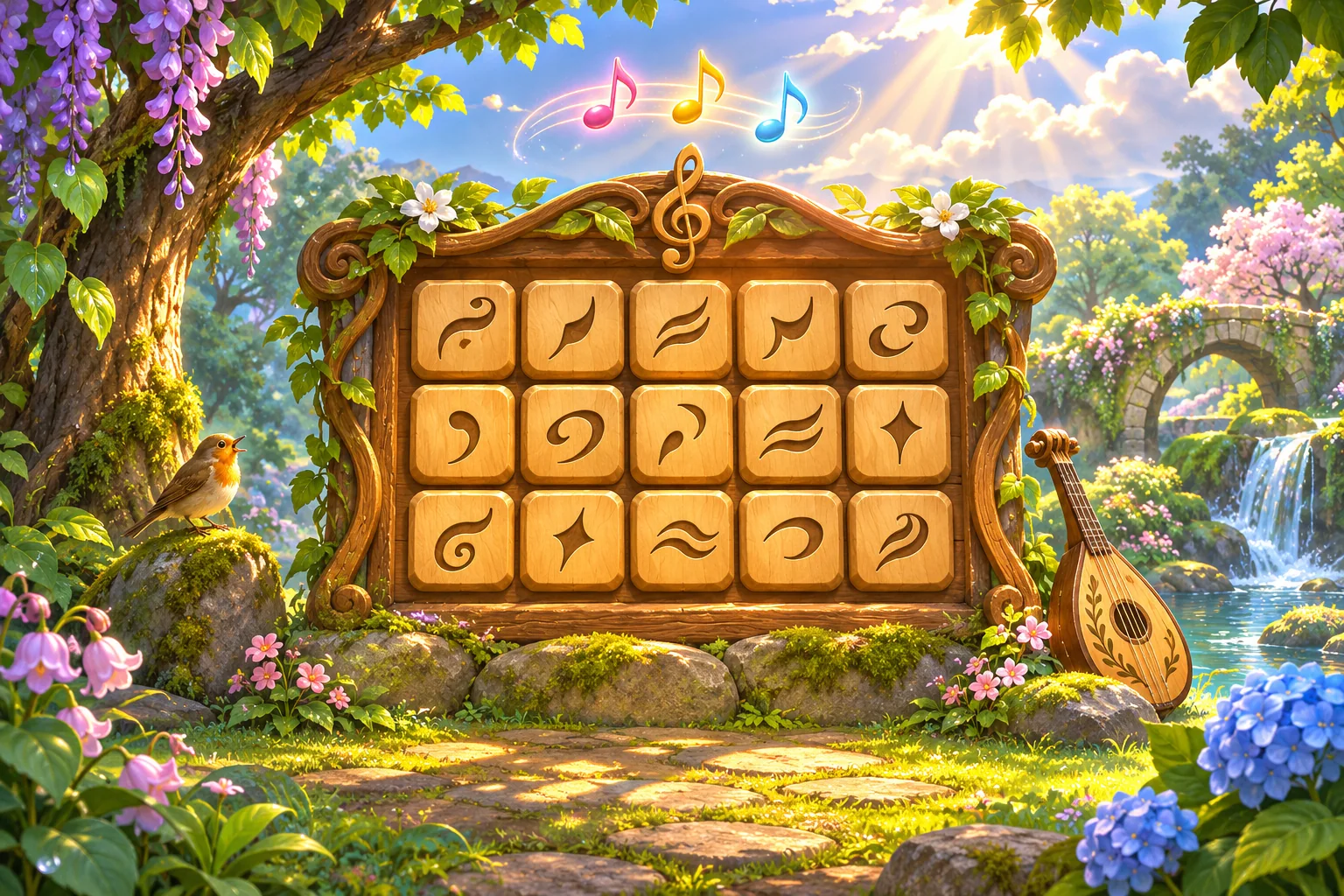
The first draft refreshed the used letters after each accepted word, which let a player replay CART and add the same note repeatedly. Keep accepted cells locked until the environment changes. Hand-check CART, SHIP, FROG in order: C, E, G triggers exactly one transition and refreshes the board only then. This is a proposed rule correction from a written trace, not a test of a generated game.
Replay the full four-word sequence and reject an unlisted word, a diagonal-only path, and a locked-cell reuse. Confirm that rejected input leaves the note queue, visible rows, and environment unchanged. The W3C keyboard guidance can inform tile selection and submission; this article does not claim conformance.
Revise tile reuse after an offline trace
Keep the first puzzle to four words, one note mapping, one three-note motif, and one environment change. Players should be able to predict which note a word emits and which row becomes usable. Once the C–E–G route works on paper, add another motif or word family and update the reset and tile-refresh rules before expanding the board.
Read the word-building rules guide.
Start a puzzle prototype with SEELE.
Frequently asked questions
How does music change the environment in this word game?
Each accepted word emits a note based on its last vowel. The latest three notes form a short motif; C–E–G clears Rain and reveals the flooded row. The pattern changes which letters are available, so the music affects the puzzle state instead of acting only as background audio. This keeps the music mechanically meaningful.
Why use a fixed word list first?
A small list makes every expected note and path reproducible. CART, SHIP, and FROG produce the motif; MUDS tests the newly revealed row. A larger dictionary can come later, after spelling, adjacency, tile locks, and note timing are clear. That keeps early testing easy to repeat.
Read W3C's keyboard accessibility guidance.
What happens when a player submits an invalid word?
Reject it without changing the board, note sequence, or environment. Explain whether the word is outside the list, uses an inactive or locked cell, or follows a non-adjacent path. Keeping state unchanged makes the next attempt easy to inspect. Clear feedback helps diagnose the rule.
Should accepted tiles return after each word?
Not in this first version. Lock them until the C–E–G transition so the same word cannot be replayed to manipulate the note sequence. Refresh all cells once when Rain clears, then reveal the final row and allow MUDS. Keep the rhythm tied to clear state changes.