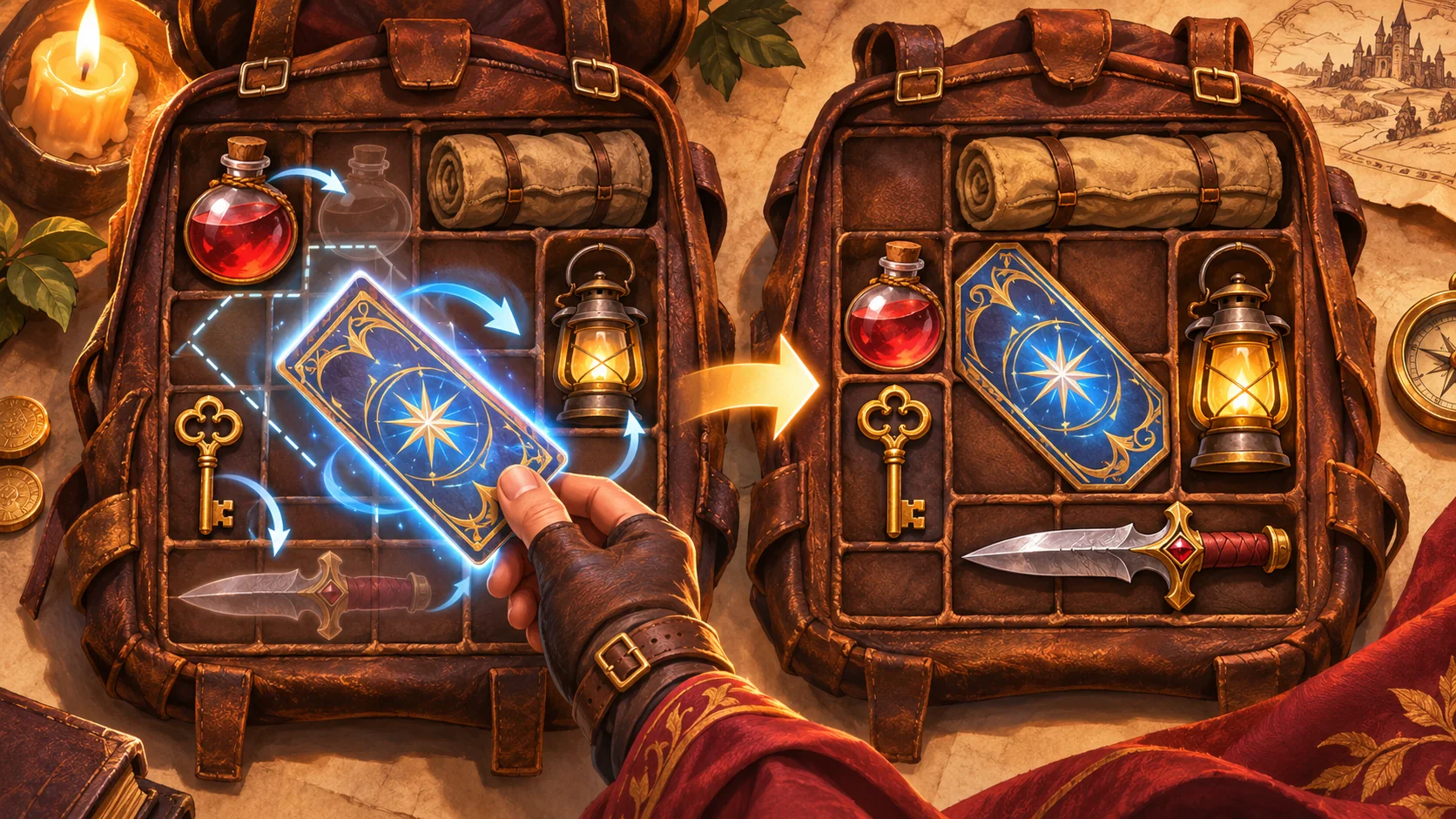
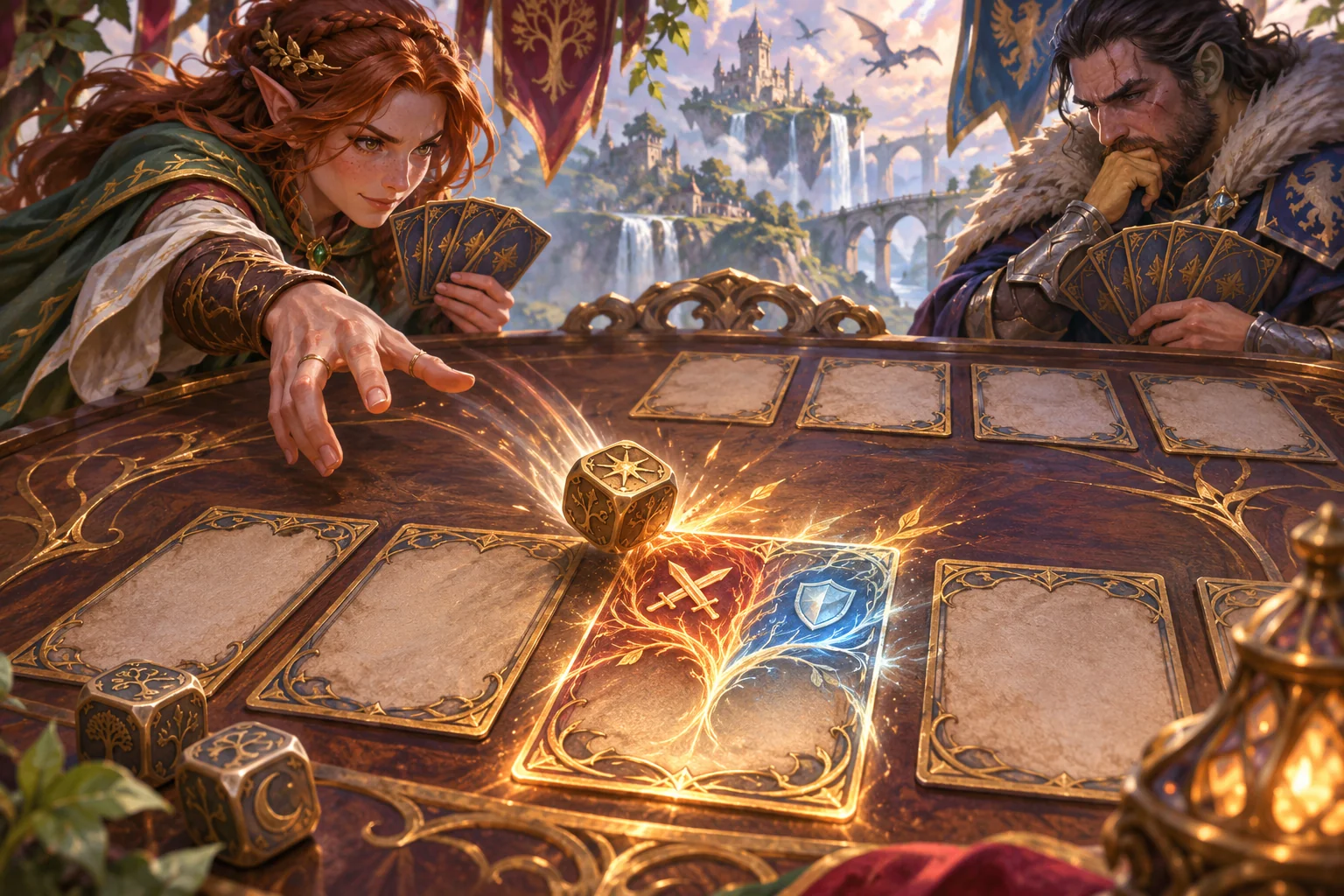
In the fictional Wavelength table, players follow the led suit and compete to win each trick. A played card's rank is its base strength; rolling the led suit on a six-face die adds 2. The higher strength wins one point. After winning, that player permanently changes one Blank face on their die to the led suit. In the Wave fixture, a rank-4 card plus a matching roll scores 6 and beats a rival's rank-5 card with a nonmatching roll at 5. The winner reshapes Blank to Wave, increasing Wave faces from two of six to three. The next matching Wave roll can then score 5 against a rival's 3. Wavelength and all values are fictional; the local test checks only these trick and die rules.
Resolve tricks with a clear die bonus
Use four suits: Wave, Sun, Leaf, and Wind. A player must follow the led suit when able. The card rank gives its base strength; after playing, roll a six-face die. A face matching the led suit adds 2 strength, while any other face adds zero. The highest total wins the trick and scores one point. Keep card rank and die result visible so luck contributes without hiding the comparison.
For the first Wave trick, the player plays rank 4 and rolls Wave, reaching 6. The rival follows Wave with rank 5 but rolls Sun, reaching 5. The player takes the point. Make suit-following and tie resolution explicit in the prototype; this fixture has no tie. The rule table should apply the same bonus and die structure to either player.

Let a trick win reshape one die face
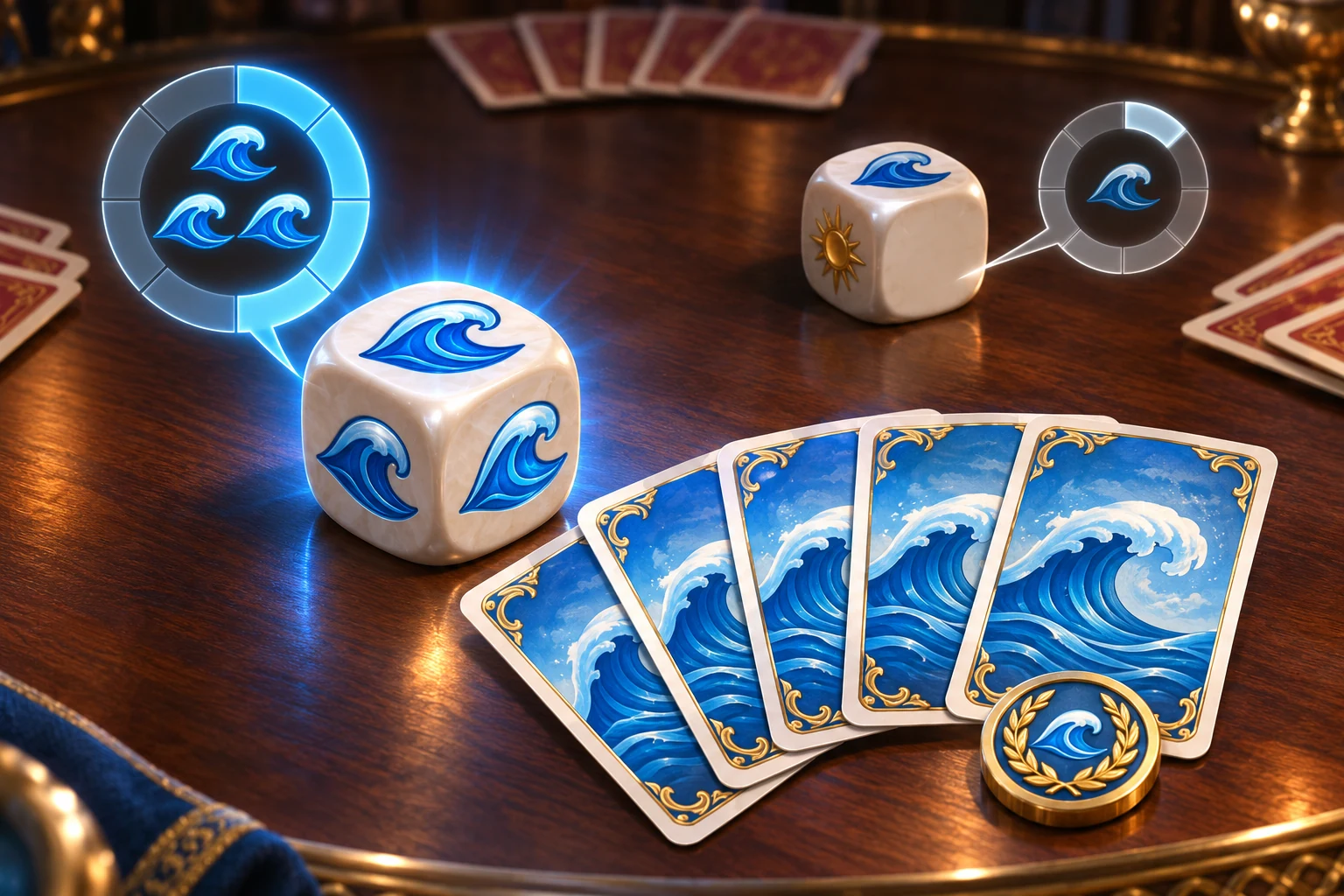
After scoring a trick, let its winner choose one Blank face on their own die and permanently replace it with the led suit. The starting die has two Wave faces plus Sun, Leaf, Wind, and Blank. Winning the first Wave trick changes that distribution to three Wave faces and no Blank. The die remains a six-face die, but its future odds now reflect a prior card-play decision.
Show the die before and after reshaping and save the changed face between tricks and rounds. In the next Wave fixture, the player rolls the newly assigned Wave face with a rank-3 card for strength 5; the rival's rank-3 card and Wind roll score 3. The reshaped die helps the player win another point. Avoid resetting faces at the end of a round unless a separate rule says so.
Compare a reshaped die with an unchanged control
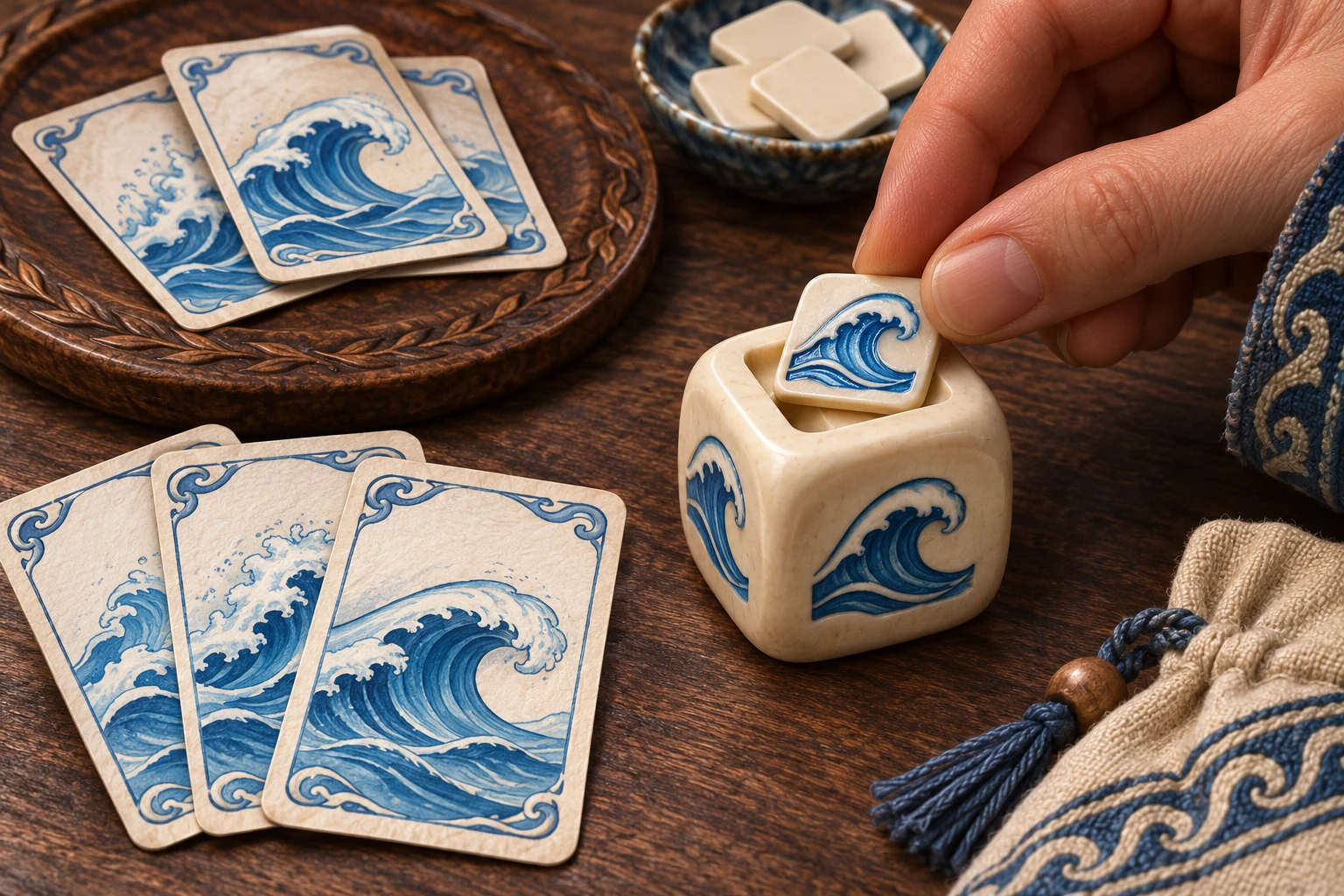
Run two tricks with permanent reshaping enabled. The player wins the first 6 to 5, scores one point, and changes Blank to Wave. Wave now appears on three of six faces. In the next fixed roll, that Wave face adds 2 to rank 3, for 5 against the rival's 3. Record led suit, card ranks, die faces, trick totals, points, and the die's face distribution after each trick.
For a control, keep the die unchanged after the first trick. It still has only two Wave faces out of six, and the Blank face remains. Compare the saved die state and later roll outcomes under the same scoring rule. Wavelength and the results are fictional; this local test verifies only suit following, scoring, trick points, and the permanent face change.
Ask an AI game maker to prototype permanent die shaping
Create a trick-taking game called Wavelength with four suits: Wave, Sun, Leaf, and Wind. Players must follow suit. Card rank is base strength; a six-face die roll matching the led suit adds 2. Highest total wins one point. After a trick, its winner permanently replaces one Blank die face with the led suit. Start with two Wave faces and one each of Sun, Leaf, Wind, and Blank. Test a Wave trick: player rank 4 plus Wave roll scores 6; rival rank 5 plus Sun scores 5. The player wins and changes Blank to Wave, making three Wave faces. Test a later rank-3 Wave hand with Wave roll against a rival rank-3 hand with Wind: 5 to 3. Add an unchanged-die control and show face counts.
Check follow-suit, add the two-point bonus only when the die matches the led suit, and award one point to the higher trick total. After the first 6-5 win, permanently replace Blank with Wave; the die must have three Wave faces out of six. The next fixed roll scores 5 against 3. In the unchanged control, retain two Wave faces and Blank.
FAQ
How can dice add strategy to a trick-taking game?
Let card rank set a reliable base and use the die for a small, visible suit bonus. Then give players a choice that changes future rolls, such as permanently reshaping a face after winning a trick. This links current card play to later probability without replacing suit-following.
How do I make dice faces change permanently between rounds?
Store each die as an explicit list of faces and update one entry when the rule triggers. Keep the new face through later tricks and rounds, show the before-and-after distribution, and define what happens when no Blank face remains. The example changes Blank to the winning trick's led suit.
What should I test in a dice-based trick-taking prototype?
Check that players follow suit, only a matching die face grants its bonus, and the higher total wins the point. Then verify the winning player changes exactly one face and that the new distribution persists. Compare the same fixture with an unchanged-die control.