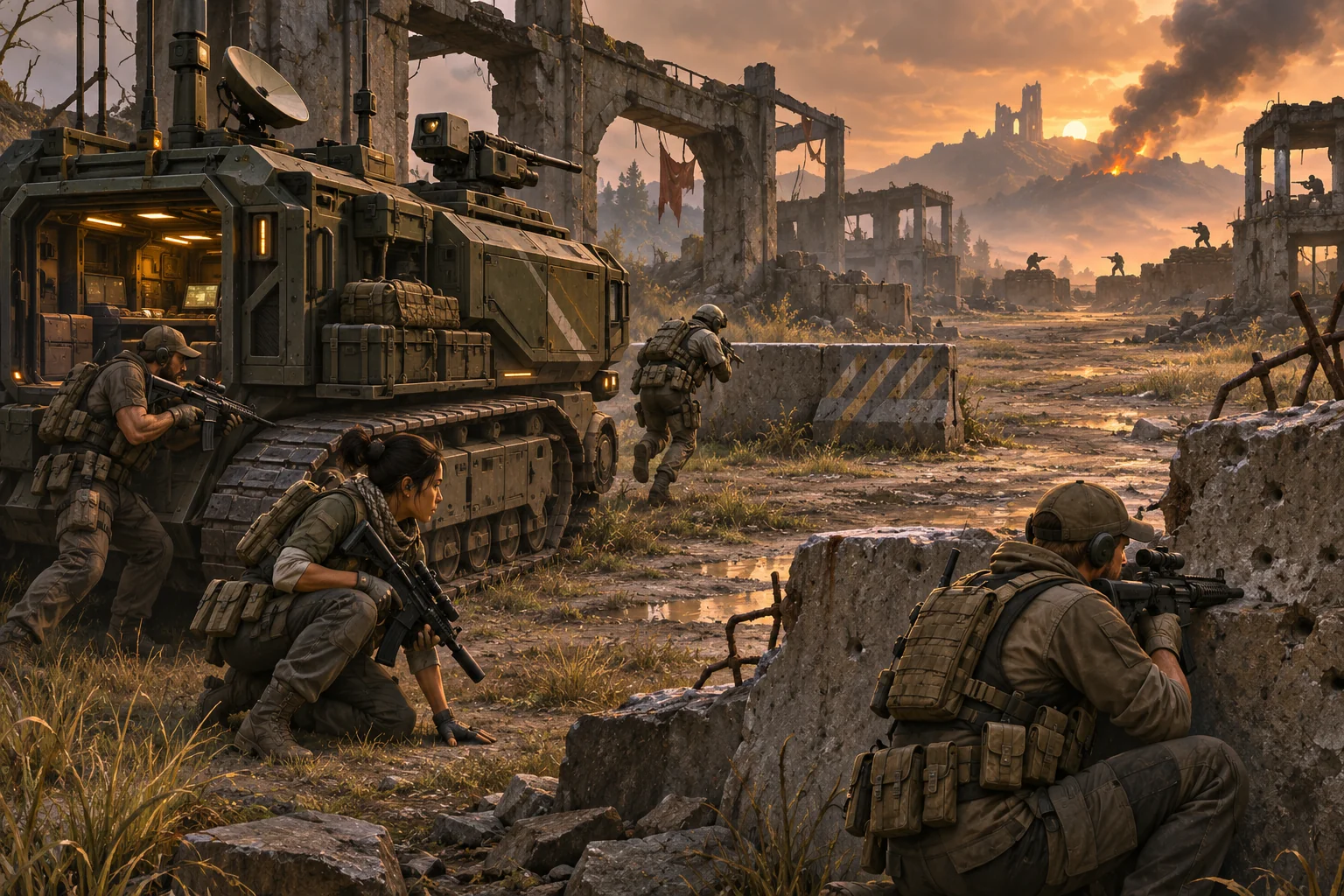
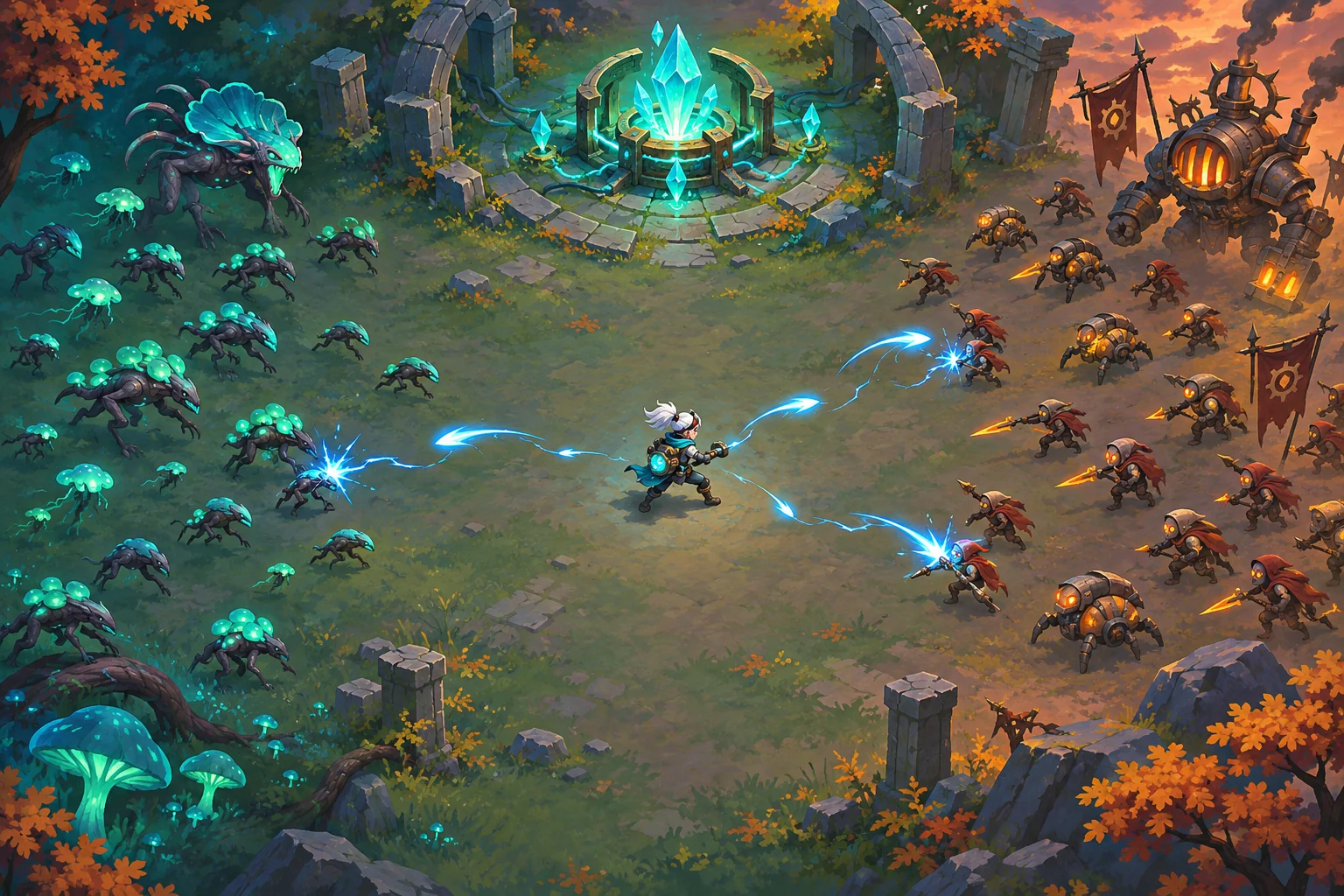
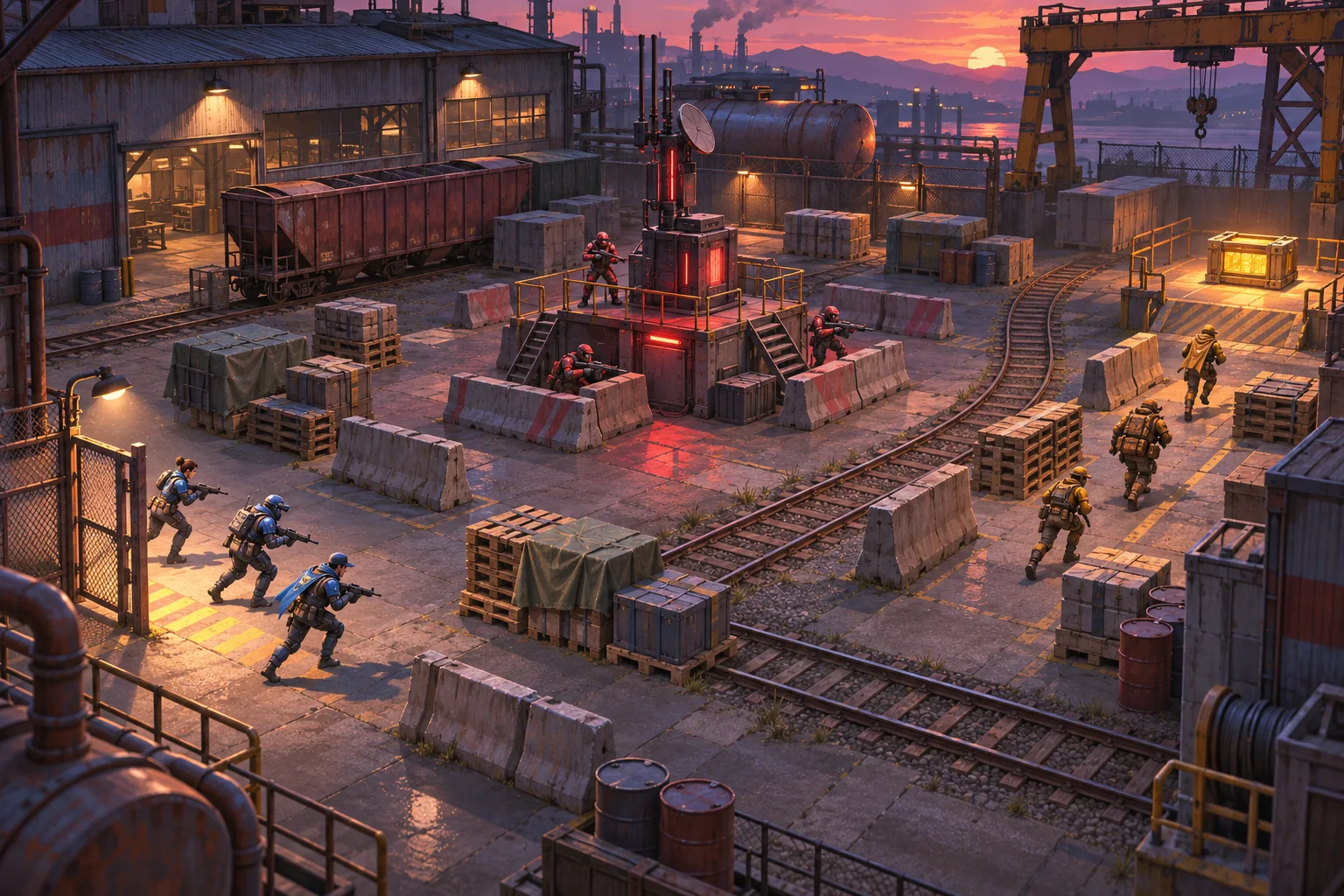
A turn-based shooter feels different when enemies have plans that collide with one another. In Cinderline, a salvage crew wants a battery crate at the east gate while a security squad must hold a central relay. The player arrives from the west, where a loading yard offers a few safe routes and plenty of sightline choices. Neither enemy group waits for the player to become its only target.
The first playable slice needs clear turns, not a complicated simulation. Salvage moves first, security reacts second, and then the player squad acts. Before the round begins, every unit shows its intended move or shot. During each faction phase, units move toward their objective, choose a target according to a short score, and fire only if line of sight and ammunition allow it. The player can exploit that competition, but can also lose the relay or crate if the factions win their own contest.
Give each faction an objective it can pursue
Use a 9×7 grid with west entry, central relay, and east battery crate. The player controls two units; Salvage has a scout and rifle unit; Security has two guards. Salvage seeks the crate, then a clear shot at Security. Security holds the relay and prioritizes Salvage units contesting it. Show each unit’s planned move, target, and reason before the round is committed. A faction unit may move up to three orthogonal cells, cannot pass through occupied cells, and may end on an objective only if the tile is empty. After movement, a unit with line of sight and at least one round may fire once at a visible enemy within four cells. A hit removes one health; units start with two. A suppress order deals no damage but makes the target’s next move one cell shorter. Relay control belongs to the last living unit to end a faction phase on its marked tile. Ties in target score resolve by lower health, then shorter distance, then stable unit ID. A blocked route uses the reachable cover tile closest to the objective, with row then column as a final tie-break. End the slice when the player reaches the east crate or both enemy factions are eliminated; reset restores positions, health, ammunition, relay ownership, and intent previews.
| System | Expected behavior |
|---|---|
| Objectives | Salvage advances to the east battery crate; Security holds the center relay and tries to stop Salvage. |
| Turn order | Salvage moves, Security moves and reacts, then the player acts; shots resolve after each faction's movement. |
| Intent preview | Show target tile, intended target, and a short reason before the player commits. |
| Movement | Move up to three orthogonal cells; occupied cells block movement and cover tiles break line of sight. |
| Target score | Objective contest +4, exposed enemy +2, player +1, blocked objective route +1; require visibility and range. |
| Combat | One shot per unit phase, range four, one damage, two health; suppressing deals no damage and shortens next move by one. |
| Control and reset | The last living unit ending on the relay controls it. Reset restores health, ammo, positions, ownership, and previews. |
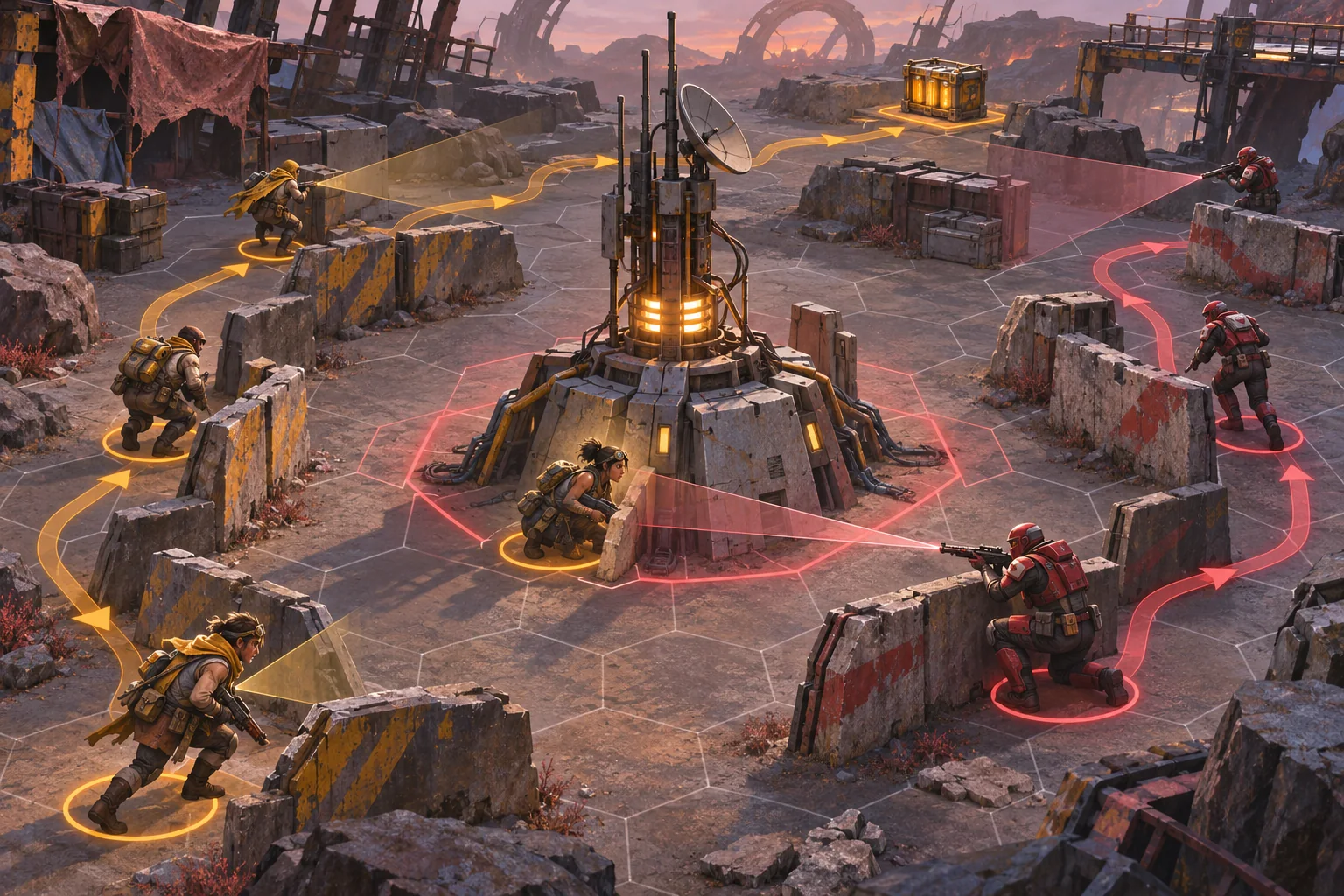
Show intent before movement and fire
Begin with Salvage at the north approach, Security around the relay, and the player at the west gate. Salvage’s scout moves three cells toward the relay because an empty side tile brings it closer to the crate route; the rifle unit takes cover facing the battery. Security previews a shot at the scout: it is visible, within range, and contesting the relay, so its score beats a player unit behind cover. Security moves one guard onto the relay tile and fires at the scout. The scout loses one of two health, but remains alive and the relay now belongs to Security. The player can move behind a western loading pallet and suppress that guard, reducing its next movement, or take a shot at the exposed rifle unit. Suppression changes the planned turn but does not secretly guarantee a hit. If the scout is eliminated before ending on the relay, ownership does not change. This is an authored rules trace, not a playable test.
| Check | Expected result |
|---|---|
| Scout moves toward the relay | Intent shows the destination and objective reason; occupied cells remain blocked. |
| Security considers the scout and player | Target scoring favors the visible scout contesting the relay over a covered player. |
| Security moves and fires | Guard takes the relay if empty; shot removes one scout health if visible and in range. |
| Player suppresses the guard | No damage is dealt; the guard's next move is reduced by one cell. |
| Route to crate is occupied | Salvage chooses the nearest reachable cover tile, with row/column tie-break. |
| Reset the encounter | Restore units, health, ammunition, relay ownership, and all intent previews. |
Trace one exchange around the relay
Ask SEELE to build a compact turn-based encounter with two enemy factions that pursue visible, conflicting objectives. Keep turn order and target choice deterministic so a designer can replay one round and understand why a unit moved or fired.
Create a local turn-based tactics shooter encounter named Cinderline on a 9-by-7 grid. Place the player squad at the west entry, a Salvage faction scout and rifle unit in the north lane, and two Security guards at the center relay. Put a battery crate at the east gate. Salvage seeks the crate, then a clear shot at Security; Security holds the relay and prioritizes Salvage units contesting it. Before committing a round, show each unit's destination, intended target, and concise reason. Resolve the faction phases in order: Salvage movement and shots, Security movement and shots, then player actions. Each unit may move up to three orthogonal cells; occupied cells block movement, and solid cover blocks line of sight. After movement, a unit may fire once at a visible enemy within four cells if it has ammunition. Every unit has two health; a hit removes one. A suppress action deals no damage but reduces the target's next move by one cell. Score visible targets deterministically: objective contest +4, exposed enemy +2, player +1, blocked objective route +1; break ties by lower health, shorter distance, then stable ID. If an objective route is blocked, choose the reachable cover tile nearest the objective, with row then column as the final tie-break. Relay ownership changes only when a living unit ends its faction phase on the marked tile. Finish when the player reaches the crate or both enemy factions are eliminated. Reset all unit positions, health, ammunition, objective ownership, and previews. Show a small combat log and preserve the same result on replay. Do not add random movement, hidden target rules, real-time timers, or claims that the authored example was tested in a running game.Ask AI to make target choice inspectable
The first draft made both factions prefer the player, which erased their rivalry and turned the feature into ordinary target selection. Give each group an objective bonus and make a rival contest worth more than a covered player. Preview the exact target and reason before committing the phase. This correction follows an authored scoring example, not an observed game test.
Replay the scout's advance, Security's relay move, and the shot at the visible contesting unit. Check occupied cells, cover, range, ammunition, damage, tie-breaks, and relay ownership after each action. A blocked objective should produce a deterministic reachable-cover choice. Keep intent labels short enough to fit beside a unit without covering the board.
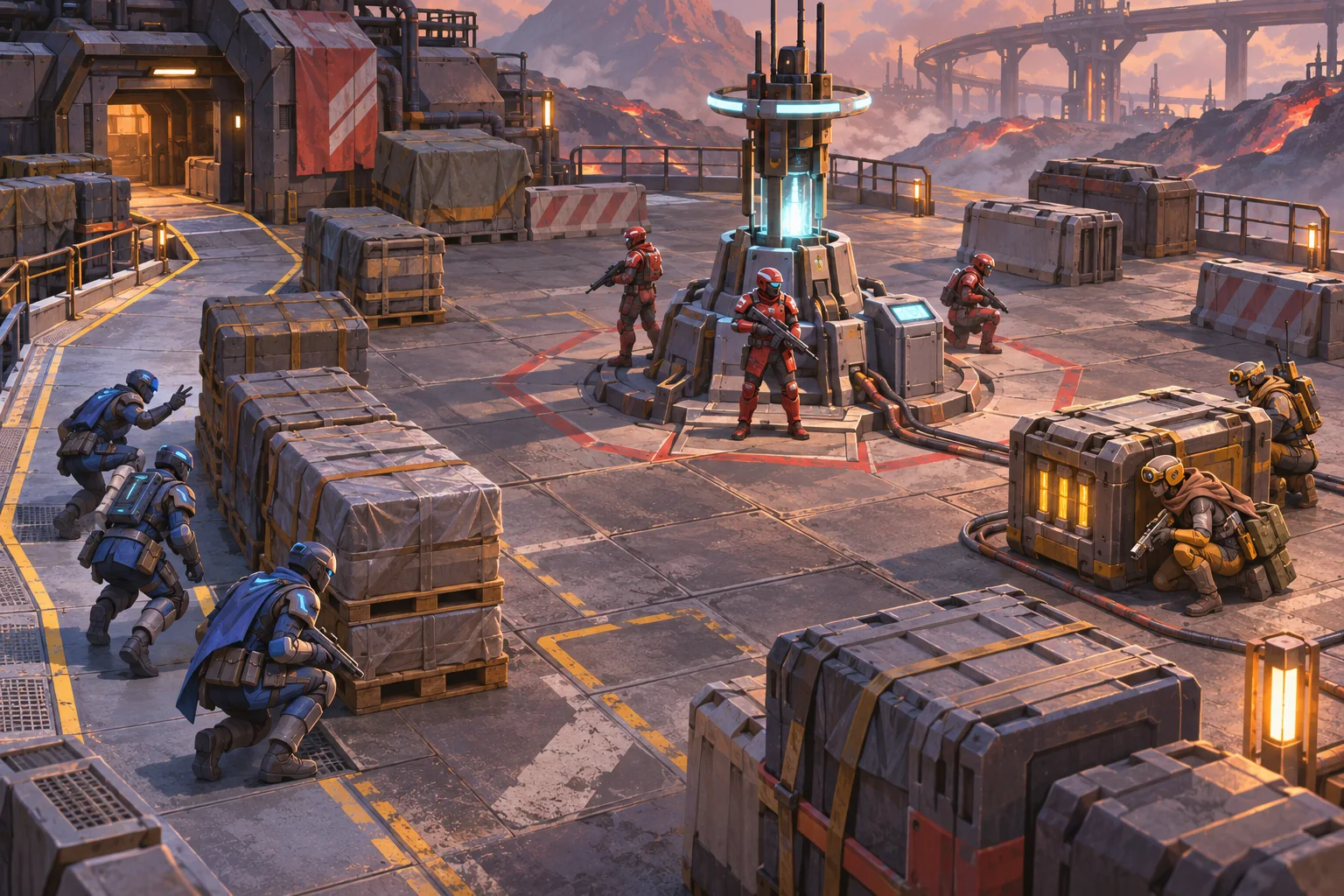
Revise the first turn after an offline trace
Start with two rival factions, one relay, one crate, a fixed order, and visible target scores. Add more squads only after a complete round can be replayed from the combat log. If designers cannot predict why a unit chose a rival or the player, tune the score and display its reasons before adding more weapons or objectives.
Read the turn-based shooter design guide.
Explore SEELE's AI game creation workflow.
Frequently asked questions
How do I make enemies fight each other in a turn-based shooter?
Give each faction its own objective, then score visible targets by objective relevance, exposure, distance, and health. A unit should sometimes attack a rival because that rival blocks its goal. Preview the target and reason before the turn so the behavior remains understandable.
Should the factions share one AI?
They can share movement and line-of-sight code while using different objective weights and target priorities. Salvage values the battery crate; Security values the relay and a rival contesting it. Shared rules reduce bugs, while faction-specific goals create the competition. That makes each rule auditable.
Read Godot's navigation and pathfinding documentation.
How can I keep enemy decisions predictable?
Use fixed turn order, deterministic scores, explicit tie-breaks, and a short combat log. Avoid hidden random target swaps in the first slice. If randomness is added later, show its range and preserve a seed so a designer can reproduce a confusing turn.
What should the player be able to see before committing?
Show each enemy's intended destination, target, and a concise reason, along with range, cover, objective status, and ammunition. A preview should describe a plan, not promise the result: another unit or a blocked tile may change what is reachable during resolution.