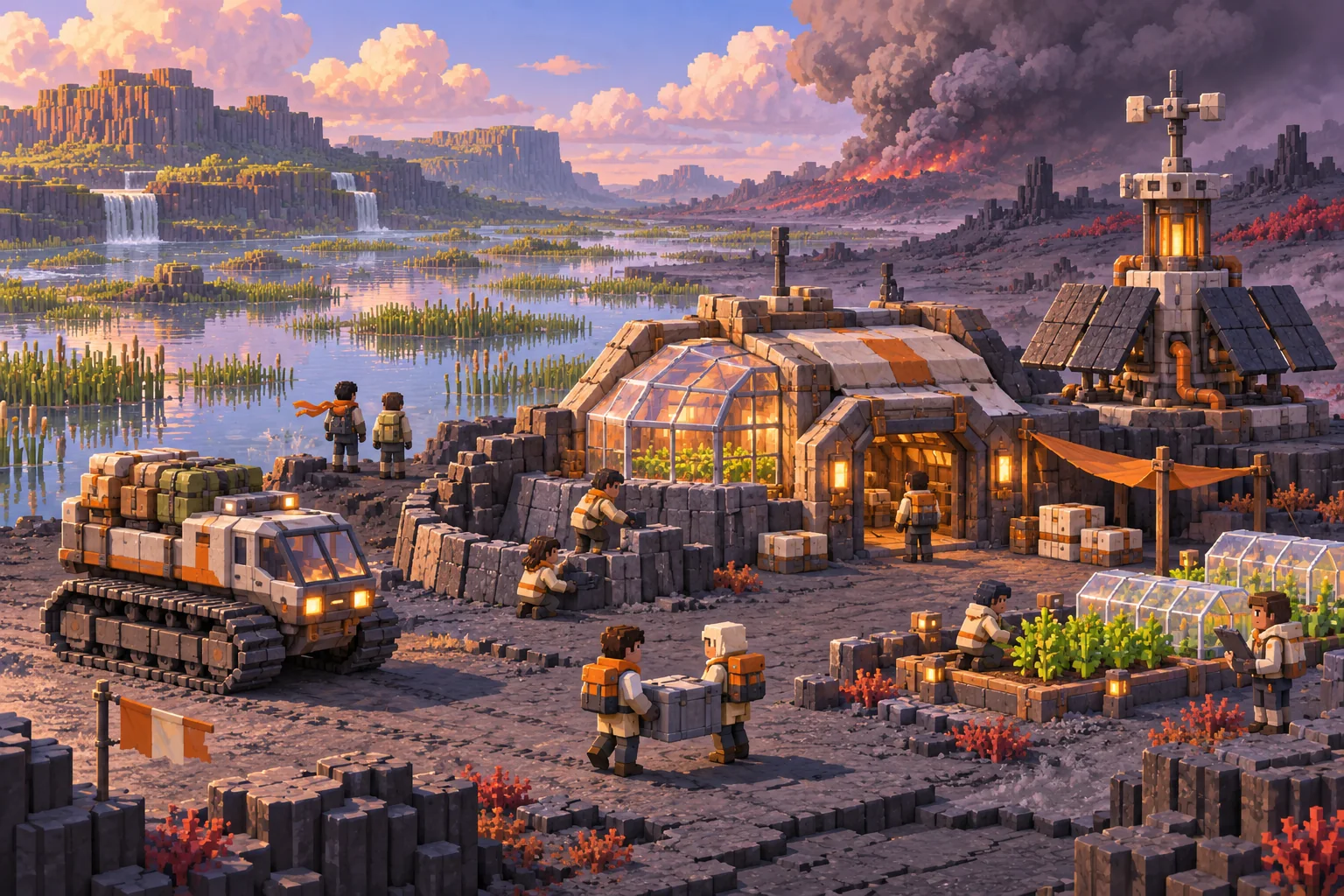
A colony that stays in one place can optimize its walls and workshops. A migrating colony has to decide which parts of that work are worth carrying. Rookery Drift is a fictional voxel-building game where a small settlement moves from Reed Basin to Ash Shelf and then Frost Crown before each local hazard arrives. Players build paths and rooms from blocks, dismantle useful pieces, and fit essential modules into a four-slot crawler.
The crawler carries a Core, Shelter, Waterworks, and one Climate Rig. The rig is reconfigured with two local voxel plates: reeds for floodwater, basalt for heat, or crystal for cold. Each site warns the player three days before its main hazard. A new landing offers one setup day before its next hazard clock starts. That window turns migration into a repeating build cycle: read the forecast, reach a safe landing, reclaim blocks, pack the four modules, and adapt the rig to the next environment.

Make migration the reason to build with voxels
Start with a 6-by-6 tile map. The crawler begins at (2,2); a raised landing at (4,3) stays above the Reed Basin flood line. The flood submerges rows 1–2 at the end of day three. One action moves the crawler one orthogonal tile. A stair made from two voxel blocks connects one elevation step. The crawler has exactly four module slots: Core, Shelter, Waterworks, and Climate Rig. The rig accepts two plates that match the local hazard: reed for water, basalt for heat, crystal for cold. Every site gives a three-day warning. After arrival, one setup day passes before the new site's hazard timer starts. Dismantled blocks return to inventory once; structures not packed remain in the old biome. If a fifth module is selected, reject packing until a slot is freed.
| System | Rule and result |
|---|---|
| Crawler capacity | Four module slots: Core, Shelter, Waterworks, and Climate Rig. |
| Climate Rig | Uses two local plates: reed for flood, basalt for heat, crystal for cold. |
| Environment warning | The site hazard arrives at the end of day three; display the countdown. |
| Setup window | The first day after arrival has no new hazard timer; adapt the rig during this window. |
| Voxel stair | Two blocks connect one elevation step; each placement or dismantle updates inventory once. |
| Migration | Reach the safe landing and pack before the hazard. Unpacked walls and workshops stay behind. |
| Overflow | A fifth module cannot fit; reject the pack request without losing any module or block. |

Set the module limit and environmental clock
In Reed Basin, the colony starts at (2,2) with the flood forecast at three days. On day one, spend two reed blocks on a stair path to the raised landing at (4,3). The landing stays dry when rows 1–2 flood. On day two, dismantle a three-block workshop wall and return exactly three blocks to inventory. Pack Core, Shelter, Waterworks, and Climate Rig into the four crawler slots. If the player also selects a decorative beacon as a fifth module, reject the pack request and keep the current loadout unchanged. Before day three ends, move along the prepared stair route and leave the basin for Ash Shelf; the flood then covers the abandoned lowland structures. At the new landing, the one-day setup window begins. Gather two basalt plates and replace the two reed plates in the Climate Rig before the Ash hazard clock starts. The rig stays in its module slot while its local material changes. This is a hand-authored planning trace, not a playable test.
| Check | Expected result |
|---|---|
| Day 1: place two reed stair blocks | Connect the starting area to the raised landing; inventory decreases by 2. |
| Day 2: dismantle the workshop wall | Return exactly 3 blocks once; the wall disappears from the old site. |
| Pack Core, Shelter, Waterworks, Climate Rig | All four required modules fit in the crawler. |
| Add a decorative beacon as module five | Reject packing; retain the original four modules and inventory. |
| Move before the Basin day-three flood | Crawler and packed modules reach Ash Shelf; lowland builds remain behind. |
| Install two basalt plates at Ash landing | Climate Rig is configured for heat before the setup window closes. |
| Arrive with reed plates still installed | Mark the rig as mismatched; do not report heat protection until replaced. |
Trace a move from the flooded basin
Ask SEELE for a small voxel-colony slice with one hazard forecast, one migration route, and a visible four-slot loadout. Keep block inventory, structures left behind, module capacity, and the setup-day timing in the same state panel so a player can inspect why the colony is ready to move.
Create a local voxel-building colony prototype called Rookery Drift. Use one 6-by-6 tile map for the first slice. The crawler starts at (2,2); a raised landing at (4,3) stays dry when Reed Basin rows 1–2 flood at the end of day three. One move action advances the crawler one orthogonal tile. Two voxel blocks build a stair connecting one elevation step. The crawler has exactly four module slots: Core, Shelter, Waterworks, and Climate Rig. The Climate Rig accepts two plates matching the current hazard: reed for water, basalt for heat, crystal for cold. Display the three-day hazard countdown. After reaching a new site, give one setup day before its hazard timer starts. Let players place and dismantle voxel blocks; dismantled blocks return to inventory exactly once. Structures not packed remain at the old site. Before migration, require all four essential modules to fit in the crawler; reject any fifth module without changing the loadout or inventory. Show the written sequence: day one, spend two reed blocks on a stair route to the raised landing; day two, dismantle a three-block workshop wall and pack the four essential modules; day three, move to Ash Shelf before the flood; during its setup day, swap in two basalt plates before heat begins. Add a deterministic reset to Reed Basin, the starting inventory, and the original module configuration. Display map coordinates, hazard timer, cargo slots, block inventory, climate plate type, and current site. Use keyboard-accessible controls without timed key presses. Keep settlers, combat, food systems, and long-term economy out of this first slice.Ask AI for one small migratory colony slice
The first packing draft accepted the Core, Shelter, Waterworks, Climate Rig, and a decorative beacon at once. That exceeded the four-slot crawler capacity. Reject the fifth module as one transaction, leave the original loadout unchanged, and let the player dismantle or leave an optional module before trying again. Do not duplicate or destroy voxel blocks during that correction.
Replay the Basin-to-Ash sequence. Confirm that the day-three flood arrives after migration, that two stair blocks reach the raised landing, that dismantling the workshop returns exactly three blocks, and that the Climate Rig has basalt plates before the heat timer begins. This written trace describes proposed checks; it is not a test of a generated game.
Check inventory and hazard edge cases
Keep the first build to three environments, four carried modules, one climate rig, and one migration route. Players should be able to say what will flood, which structures they are leaving, what fits in the crawler, and which two plates the next biome requires. After the move sequence is predictable, add another landing choice or voxel material and update the cargo and hazard checks before expanding the colony.
Read the colony-management planning guide.
Start a local prototype with SEELE.
Frequently asked questions
How does a migrating colony differ from a normal base builder?
The environment forecast makes relocation part of construction. Players build paths that reach a safe landing, decide which structures to dismantle, and pack a limited set of essential modules before the hazard arrives. A stationary base can optimize one site; this loop values what can be moved and rebuilt.
What should the crawler carry first?
Keep the Core, Shelter, Waterworks, and Climate Rig in the four available slots. Optional workshops and decorations must be dismantled, left behind, or swapped for another module. Showing the cargo slots before packing makes the tradeoff clear. Make the capacity visible before each move.
Read Godot's GridMap documentation.
How should voxel building connect to the environment?
Give each local material a job in the migration loop. Reed blocks can form a stair through the basin, basalt plates can adapt the Climate Rig for heat, and crystal plates can prepare for cold. Keep the first map small enough to see where a placed block helps the route or the next hazard.
What should reset restore?
Return the crawler to (2,2), restore the initial four modules and Reed Basin plates, reset block inventory and the three-day countdown, and remove the temporary stair and workshop changes. Test the same migration plan again from that state. Begin the next run from that clean start.