A warehouse management game can make city growth a negotiation between operators. When one business buys a rival, the buyer gains a facility but also inherits its stock and dispatch commitments. A purchase should change control without making parcels disappear or deadlines reset. Start with one buyer, two offers and a clear operating reserve.
Show the offer beside cash and open orders
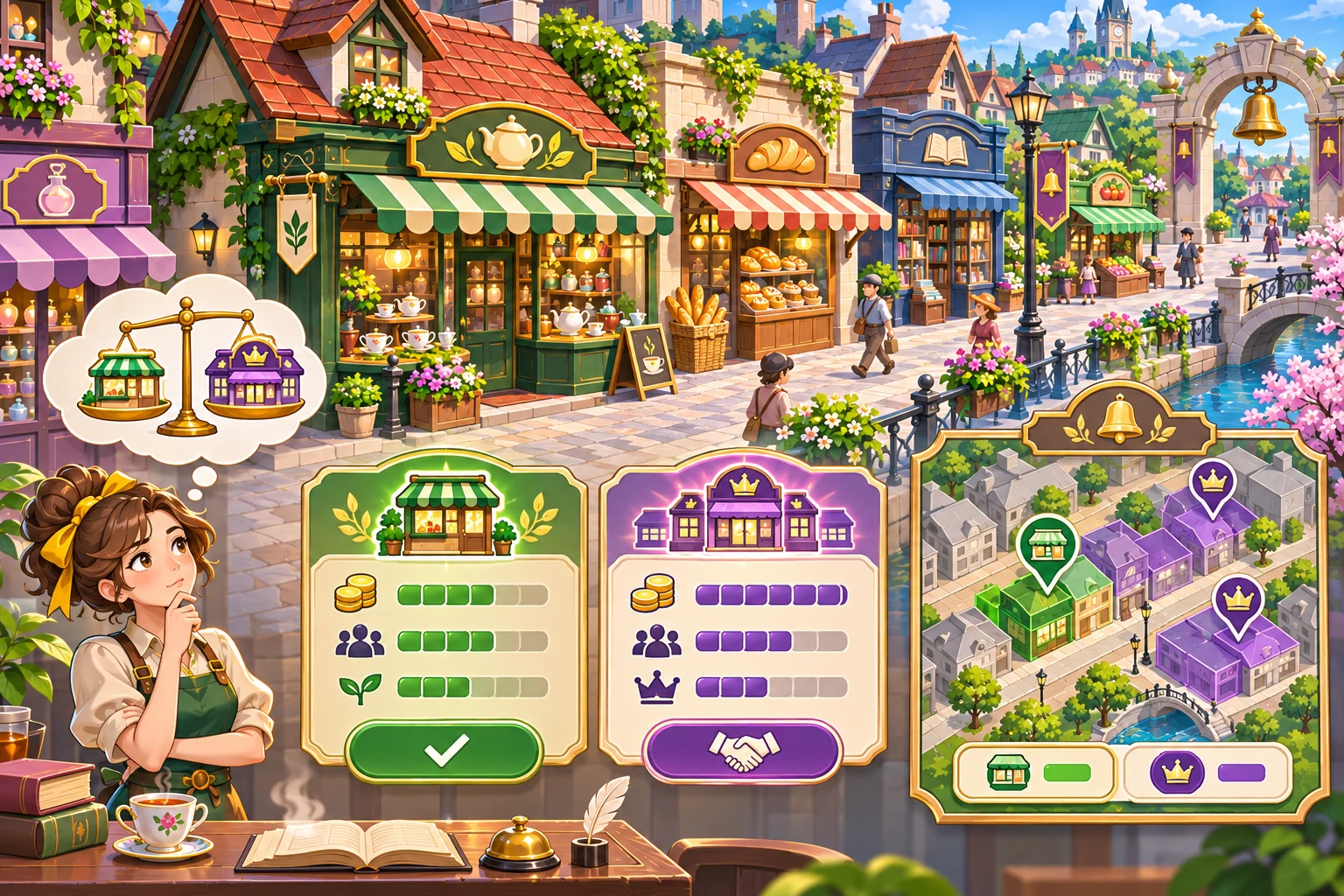
Give the buyer 9 credits and require a 3-credit reserve for daily operations. Rival Warehouse B asks 6 credits and has two open dispatch orders. Rival Warehouse C asks 7 and has one open order. Show price, current balance, reserve after purchase, inventory and open orders together before accepting. The player can compare both deals instead of seeing only the acquisition price.

Keep the first city to three facilities and a small ledger. Label all amounts as prototype credits. The reserve is a game rule that prevents a purchase from consuming all operating cash; it is not a real-world financing recommendation.
Preserve stock and commitments through a transfer
Buying Warehouse B costs 6 credits and leaves exactly 3. The buyer meets the reserve and takes control of the facility. Its two open orders remain active under the new owner with the same items and dispatch status. If the player considers Warehouse C, the 7-credit price would leave 2, below the reserve, so the offer cannot close. No ownership or order data changes after that rejected offer.

Preview the acquisition outcome before confirmation: remaining cash, new facility ownership and the open work that transfers. Keep failed purchases reversible and visible. Never silently cancel a delivery order to make the transaction fit.
Replay an affordable and unaffordable offer
The local check starts with 9 credits and a required reserve of 3. Buying B for 6 leaves 3, so the purchase is allowed. Its two orders stay open under the buyer. Buying C for 7 would leave 2, so the reserve check rejects it and C remains independent with its one order unchanged.
| Offer | Price | Cash after | Reserve met? | Orders after |
|---|---|---|---|---|
| Warehouse B | 6 | 3 | Yes | 2 transferred and active |
| Warehouse C | 7 | 2 | No | 1 remains with rival |
This deterministic check verifies affordability, ownership and order continuity only. It does not model market valuation, credit, route optimization, worker schedules or a full warehouse operation. Add those systems after the acquisition state is easy to inspect.

Build one acquisition before simulating the whole city
Ask an AI game maker for a small warehouse management prototype with three facilities, a buyer balance of 9, a reserve of 3, Warehouse B at price 6 with two open orders, and Warehouse C at price 7 with one open order. Allow the buyer to review and confirm a deal. On purchase, transfer ownership and preserve open orders. Reject a deal that would leave less than the reserve. Add a reset for the same city state.
Once the transfer is clear, add warehouse capacity, vehicle routes or valuation rules one at a time. Replay the same offers after each change. This keeps a purchase connected to storage and dispatch rather than making acquisition a separate menu action.
Create a warehouse management prototype in a small city. The buyer has 9 credits and must preserve a 3-credit operating reserve. Warehouse B asks 6 credits and has two open dispatch orders. Warehouse C asks 7 and has one open order. Show each price, cash after purchase, reserve status, ownership and order state. Allow the B purchase: leave 3 credits and transfer the facility while both orders remain active. Reject C because it would leave only 2 credits; its ownership and order stay unchanged. Add a reset. Treat values as prototype rules; do not simulate valuation or route optimization yet.
Start a warehouse management prototype in SEELE
Frequently asked questions
What should transfer when one warehouse buys another?
Ownership and control of the facility should change, while inventory and open dispatch commitments remain visible. Keep each order’s items and status so the new owner can continue the work instead of erasing it during the purchase. Keep the delivery history intact as well.
Why does the buyer need an operating reserve?
The reserve gives the prototype a clear affordability boundary. A purchase is allowed only if the buyer can pay and still keep the required cash for operations. Show the remaining balance before confirmation. This keeps the operation running after the deal.
What should the first acquisition test cover?
Check the offer price, cash after purchase, reserve, ownership change and order continuity. Compare one affordable and one rejected offer. This does not validate market valuation, credit systems or warehouse logistics. Do not infer full logistics performance. or operational efficiency.