A worker who repeats the same warehouse job can become faster at that job, but the learning should come from completed assignments rather than a generic level-up. In North Warehouse, Mira gains Pick experience only by finishing Pick orders. Forklift assignments use a separate track, and canceled jobs grant no progress.
This fictional warehouse begins with a six-point shift and a novice Picker whose tasks cost three points each. After three successful Pick jobs, Mira reaches Picker I and each new Pick costs two points. The trace spans two shifts to show that task progress persists, the threshold is reached on completion, and the next job uses the improved cost.

Tie employee learning to assigned work
Track progress by employee and task type. Mira starts at Pick rank 0 with Pick progress 0. A Pick order costs three work points at rank 0 and two at rank 1. Each successfully completed Pick adds one point to Pick progress; when progress reaches three, unlock Picker I immediately after that job completes. The next job uses the new cost. Forklift work has its own progress and never advances Pick. A canceled or interrupted job adds no experience. Each shift grants six work points, and unspent points expire at shift end. Progress persists into the next shift. This makes the timing readable: at the start of Shift 1, two novice Picks cost six and raise progress to two. On Shift 2, the third Pick still costs three; completing it reaches the threshold and unlocks rank 1. Mira then has three points left in the same shift, so a fourth Pick costs two and completes with one point remaining. If she instead uses the third assignment for Forklift, Pick progress stays at two, so the next Pick still costs three. Keep the job log visible so a player can explain which assignments changed each skill. The prototype uses invented work points; it does not model real warehouse safety, labor standards or worker performance.
| Work rule | Resolution |
|---|---|
| Novice Pick | Costs 3 points at Picker rank 0. |
| Successful Pick | Completes one order and adds 1 to Pick progress. |
| Picker I threshold | At progress 3, unlock rank 1 after the current job; the next Pick costs 2. |
| Forklift assignment | Uses a separate skill track and does not advance Pick progress. |
| Canceled task | Adds no progress and spends no task cost. |
| Shift budget | Six points per shift; progress persists, unused points reset at shift end. |
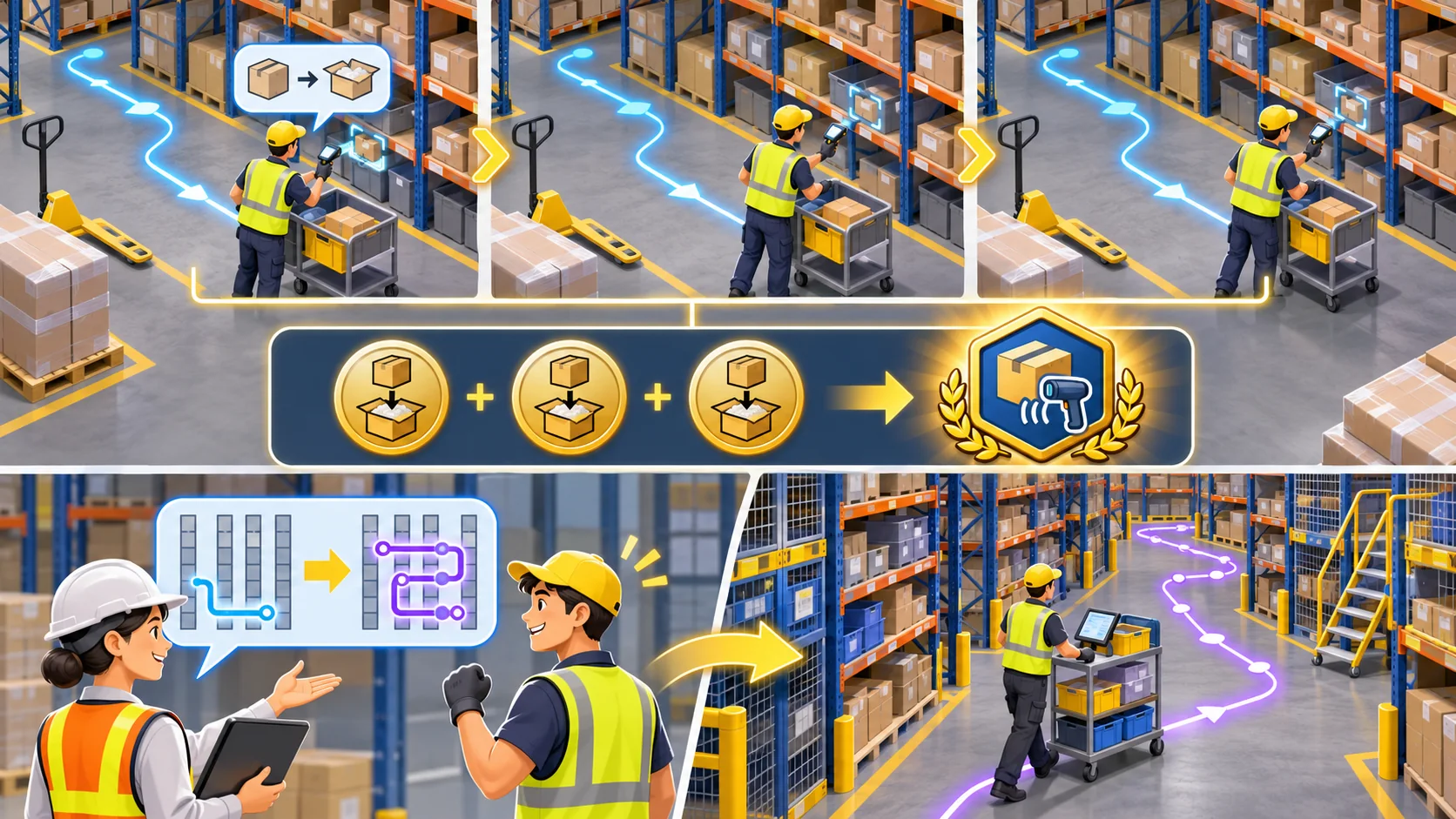
Trace skill progress across two shifts
Start Mira at Pick progress 0 and rank 0 with six points. Shift 1: complete Pick order 1 for three points, progress becomes 1; complete Pick order 2 for three more, progress becomes 2 and the shift ends. Shift 2 starts with progress 2 and six points. Pick order 3 costs three at the current rank; when it completes, progress becomes 3 and Picker I unlocks. Three points remain. Pick order 4 now costs two at rank 1, completes, and leaves one point. The same task became cheaper only after its third successful completion. Counterexample: assign the third job to Forklift. It advances the Forklift track, not Pick; the next Pick still costs three. A canceled Pick also leaves progress at two. All skill and work-point changes follow the job log, not a hidden performance roll.
| Check | Expected result |
|---|---|
| Start Pick progress 0 | Rank 0; one Pick costs 3 points. |
| Complete two Picks in Shift 1 | Spend 6 points; progress becomes 2. |
| Complete a third Pick in Shift 2 | Spend 3; progress reaches 3 and Picker I unlocks after completion. |
| Start the fourth Pick | Use rank 1 cost 2; three remaining points become one. |
| Assign Forklift instead | Only Forklift progress changes; Pick remains at 2 and still costs 3. |
| Cancel a Pick job | Do not spend task cost or award experience. |
Ask AI for a small warehouse roster
Ask SEELE for one employee, two task tracks and two shifts before expanding to a large warehouse. Specify when progress is awarded, what happens at rank thresholds, and whether the current or next job uses the new rank. Compare the completed-pick trace with a forklift assignment and a canceled job.
Create a local warehouse management prototype called North Warehouse. One employee, Mira, has Pick rank 0 and Pick progress 0. Each shift has six work points. A novice Pick order costs 3 points; each successfully completed Pick adds 1 Pick progress. At progress 3, unlock Picker I immediately after that job completes; the next Pick costs 2 points. Forklift has a separate progress track and never changes Pick skill. Canceled or interrupted jobs add no progress and spend no task cost. Progress persists between shifts; unused work points reset. Trace: Shift 1 completes two Picks for six points total and leaves Pick progress 2. Shift 2 completes the third Pick for 3 points, reaches progress 3 and unlocks rank 1; then completes a fourth Pick for 2 points, leaving 1 point. Counterexample: assign the third job to Forklift; Pick stays at progress 2 and a later Pick still costs 3. Show assignment, task type, cost, completion, progress, rank and remaining shift points after each action. Add reset. Keep assignments and confirmations keyboard-operable without timed input. Do not present invented work points as real productivity advice.Show why a different job does not train picking
The first draft awarded Pick progress when Mira was assigned a job, even if the order was canceled. Award it only after a successful completion and tie it to the task type on that job. When the third Pick completes, update rank before costing the following order, not retroactively on the order that reached the threshold.
Replay the two Pick shifts, then replace the third Pick with Forklift. Confirm that only the matching skill track moves, canceled work gives no progress, and unused shift points reset while experience persists. Keep this as fictional game math, not an assessment of real workers or safety practice.

Add worker specializations after the ledger works
Keep one employee and two task types fixed while checking whether repeated assignments produce a skill that feels earned and legible. Mira should be able to point to three completed Pick orders and explain why a fourth costs less. Once the log and threshold match the trace, add a second employee or a specialization choice without merging progress between jobs.
Read Godot Resource documentation.
Read Godot save-game documentation.
Frequently asked questions
Should progress be awarded on assignment or completion?
Award task-specific progress only after a successful completion. This prevents canceled work from training the employee and lets the job log explain exactly why a skill changed. A threshold should update before the next task is priced. This also makes each skill change easy to trace in the shift summary.
Does forklift work improve picking?
No. In North Warehouse, each job type has a separate progress track. A forklift assignment can advance forklift skill, but Pick remains at its current rank and cost. This makes specialization choices visible instead of granting a generic level bonus. Separate tracks make the reason for each task cost easy to verify.
Start a local game prototype with SEELE.
What happens to experience between shifts?
Keep completed-task progress when the work-point budget resets. Mira carries two Pick completions into the next shift, then the third completion unlocks Picker I. Resetting the whole roster each day would hide the reward of repeated assignment. Progress persists while unused shift points still reset at the end of the day.
Are these warehouse work-point values realistic?
No. The six-point shift and three-to-two Pick costs are invented values for a deterministic prototype. They are not labor guidance, productivity research or safety standards. Use appropriate research and expert review before making real-world claims. This boundary keeps prototype values separate from real-world guidance.