In a contract-driven engine-building card game, customers give your resource engine a reason to change. In the fictional campaign Harborlight, each client posts a recipe, a deadline, and a consequence for the next chapter. Station cards activate in a fixed order, producing or converting resources. Fulfill a contract to unlock a new customer and market; miss it and lose trust or take a less favorable route.
Start with one short contract and a visible two-card market. The player builds stations, watches the order in which they activate, and decides whether to add production or conversion. Use a fixed one-round example to show that a small engine upgrade can turn a missed deadline into a completed order. Treat the result as a rules-based paper simulation until a playable build has been tested.
Make each customer contract change the campaign
Give every contract three parts: a resource recipe, a deadline and a campaign consequence. A client might request Timber and Pigment before the end of round one. Fulfillment raises that client’s trust and reveals a follow-up contract; missing the deadline lowers trust and sends the player toward a different customer or route. The campaign then grows from the work the player actually completes.
Keep two contracts visible at a time. Each round, activate owned stations, check whether the open recipe is complete, then choose one new station or upgrade from a small market. Resolve deadlines after production. This order makes the central decision readable: improve the engine for a future promise, or take a card that helps deliver the current order.
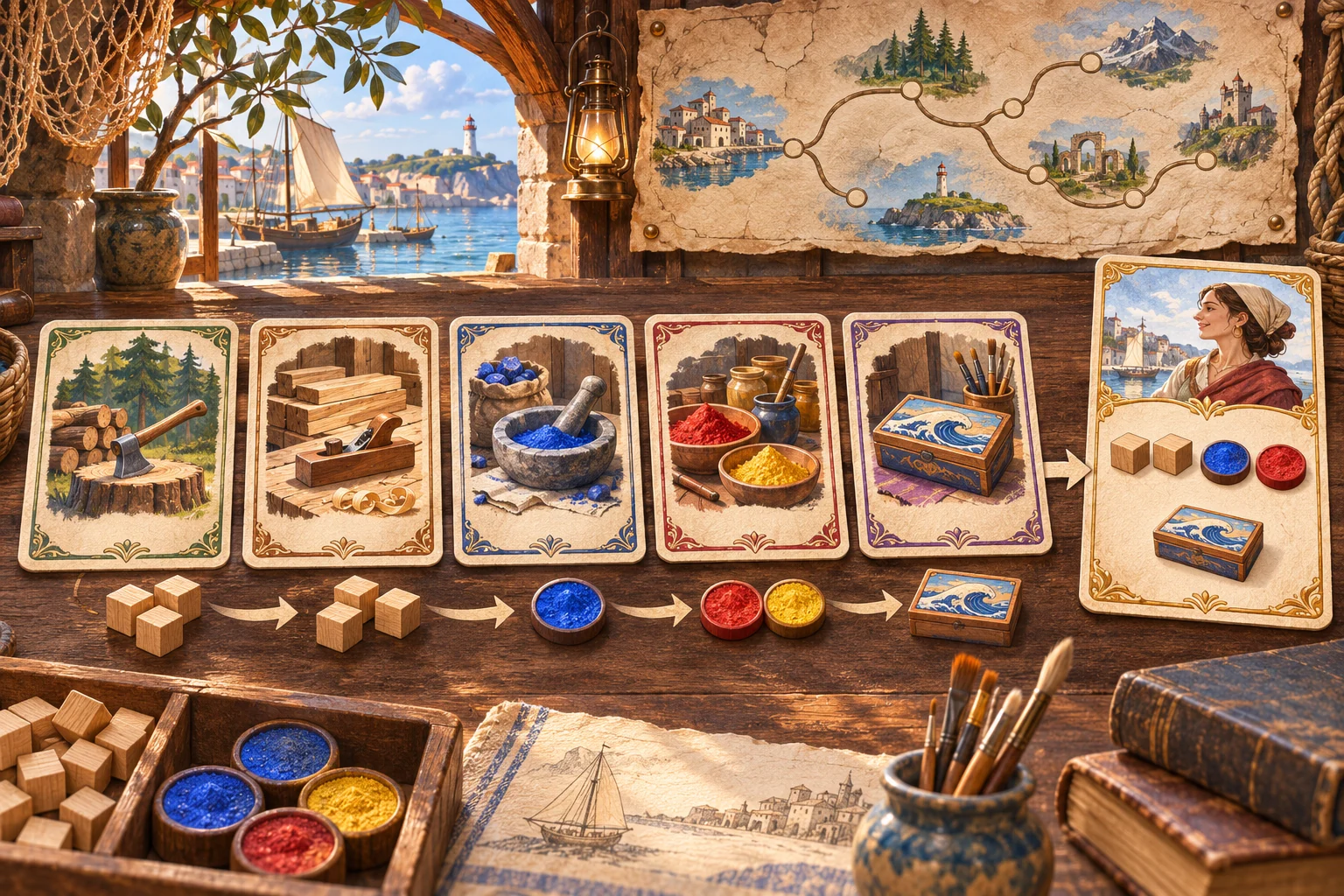
Give production and conversion cards a clear activation order
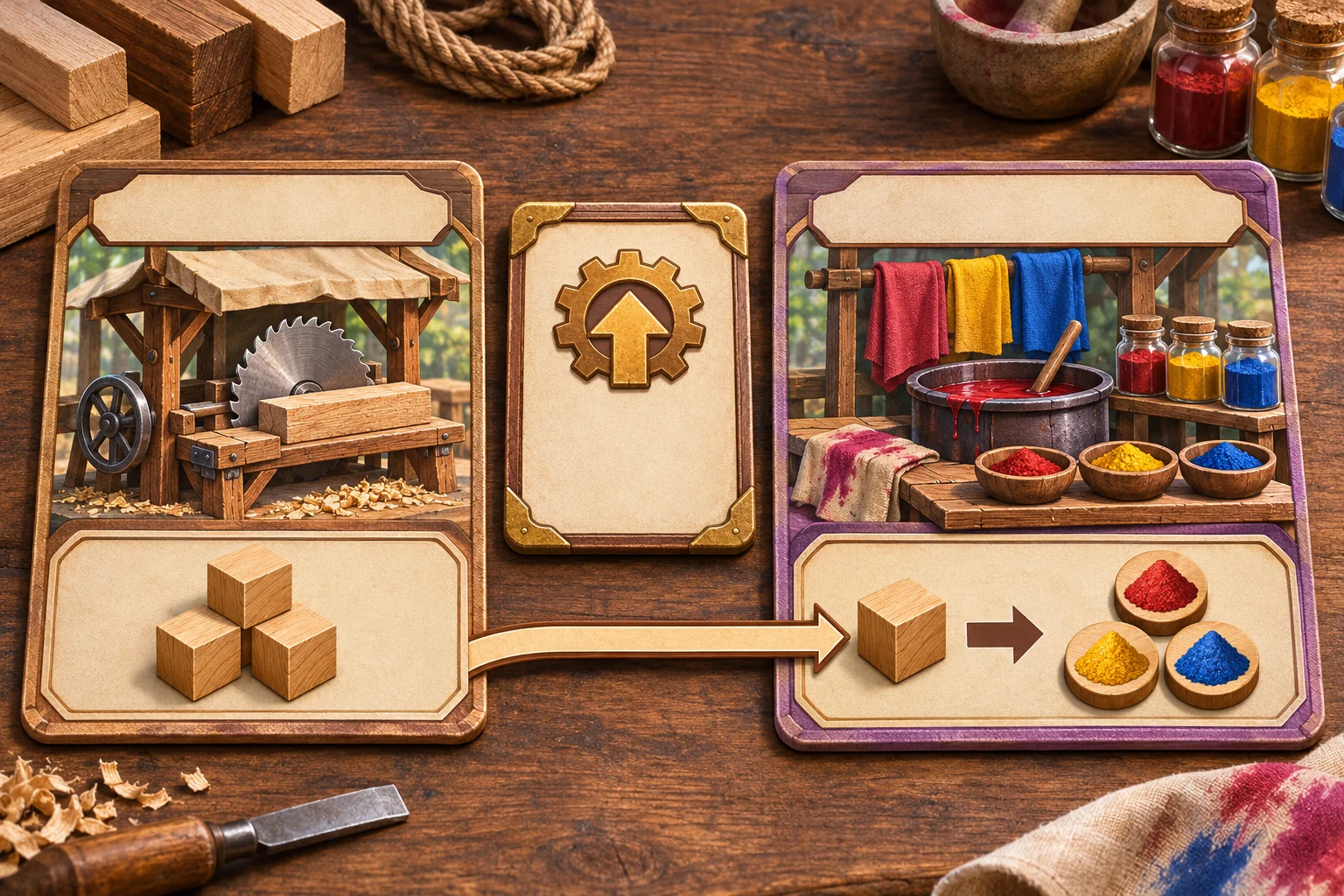
Represent the engine as a left-to-right row of station cards. At round start, resolve each card once from left to right; resources made by an earlier station are available to later stations that same round. The Saw produces 2 Timber. The Dye Bench spends 1 Timber to make 2 Pigment. An upgrade such as Tandem Blade adds 1 Timber to the Saw before the Dye Bench activates.
Print each station’s input, output and timing on its card. Show the current resource pool and preview the result of the full activation chain before the player commits. A card that makes a resource and a card that converts it should have different costs and opportunities. This lets players spot whether they need more supply, better conversion or a new contract that fits the engine they have built.
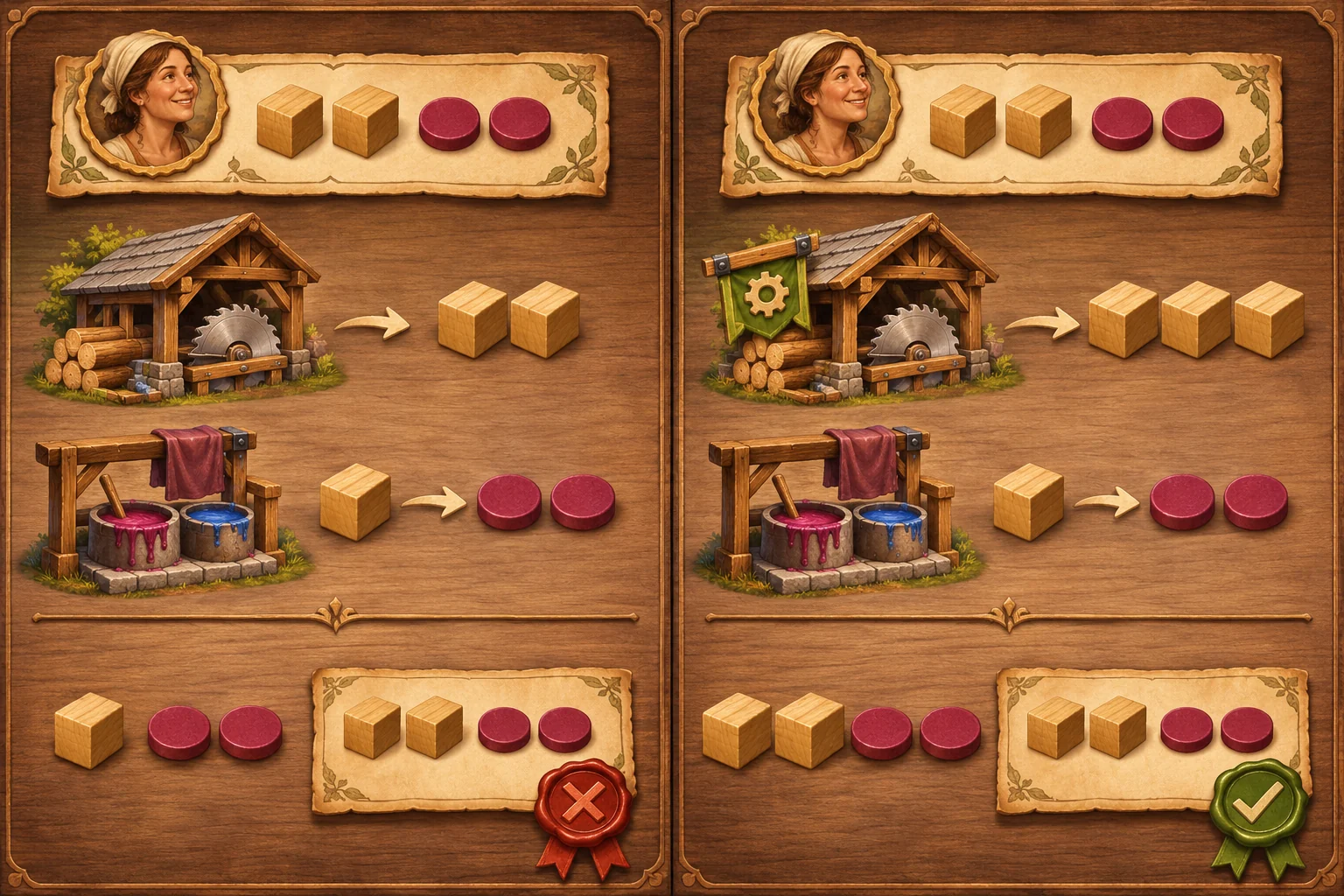
Replay one timed contract with and without an upgrade
Use a round-one customer contract called Harbor Sign. It requests 2 Timber and 2 Pigment by the end of the round. The starting engine has Saw and Dye Bench. Resolve the Saw: gain 2 Timber. Resolve the Dye Bench: spend 1 Timber and gain 2 Pigment. The pool ends at 1 Timber and 2 Pigment, so the contract misses by 1 Timber. Record the miss and its campaign consequence.
Reset the same state and add Tandem Blade, which makes the Saw produce 3 Timber. The Dye Bench then spends 1 Timber for 2 Pigment, leaving 2 Timber and 2 Pigment. Harbor Sign is fulfilled before the deadline and its follow-up customer becomes available. The comparison is a paper simulation derived from the written rules, not a measured game result. In playtests, record contracts met, turns to fulfillment, unused resources and route choices. If one upgrade solves every order, change its cost or the contract recipes.
Prototype the contract market before writing a long campaign
Build a small resource pool, three station cards, a two-contract market, one deadline and two campaign outcomes. Add a reset button so the same engine can be replayed with and without an upgrade. Show activation order, current stock, recipe progress and the consequence of a deadline in one view. Add new customers only after the resource chain and campaign handoff are easy to understand.
Create Harborlight, a compact engine-building card game driven by customer contracts. Stations sit in a left-to-right row and activate once per round in order. Saw produces 2 Timber; Dye Bench spends 1 Timber for 2 Pigment; Tandem Blade adds 1 Timber to Saw output. Harbor Sign requests 2 Timber and 2 Pigment by the end of round one. Fulfillment unlocks a follow-up customer; a miss lowers trust and redirects the campaign. Show input, output, resource stock, contract progress, deadline and campaign consequence. Include a resettable example comparing the base engine with the upgrade. Track contracts met, turns to fulfillment, leftover resources and route choices.
SEELE's official page describes a general workflow: generate a playable first version from a prompt, test it in a browser and refine it with follow-up prompts. Use that workflow to inspect resource timing, contract previews and campaign transitions; Harborlight and its rules are fictional design guidance.
Build the customer-contract card game in SEELE
Frequently asked questions
How do customer contracts shape an engine-building campaign?
Give each contract a recipe, a deadline and a persistent consequence. Fulfillment can reveal a new customer or card market, while a miss changes trust or closes a route. The campaign then responds to the resources and upgrades the player chose to build.
How should resource engine cards resolve?
Print each card’s inputs, outputs and timing, then activate stations in a visible order. Let resources from earlier cards feed later converters in the same round. Preview the whole chain so players can tell whether they need more production, a different converter or a better-fitting contract.
What should I track in a contract-driven card game test?
Replay the same starting engine and contract, then record contracts met, turns to fulfillment, unused resources and campaign route choices. Compare runs with one upgrade changed. If a single card solves every deadline or no recipe fits the engine, adjust card output, cost or contract requirements.