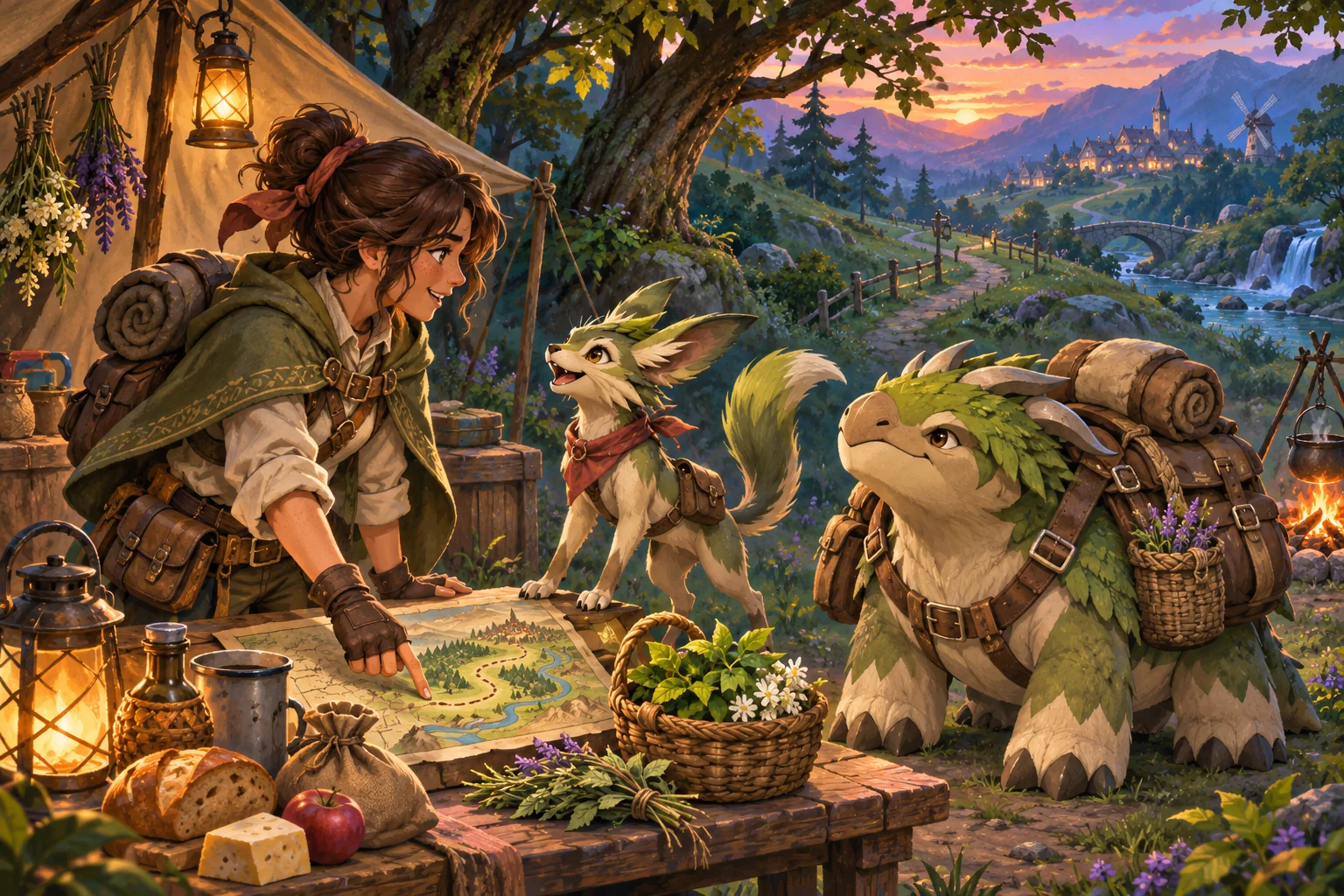
At the guild board, a courier team accepts a contract to deliver glass medicine to a hill clinic. The player equips two companions, departs for a short errand, then returns to a quest report. A trail cloak reduces route delay; a warded pack protects the medicine. The quest continues during a bounded absence, and equipment determines how the team handles its obstacles.
The design challenge is to make waiting a decision rather than a timer. Before leaving, the player chooses gear and a contract. On return, a compact report shows elapsed ticks, route progress, cargo condition and the next choice. Keep the simulation bounded so players know when a result will arrive and can see why their loadout mattered.
Make departure a meaningful equipment choice
Use one short courier contract with two companions and a route divided into three ticks. The road includes a muddy pass and a narrow ridge. A trail cloak helps the team move through the pass without losing a tick; a warded pack keeps the fragile medicine safe if the ridge crossing goes badly. Give each item a visible trait before the player commits.
Show a departure screen with the chosen contract, companion roles, equipped items and expected return window. Then let the player leave the guild hub. While away, advance the quest by a fixed number of ticks rather than running an endless invisible clock. When the player returns, summarize the resolved stages and present the delivery outcome.

Give each equipment trait a distinct job
Separate travel and protection so the loadout is a real tradeoff. The trail cloak reduces route delay by one tick on muddy ground, but it does not protect the cargo. The warded pack absorbs one damage event to the glass medicine, but it does not make the team faster. If the player can equip both, limit the team to one major gear slot so the choice stays legible.
Describe the effect before departure and repeat it in the report. For example, show the cloak removing a delay from the muddy pass, or the pack preventing a crack during a rough crossing. Gear should alter a quest step the player can understand, not silently increase a hidden success percentage.

Replay the same absence with two loadouts
Reset the same contract with the same companions, route and three-tick absence. In the first run, send the team without a trail cloak. They lose one tick at the muddy pass and arrive after the clinic's intake window; the report marks the delivery late. In the second run, equip the cloak. The team avoids that delay and reaches the clinic on time. The warded pack remains the separate protection choice for cargo condition.
Record the departure loadout, each quest tick, arrival time and cargo state. Keep the result deterministic so a player can connect a gear choice to an outcome. If a late delivery has no consequence, add a visible tradeoff such as reduced payment or a clinic reschedule. Do not advance the quest beyond its stated return window while the player is away.

Prompt a bounded quest that resolves off-screen
Start with one short contract, two companions, two distinct equipment traits and a three-tick absence. Ask the prototype to report what happened during each tick and why the loadout changed the result. Add longer contracts or more gear only after the return report is understandable.
Create a compact equipment-driven guild RPG. A two-person courier team delivers fragile glass medicine to a hill clinic along a route with a muddy pass and narrow ridge. The trail cloak removes one travel delay at the muddy pass. A warded pack protects the medicine from one damage event but does not speed travel. Let the player choose gear, depart for a bounded three-tick absence, then return to a report showing each quest stage, arrival time, cargo condition and outcome. Include a reset and compare the same contract with and without the trail cloak. Do not simulate unlimited offline time.
SEELE's free game maker describes starting with a text prompt and refining a first version through follow-up requests. Use that general workflow to inspect the departure choice, bounded quest ticks and return report before expanding the contract system.
Start the equipment-driven RPG in SEELE
Frequently asked questions
How do I make an away quest feel interactive?
Give the player a meaningful choice before departure and a readable report on return. Equipment can change a route step, protect cargo or affect a companion role. Show which trait caused each result so the player can adjust the next loadout instead of waiting on an unexplained timer.
How long should an off-screen quest continue?
Use a bounded duration with a clear return window. A short prototype can resolve a few ticks and stop at a known result. Avoid advancing a quest indefinitely while the player is away; a fixed limit makes timing, rewards and consequences easier to understand and test.
What should I compare in the first equipment test?
Replay the same contract with the same team and route, changing one item at a time. Track elapsed ticks, arrival time and cargo condition. If the item does not alter a visible event or outcome, give it a clearer quest trait or choose a more revealing obstacle.