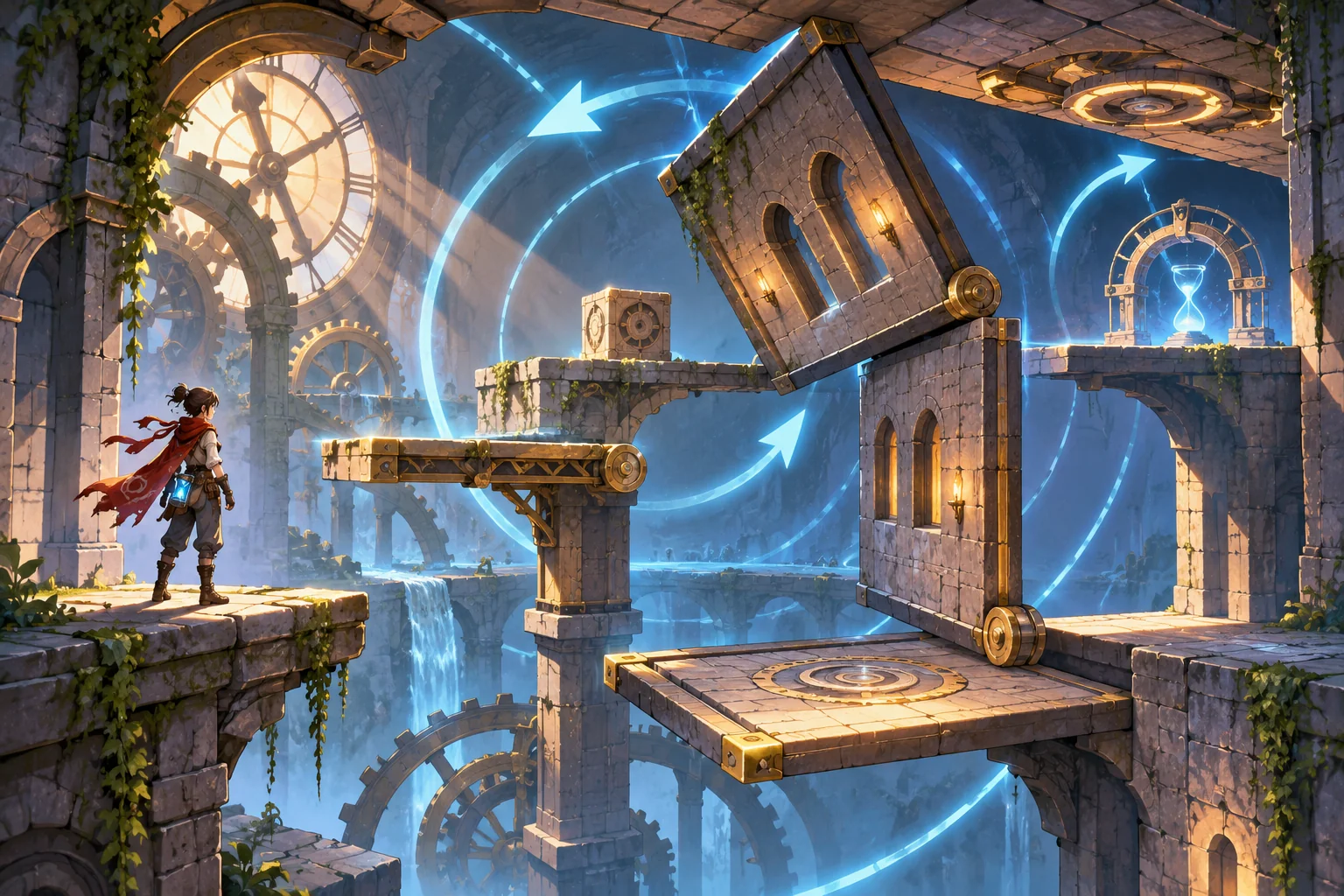
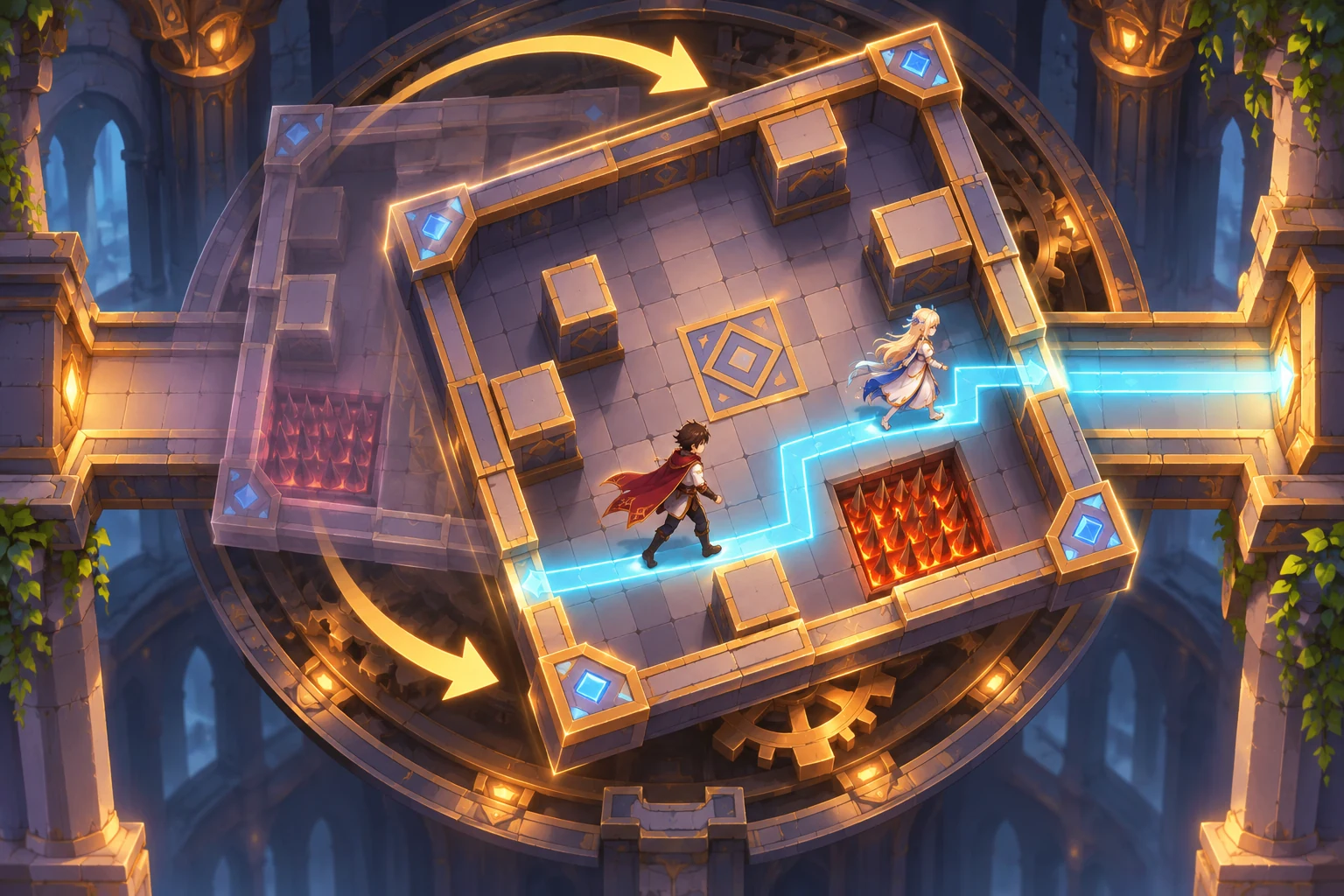
In the fictional Clockwork Vault, two square rooms turn in quarter rotations. Each room has exits, safe tiles, and a hazard lane that rotate with its geometry. The companion stands on a marked safe tile and must keep the same relative position as the room turns. Rotate the first room once to connect its east exit to the next room's west entrance, then align the second exit with the door. The local fixture checks exit alignment and companion position updates. All rooms and outcomes are invented.
Define room rotation and companion-safe tiles
Represent each room as a grid with named exits, safe tiles, and hazards. A clockwise quarter-turn changes every local coordinate and rotates the exit directions. For a 3-by-3 room, map a tile at (x,y) to (2-y,x). The companion occupies a safe tile in room-local coordinates, so its position must transform with the room.
Keep the companion's safe-tile marker visible before and after a turn. Rotate hazards and exits with the room, then check that the transformed companion tile is still safe. Show the new orientation and connected exit so the player can see how a room action changes both route and escort risk.

Connect rotating rooms into a safe route
Start with room one facing north and room two's entrance on the west. Rotate room one clockwise once so its exit points east and joins the next room. Turn room two until its north exit lines up with the vault door. The companion follows the marked safe tile through each rotation; it does not teleport between rooms or leave the grid.
Let the player rotate one room at a time and preview the resulting openings. A route counts as connected only when adjacent exits face each other. If a turn places the companion on a hazard tile, reject the move or show the danger before confirming it. This makes escort safety part of the puzzle rather than a passive follower animation.

Test room links and companion state after each turn
In the valid plan, rotate the first room clockwise and transform the companion's tile from (0,1) to (1,0) on the 3-by-3 grid. Confirm the east and west exits connect, then rotate the next room to reach the door. Log each room orientation, exit direction, companion coordinate, and hazard location.
For a control, rotate the room but leave the companion at its old coordinate. The fixture should detect that the position no longer matches the safe tile, even if the exit alignment looks correct. Clockwork Vault and its results are fictional; the local test checks only rotation mapping, linked exits, and safe-tile state.
Ask an AI game maker to prototype an escort puzzle with rotating rooms
Create an escort action puzzle called Clockwork Vault. Two 3x3 rooms rotate clockwise by quarter turns. Exits, hazards, and safe tiles rotate with room geometry. The companion follows its marked local safe tile; map coordinates (x,y) to (2-y,x) on each clockwise turn. Rotate room one so its east exit meets room two's west entrance, then align the next exit with the vault door. Show orientations, links, hazards, and companion position.
Test the valid plan with clockwise quarter-turns. Transform companion tile (0,1) to (1,0), verify linked exits and safe status, then align the door. In a control, rotate geometry but keep the old companion coordinate; flag the mismatch. Log orientations, exits, positions, and hazards.
FAQ
How can rotating rooms make an escort game more strategic?
Make each turn change the room's exits, hazard lanes, and safe route together. The player must plan connections while checking where the companion will stand after rotation. Show the transformed state before confirmation so the puzzle asks for deliberate protection, not only quick movement.
How should a companion move when its room rotates?
Store the companion's position in room-local coordinates and apply the same quarter-turn transform as the room. Rotate exits, safe tiles, and hazards in that coordinate space too. Then recheck safety and adjacent connections before resolving the move or letting the companion continue.
What should I test in a rotating-room escort prototype?
Check the coordinate transform in every orientation, exit alignment between neighboring rooms, and whether the companion remains on a safe tile. Replay the same layout with the companion correctly transformed and with its old position left behind. Log room orientation, exits, hazards, and escort state.