Introduction
An explorable lore prototype turns worldbuilding notes into places, objects and choices a player can encounter. For worldbuilders, the first goal is coherence: a location should reveal something useful, a discovery should connect to the wider setting, and player actions should have understandable consequences. A map full of lore text is not automatically an explorable experience.
This guide uses Aeralis, a fictional archipelago of floating islands and wind-powered ports. Its factions, history, relics and routes are invented for illustration. No published setting, worldbuilder or playable prototype was tested.
Choose what exploration should reveal
Pick one player question, such as why a route between two islands is closed. Decide what the player can learn through movement, conversation or object inspection. Set a small boundary: one hub, two nearby locations, one discovery and one choice. This lets the prototype connect lore to action rather than presenting a large encyclopedia.
Prompt 1 — worldbuilding prototype brief
Create a fictional explorable lore prototype called Aeralis. Define the player question, starting location, two reachable places, one discovery, one choice and the intended ending state. Use original setting details, identify which notes must be discovered in play and list open continuity questions.
Write down the truth of the fictional setting separately from what the player can know at the start. A discovery should change the player’s understanding or available options, not merely repeat a paragraph from the setting bible.
Turn setting notes into explorable locations

Give each place a purpose, visible feature, possible action and lore connection. Add prerequisites only where they help the experience. A location record can also say what the player does not learn there, which prevents every stop from carrying every piece of backstory.
Prompt 2 — location graph
Map three fictional Aeralis locations: Lantern Quay, the Windglass Archive and a floating orchard. For each, define entry conditions, visible details, player actions, discoveries, exits and one connection to another place. Mark optional lore separately from information required to understand the main choice.
| Location | Visible detail | Player action | Possible discovery |
|---|---|---|---|
| Lantern Quay | A wind gate is closed | Inspect its mechanism or speak with a courier | Learn what condition opens the route |
| Windglass Archive | A damaged route chart | Compare marks with a travel log | Find a missing destination link |
| Floating orchard | A signal lantern and old anchor | Restore the lantern or leave it alone | Unlock a different route state |
All details in the table are fictional. The map should let a worldbuilder trace which discovery makes each later choice possible.
Make lore respond to player actions
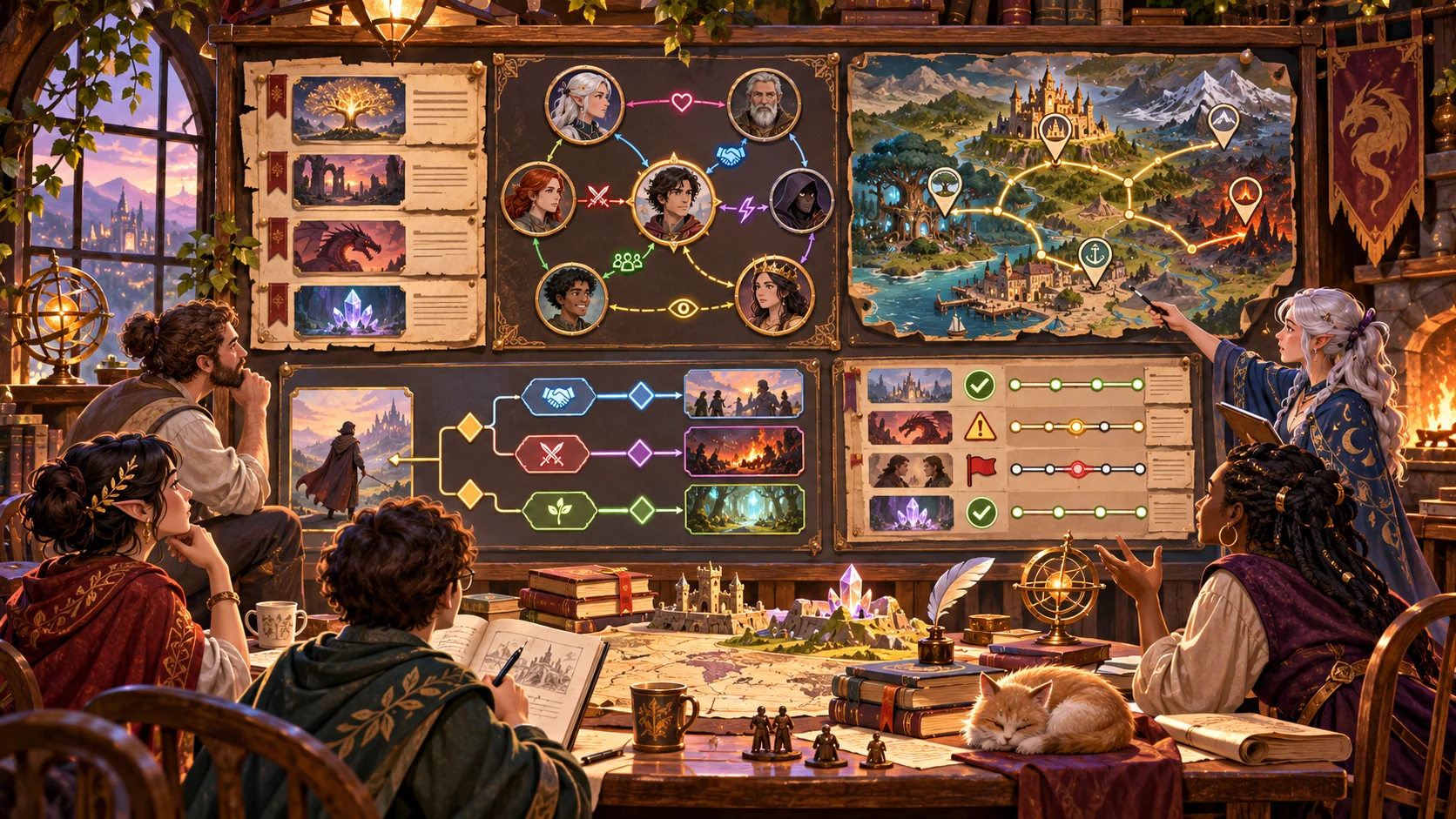
For each interactable, state the initial condition, the action, the resulting state and any new information. Keep the response proportional: inspecting a clue can reveal a fact; changing a route can affect where the player can go. Avoid hidden assumptions that make a choice appear arbitrary.
Prompt 3 — interaction and consequence
Specify the closed wind gate interaction in Aeralis. Include its initial state, clues visible before interaction, two valid player choices, resulting route states, new lore revealed and a way to revisit the choice. Label all branches as fictional and note unresolved setting logic.
A small state table can keep implementation aligned with the worldbuilding notes. If the player can open a route only after finding a chart, show how the game communicates that condition.
Separate player knowledge from world truth
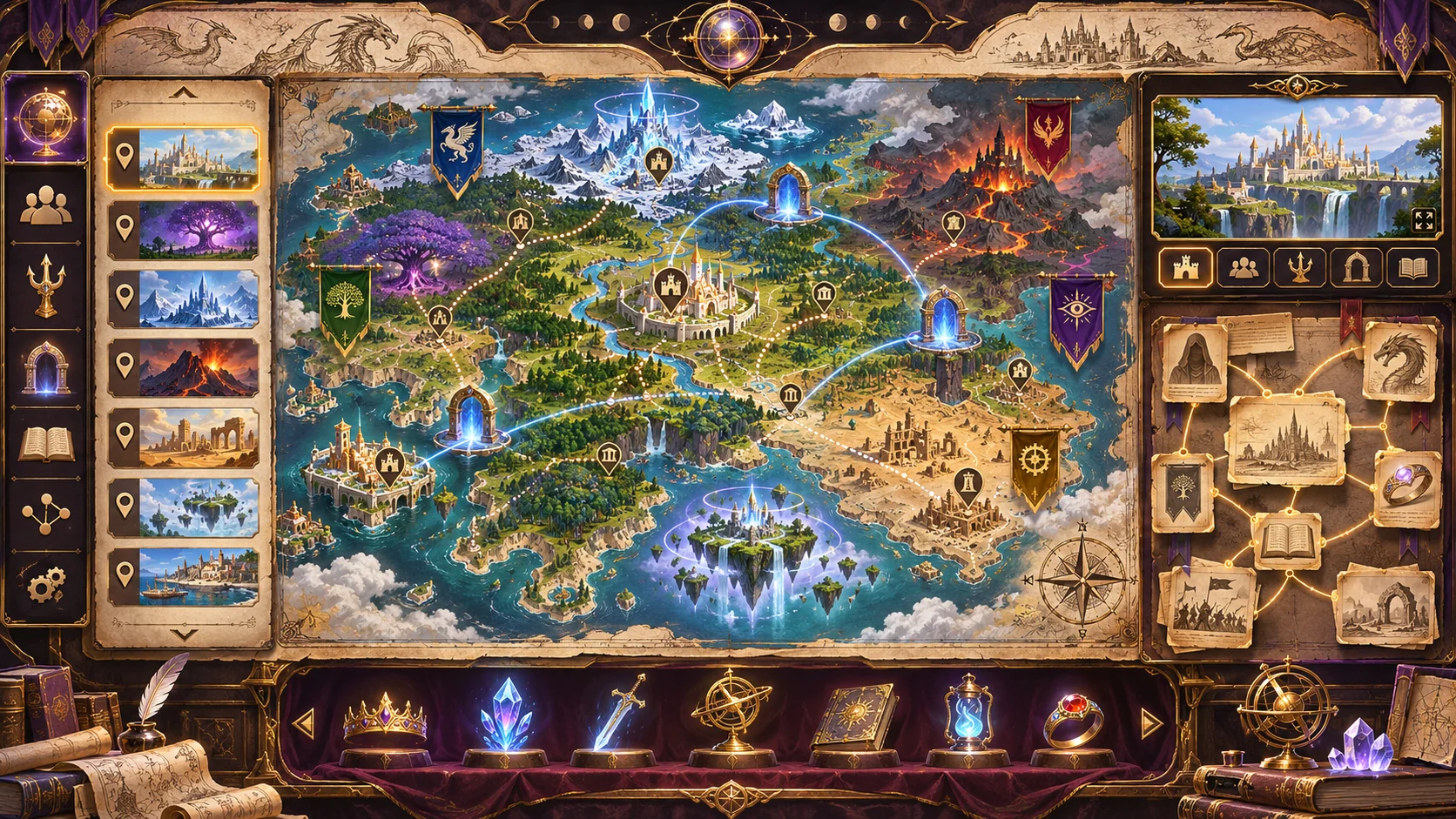
Track what is true in the setting, what the player has discovered and what remains uncertain. Use an in-world note, dialogue or environmental detail only when it suits the location. If a clue is optional, do not rely on it to explain a required event later.
Prompt 4 — knowledge and continuity ledger
Build an Aeralis continuity ledger with columns for setting truth, player-visible evidence, discovery trigger, dependent locations, optional or required status, and unresolved question. Flag any place where the player is asked to act on information they have not received.
Keep a worldbuilding template editable
The JSON below separates location links, discoveries, player knowledge, choices and continuity questions. Replace the fictional names and routes with original setting material. It is a planning artifact, not a playable game or proof that the story is coherent in production.
{
  "worldName": "Aeralis — fictional setting",
  "playerQuestion": "Why is the route from Lantern Quay closed?",
  "startLocation": "lantern-quay",
  "locations": [
    {"id":"lantern-quay","entryRequires":[],"visibleDetails":["closed wind gate","weathered courier mark"],"actions":["inspect gate","ask courier"],"discoveries":["gate opens after a signal is restored"],"exits":["windglass-archive"]},
    {"id":"windglass-archive","entryRequires":[],"visibleDetails":["damaged route chart","travel log"],"actions":["compare chart and log"],"discoveries":["missing island route"],"exits":["floating-orchard"]},
    {"id":"floating-orchard","entryRequires":["missing-island-route"],"visibleDetails":["old anchor","signal lantern"],"actions":["restore signal","leave it unchanged"],"discoveries":["route state changes"],"exits":["lantern-quay"]}
  ],
  "playerKnowledge": [],
  "choiceStates": ["gate-closed", "signal-restored", "signal-left-off"],
  "continuityQuestions": ["Who maintains the wind gate?", "What does the route change mean for the courier?"],
  "reviewNotes": ["fictional sample", "not playtested", "verify prerequisites and consequences"]
}
Keep the setting bible, discovery sequence and player-facing text linked but distinct. A worldbuilder should be able to revise a historical note without silently changing what the player has already discovered.
Prototype a short discovery loop
A first playable slice can include one hub, two routes, inspectable details, one locked location, a discovery ledger, one meaningful choice and a reset. Ask the builder to expose location prerequisites and story-state changes so the author can compare them with the source notes.
Prompt 5 — first playable slice
Build a fictional Aeralis exploration prototype with Lantern Quay, Windglass Archive and floating orchard. Implement location navigation, inspectable clues, a discovery ledger, a route prerequisite, two choice outcomes and reset. Show which interactions work, which content is static and which continuity questions remain. Do not claim a playtest.
A static map can show the intended connections but cannot prove the player can navigate them. Keep a handoff list of working actions and unimplemented notes.
Simulate a worldbuilder customization
For a fictional customization, imagine adapting the structure to Morrowfen, a made-up marshland setting with a ferry village and a submerged bell tower. Replace locations, discovery triggers and consequences; then check whether the player receives the knowledge required for each choice. This is a simulated authoring example, not a real client project.
Prompt 6 — fictional setting customization
Adapt the Aeralis schema to a fictional Morrowfen setting. Create three original locations, one discovery chain, two player choices and continuity questions. Keep setting truth separate from player knowledge, preserve editable prerequisites, and label all details invented and untested.
Prompt 7 — continuity review
Review the local prototype for reachable locations, visible prerequisites, discovery order, optional versus required lore, state changes, choice consequences and reset. Compare behavior only with the authored local notes. Mark static or untested interactions and identify the smallest continuity issue to fix. Do not claim player validation.
Fictional exploration snapshot
| Stage | Intended player activity | Evidence boundary |
|---|---|---|
| Arrival | See a closed route and inspect a nearby clue | Fictional starting state |
| Discovery | Connect a chart note to a new location | Defined in the sample data only |
| Choice | Restore or leave the signal | No prototype interaction was run |
| Return | Observe the route state change | Intended outcome, not observed evidence |
The snapshot is a planning example, not a report of a completed playthrough.
Conclusion
An explorable lore prototype should connect locations, discoveries and player choices to a consistent setting. Start with a compact route, track player knowledge separately from world truth and expose prerequisites. Aeralis and Morrowfen are fictional; no worldbuilder or playable game was tested. Review the implemented sequence and gather appropriate player feedback before making claims about story clarity.
You can take a scoped concept into the Free AI game maker, then compare the result with the editable continuity ledger.
FAQ
What is an explorable lore prototype?
It is a small playable or navigable slice that reveals setting information through locations, discoveries and player actions.
How can worldbuilders connect lore to gameplay?
Tie each discovery to a visible interaction, a location connection or a choice the player can make.
What belongs in an explorable lore template?
Include locations, entry conditions, clues, actions, discoveries, exits, player knowledge and unresolved continuity questions.
How can a prototype avoid lore dumps?
Break setting information into optional discoveries connected to exploration, while keeping required facts available before they affect a choice.
Does an AI-generated lore prototype prove a world is consistent?
No. It can help expose connections, but the author still needs to review continuity and test the implemented experience.