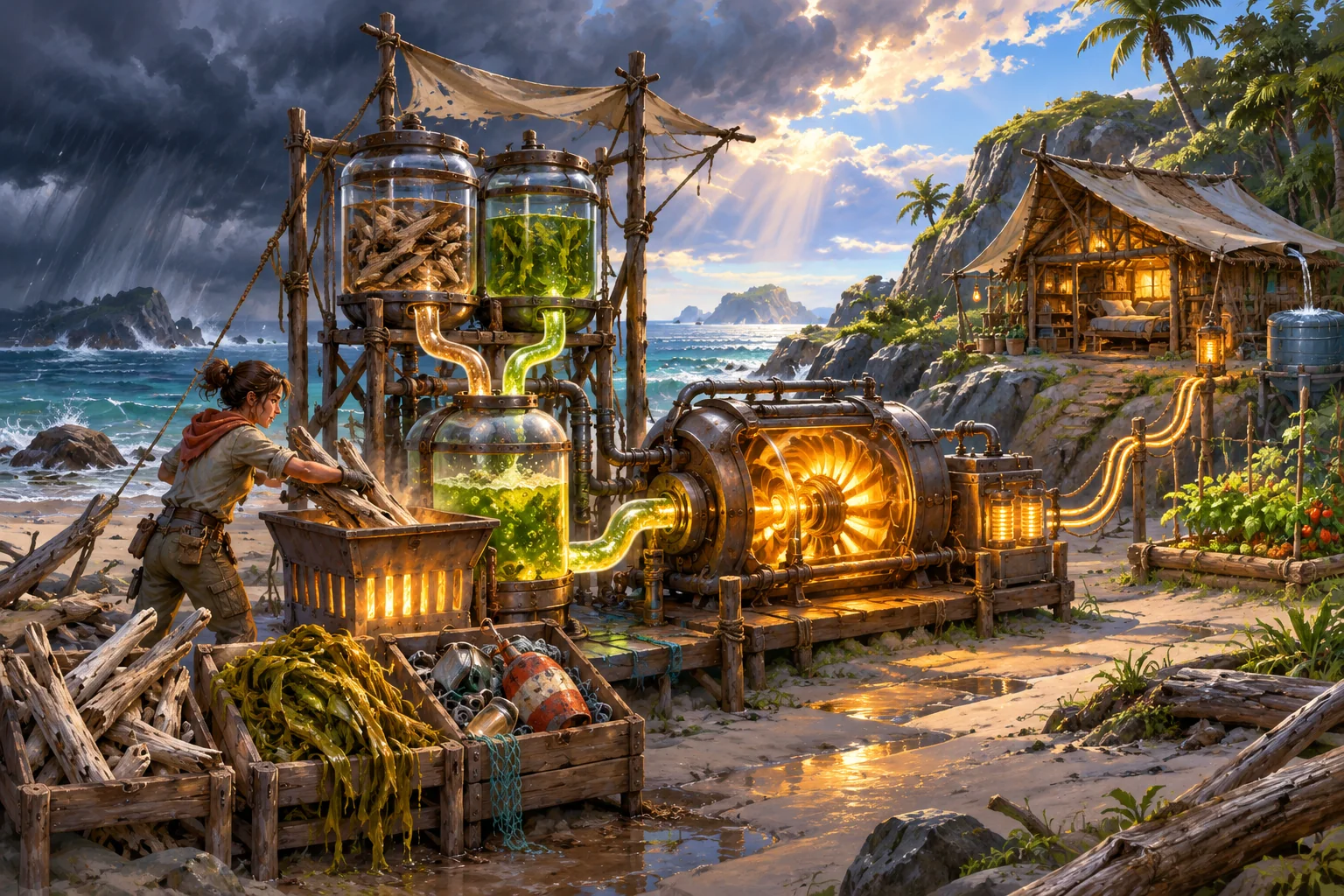
In Tidelight Works, the factory runs on materials recovered from the beach instead of an unlimited mine. After each tide, the player collects driftwood and kelp, then decides what to convert into power and what to keep for shelter repairs. The shoreline budget links energy, crafting and protection to the island’s changing conditions. Recovery is part of the survival loop, not a free supply.
Make shoreline salvage part of the survival loop

Show the tide state, recovered stock, factory demand and repair needs together. Keep the salvage area small enough that one collection trip has a clear result. Set a recovery limit per tide so players cannot repeatedly harvest the same shoreline without waiting. A shelter repair should compete with factory fuel for the same materials, creating a choice with visible consequences.
| Recovered material | Factory use | Survival trade-off |
|---|---|---|
| Driftwood | Combustion input | Keep a plank for shelter repair |
| Kelp | Binding and fuel mix | Reserve some for food or medicine |
| Tide cycle | Restocks a limited amount | Wait or plan before spending |
Let players sort materials before loading the factory. Keep the energy output and remaining repair stock visible. This makes the resource chain understandable and helps prevent a crafting screen from hiding the cost of a decision.
Tune a recipe to the available tide budget
Use a small, fixed example: one tide yields 4 driftwood and 2 kelp, while the factory needs 4 energy for a cycle. The first recipe consumes all 4 wood and 2 kelp but produces only 3 energy, leaving the shelter system short. Revising the recipe to 3 wood plus 2 kelp produces 4 energy and leaves one plank available for repair. The player can power the factory without spending every repair material.

Keep inputs and outputs explicit. Do not let the same tide stock be reused for a second production batch; the local budget must be spent once. If the island can naturally recover material over time, show the next recovery window rather than implying the shoreline is infinite.
Replay the inventory adjustment
The deterministic local check uses the same 4-wood, 2-kelp stock for each recipe. The initial recipe returns 3 energy, below the 4-unit demand. The revised recipe returns exactly 4 and leaves one driftwood. Attempting to run the revised recipe twice fails because the tide budget cannot cover both batches. This tests recipe arithmetic and inventory limits, not ecological recovery or a full factory simulation.
| Case | Initial recipe | Revised recipe |
|---|---|---|
| One tide stock | 4 wood + 2 kelp -> 3 energy | 3 wood + 2 kelp -> 4 energy |
| Factory demand | 4 energy; short by 1 | 4 energy; satisfied |
| Repair material left | 0 wood | 1 wood |
In a playable build, test whether players understand the next tide, can see why power stopped and have a meaningful choice between fuel and shelter. Tune yields and recovery after observing longer runs. The local recipe test cannot establish scarcity or ecological balance.
Start with one tide and one factory
Ask an AI game maker for a small island, one shelter, a salvage beach and a factory with a visible energy need. Start with one tide budget and one recipe. Let players choose between powering the workshop and retaining material for a repair. Add more machines only after the first cycle makes the trade-off clear.
Create Tidelight Works, an island survival prototype with a small factory powered by recovered beach resources. After each tide, let the player salvage up to 4 driftwood and 2 kelp. The factory needs 4 energy per cycle. Use a recipe of 3 driftwood plus 2 kelp for 4 energy, leaving one plank for shelter repair. Materials from a tide can only be spent once. Show tide timing, stock, factory demand and repair needs. Add a safe shelter, a reset and a clear next-recovery indicator. Treat recipes as prototype values, not real ecological data.
Start an island-survival prototype in SEELE
Frequently asked questions
How can a factory run without making island resources unlimited?
Limit each shoreline recovery and show when the next tide restores salvage. Make factory fuel compete with shelter repairs or other needs, so every batch has a cost. A visible stock and recovery timer help players plan without treating the beach as an endless mine.
How do I keep factory energy and shelter repairs in balance?
Use the same recovered materials for both systems and show the remaining repair stock after production. Keep the first recipe small enough to understand. Test whether players can power one factory cycle while preserving material for an essential repair before adding more machines.
What should I test in a recovered-resource prototype?
Check the recipe math, inventory limits, next-tide feedback and whether players understand why a machine stops. A local budget replay verifies a fixed batch. Longer playable runs are needed to judge scarcity, recovery pacing and whether the island feels sustainable.