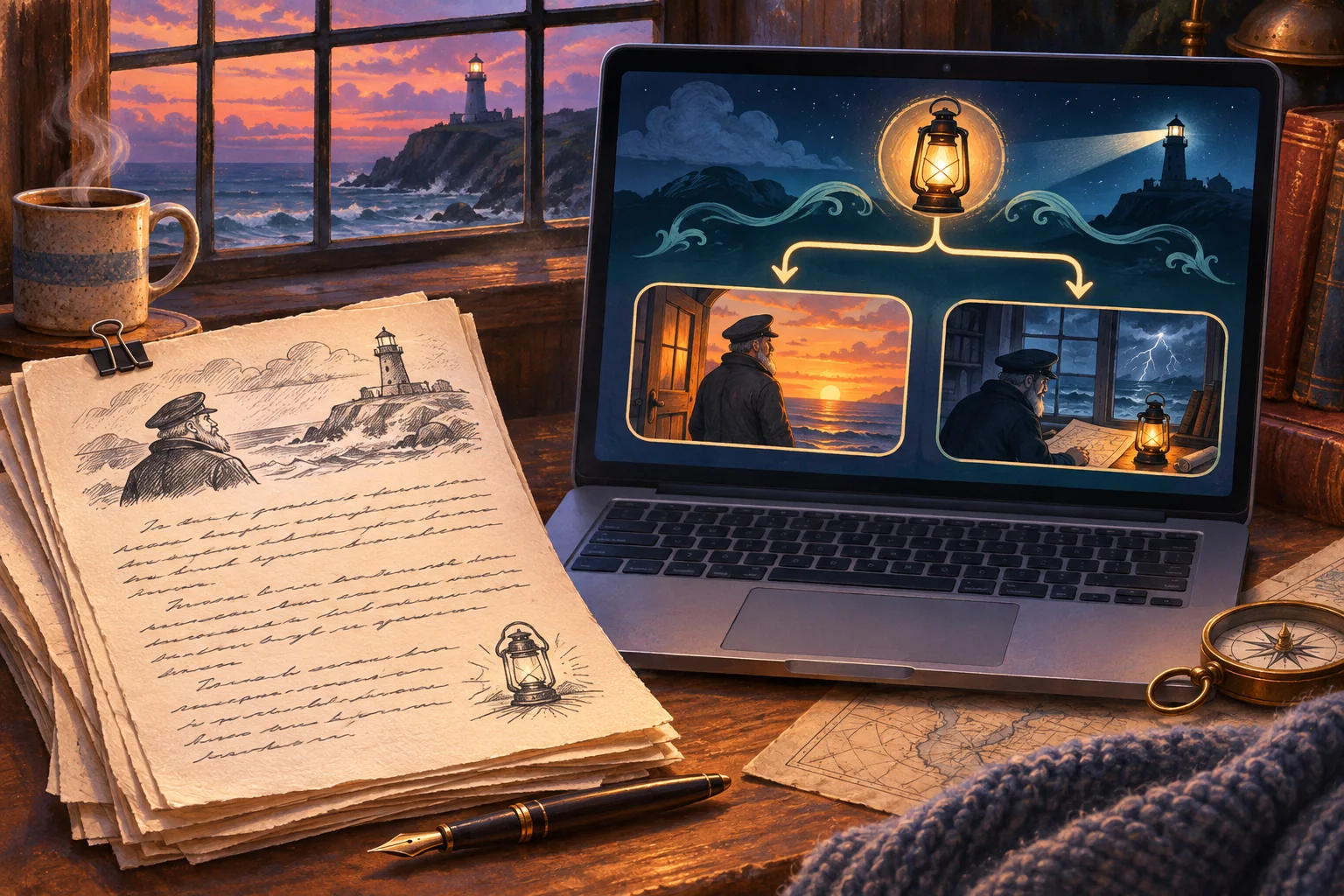
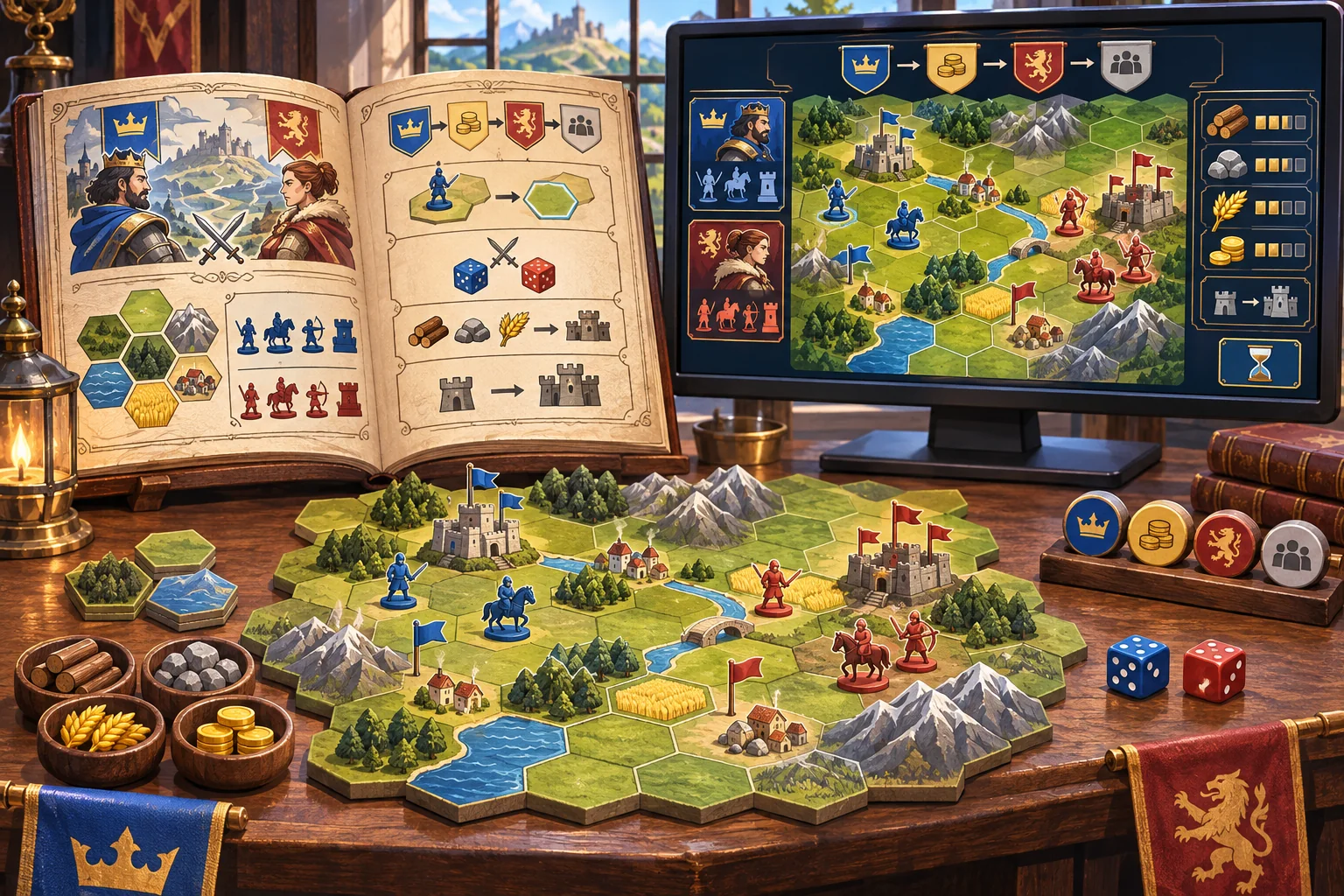
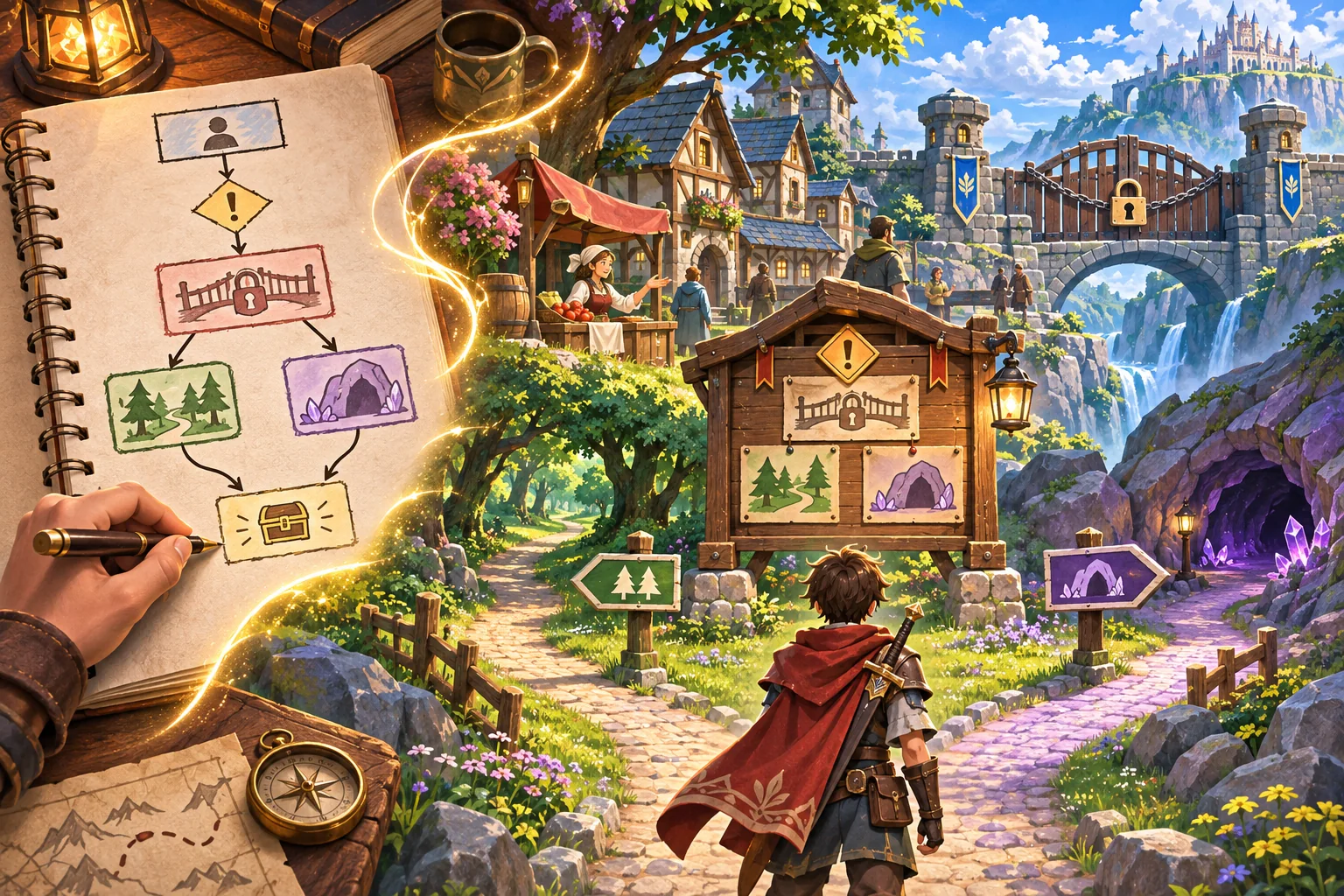
A dialogue script becomes playable when the reader can make choices that change what happens next. A dialogue scripts to narrative game workflow helps writers and developers identify meaningful branches, preserve character voice, and test the story in a running build. AI can help organize a draft, but it cannot approve the adaptation or prove that every path works.
This guide uses Glass Harbor, a fictional mystery about a lighthouse keeper and a missing logbook. The writer, script, characters, branches, game, and outcomes are invented. No dialogue source was provided and no game was built or tested. Treat the example as a planning model, not a real conversion case study.

Start with the script’s dramatic decisions
Read the script and mark moments where a character could ask, refuse, reveal, conceal, or take action. A line break alone is not a choice. A useful branch offers a distinct intent or information path, then gives the player a response that reflects the decision.
For each proposed choice, write down: what the player believes, what they choose, what changes immediately, and whether that change matters later. If nothing changes in dialogue, access, relationship, or ending, consider presenting the line as flavor rather than a choice.
Glass Harbor’s fictional script has the keeper discover a gap in the logbook. One branch asks the dockworker directly; another pretends the missing page was already found. The immediate response differs, while both paths can return to the same storm-warning scene. This shows how a short branch can create expression without doubling the entire script.
Map dialogue before choosing a tool
| Script element | Game representation | Review question |
|---|---|---|
| Scene heading | Node, passage, or knot | Where does the player enter? |
| Dialogue line | Speaker and text output | Does voice match the source? |
| Choice | Visible option and destination | Does the player understand the intent? |
| Consequence | State, access, or response change | What actually changes afterward? |
| Rejoin | Shared scene destination | Is the shared context still coherent? |
| Ending | Terminal state or final passage | Can every path reach a valid close? |
Create a flow map with scene IDs, choices, destinations, state changes, and rejoin points. Keep an authoring copy of the script and a separate implementation draft. Link each game node back to its source section or approved revision so dialogue edits remain traceable.
Use branching and rejoining deliberately
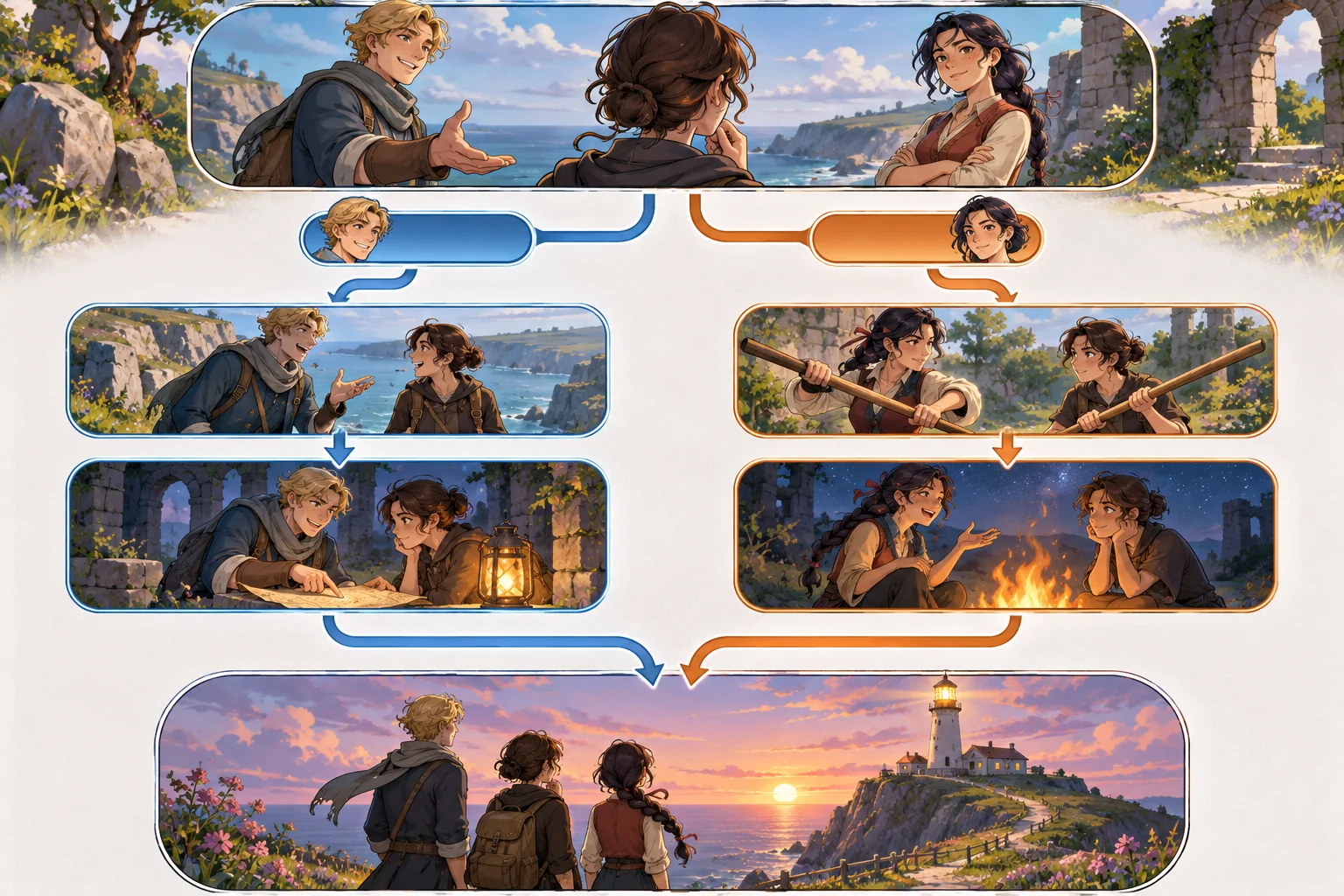
Ink’s documentation describes branching choices and paths that can join again; Ink can also run inside a game through a runtime integration. Twine documents links between passages for published stories. These tools offer different authoring models. Compare platform, state requirements, localization, team familiarity, UI needs, and deployment before choosing.
Use a branch when the choice expresses character, reveals information, changes a relationship, or opens a future possibility. Rejoin paths once the meaningful difference has landed. Keep a persistent variable only when later writing reads it. A decision log can say “the player trusted Mira; later she answers with more detail” rather than setting an unused `trust=1` flag.
Do not promise that an authoring tool will solve every interface or production need. The game still needs a conversation layout, readable text, input handling, save behavior if state persists, and error handling for unavailable content. Prototype the smallest interaction in the target environment before converting a long script.
Track state without losing the story
Make a state table with variable, allowed values, what changes it, where it is read, and when it resets. Prefer clear names such as `has_logbook_page` or `dockworker_trust` over unexplained numbers. If two choices lead to distinct reactions but do not change any later event, keep them as local choice text and let the flow rejoin.
Test combinations, not just single flags. If a player can collect a clue and alienate a character, decide how those conditions combine. Avoid contradictory lines caused by a state that was never initialized. Define a default route for missing or invalid data and verify that saved state survives the expected transitions.
Keep an author-facing outline of all states and their downstream use. If no scene reads a variable, remove it or give it a documented purpose. A compact state model is easier for writers to revise and for developers to test.
Use AI as a script assistant
AI can suggest branch points, summarize a scene, generate alternate phrasings, or identify continuity questions. Give it the approved character notes, intended consequence, and tone constraints. Ask it to flag uncertainty rather than invent canon. Compare every proposed line with the source and get approval from the writer or rights holder responsible for the material.
Source scene: [approved passage ID]
Character voice: [short approved notes]
Player choice: [what the player decides]
Consequence: [immediate and later effect]
Rejoin point: [shared scene or none]
State changed: [name, values, readers]
Ask: propose a branch outline and list continuity risks.
Do not change canon, invent approval, or claim the branch was tested.
Do not send confidential scripts or unreleased story content to a service unless the project’s policy and agreements allow it. Keep a revision record showing which AI drafts were reviewed, edited, or rejected. The final dialogue remains an editorial decision.
Build the smallest playable slice
Choose one scene with a choice, a consequence, a rejoin, and a close. Connect the narrative runtime to a simple UI that shows speaker, dialogue, and available choices. Add a clear way to advance, select, and return if the interaction supports it. Verify keyboard or controller input in the target build.
Use placeholder visuals only when their status is clear. Make sure text fits the actual display, long names wrap correctly, and choices remain distinct. Test no-choice, one-choice, conditional-choice, and terminal states. If the game supports saved progress, test both a fresh start and a resumed session.
Play through the slice inside the game, not only in a flowchart or editor preview. Confirm that audio, portraits, localization, and UI timing do not obscure the writing. A path that compiles can still feel confusing or break in the interface.
Test every reachable route
- Can a player understand the choices before selecting?
- Does each option lead to the intended scene or state?
- Do branches rejoin without contradictory context?
- Can every reachable path reach a valid ending or continue point?
- Are conditional choices visible only when their requirements are met?
- Does state persist or reset at the intended times?
- Do writer-approved lines match the source revision?
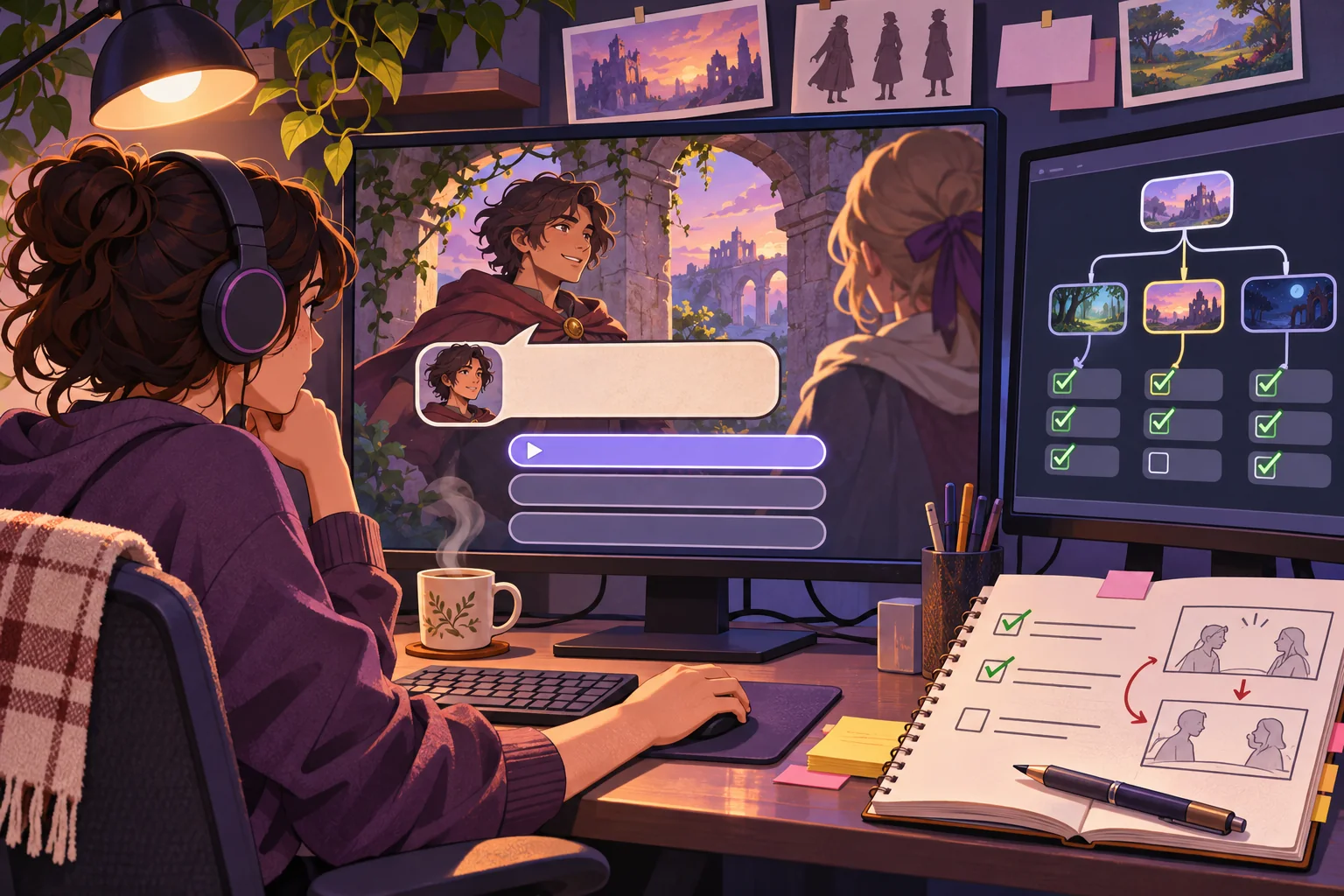
Keep a path checklist with scene IDs, conditions, expected result, observed result, build version, and defect notes. Automated checks can find unreachable nodes or missing labels, but human review should also evaluate character voice and emotional continuity. Record which paths you did not test rather than implying full coverage.
Keep the transformation reviewable
Package the approved script, flow map, state table, compiled or exported story, runtime build, and change log. Document who approved the adapted lines and which source version was used. Credit co-writers and collaborators accurately. If the project uses source material that is not yours, confirm the right to adapt and distribute it for the intended game and platform.
Glass Harbor has no source script, implementation, or playtest. For a real project, preserve an approved before-and-after sample and a tested build so readers can see what changed and verify the result.
Frequently asked questions
How do I turn a dialogue script into a game?
Identify choices, consequences, state changes, and scenes where paths can rejoin. Convert each interaction into a flow map, then implement the smallest playable branch. Keep the original script, adapted draft, and playable revision connected so edits remain traceable. Include a scene ID and writer approval note for each adapted passage.
Can AI convert a script into branching dialogue?
AI can propose branch points, summarize character state, and draft alternate responses. It may change a character's voice, invent continuity, or create choices that do not affect the story. Review every line against the approved script and test the compiled flow in the target runtime.
Which tool should I use for interactive dialogue?
Choose a tool that fits your project and team. Ink supports branching narrative scripts and can be integrated with a game runtime; Twine uses links between passages for browser-based stories. Compare target platform, state needs, localization, team workflow, and technical support before committing.
How do I keep choices from multiplying the script?
Let branches rejoin when the narrative consequence has been expressed, reserve persistent state for choices that matter later, and reuse shared scenes when appropriate. Track the state each choice changes and remove variables that do not alter later text, access, or ending.
How do I test every dialogue branch?
Compile the script, walk each reachable choice path, verify conditions and rejoin points, then test the dialogue inside the game interface. Record story version, build, paths checked, and defects. A diagram or AI review cannot replace runtime testing. Include alternate conditions and all terminal states in the review checklist.
Need a structured start for a branching narrative prototype? Explore the AI game creation workflow and map it to your approved script.