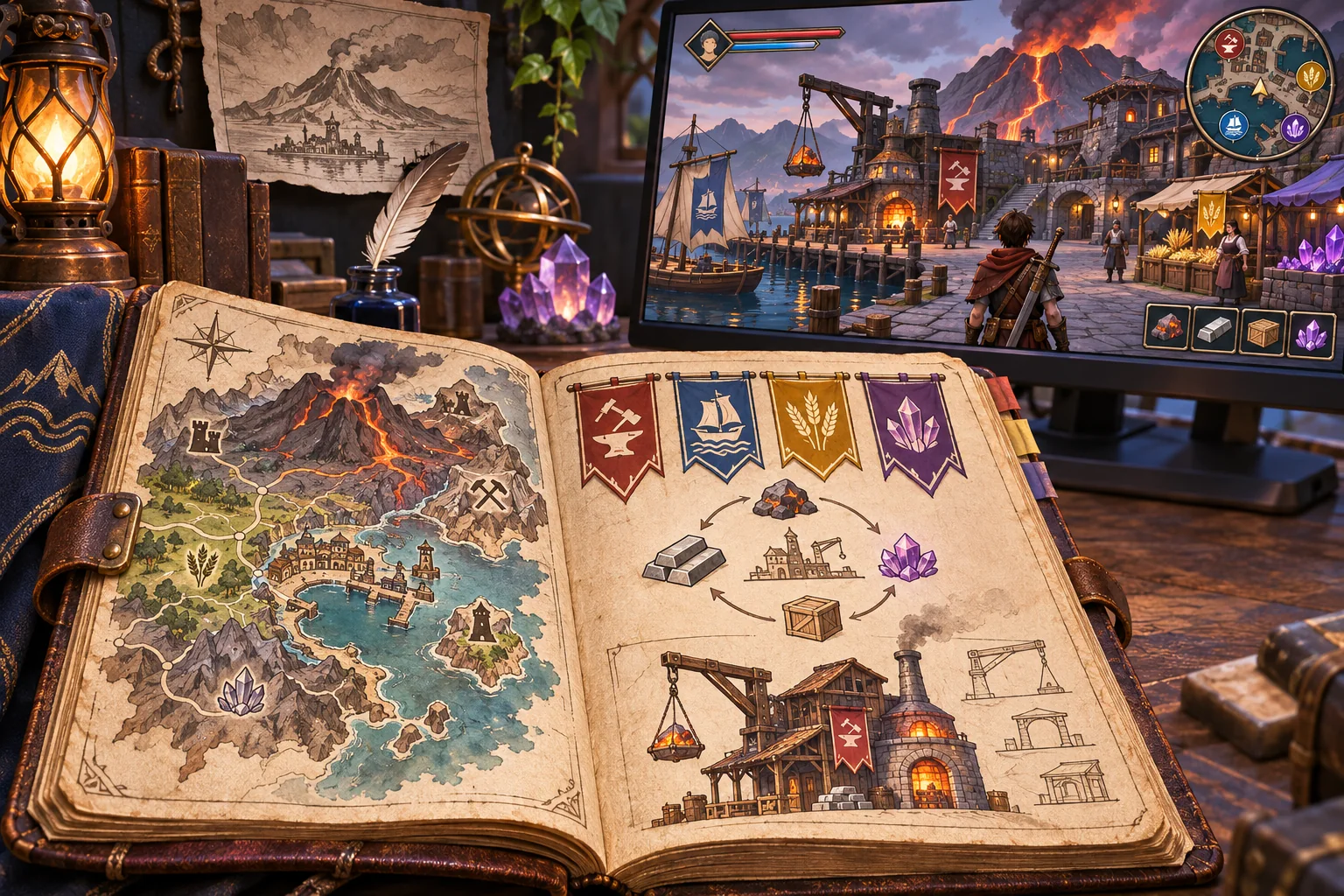
A paper strategy game already has a rules system, but the rulebook is not the same thing as a digital implementation. Players can negotiate ambiguous timing at the table; software needs explicit state, legal actions, turn order, and resolution. The first goal is not to recreate every component. It is to implement one complete round and confirm that the game behaves as its designer intends.
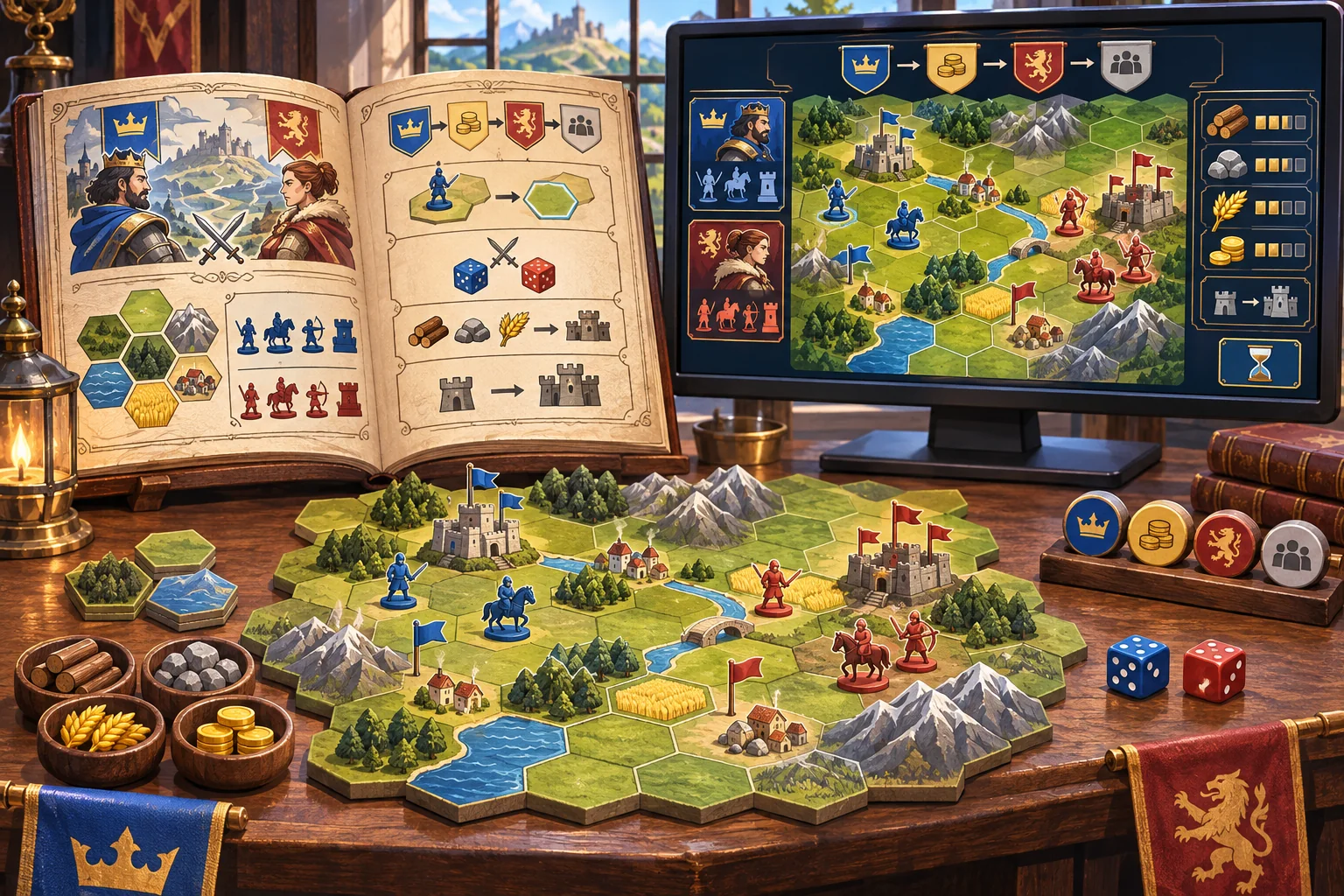
This guide uses Ember Council, a fictional hex-board strategy game, only as an illustration. Its rules, pieces, players, decisions, and outcomes are invented; no rulebook or build was supplied. Godot documentation below supports engine-specific data and UI statements, not proof that the hypothetical strategy game works.
Capture the source rules and settle ambiguity
Keep the approved rulebook, designer, revision, component list, and adaptation permissions together. Transcribe rules into sections: setup, player objective, turn structure, actions, resources, combat or contest resolution, end-of-round effects, and end conditions. Mark examples and exceptions separately so the implementation does not confuse a teaching illustration with a universal rule.
Some tabletop rules rely on custom or verbal convention. Create an ambiguity log with the original wording, interpretations, owner decision, and a worked example. Do not silently choose the easiest interpretation to code. Ask the designer to approve the ruling, then add a repeatable test case for that exact situation.
For Ember Council, imagine a player can move one unit, spend one influence token, and claim a territory only if no rival guard is present. These fictional rules are enough for an example turn. Do not add hidden modifiers, simultaneous orders, or alliance rules until the core resolution is clear.
Model game state before building screens
List the values that define the board: spaces, ownership, units, resources, player turn, available actions, and any temporary effects. Define which actions can change each value and what must always remain true. For instance, a territory can have one owner, a unit can occupy only one space, and a resource balance cannot become negative unless the rules explicitly permit debt.
Represent rules as data where that helps the team review and revise them. Godot Resources can store serializable data containers that may be nested and saved on disk. Use a clear separation between rule definitions, current match state, and visual representation. Signals can let interface or board nodes respond to events without referencing every system directly, but keep one clear owner for action validation and state changes.
Implement one complete turn
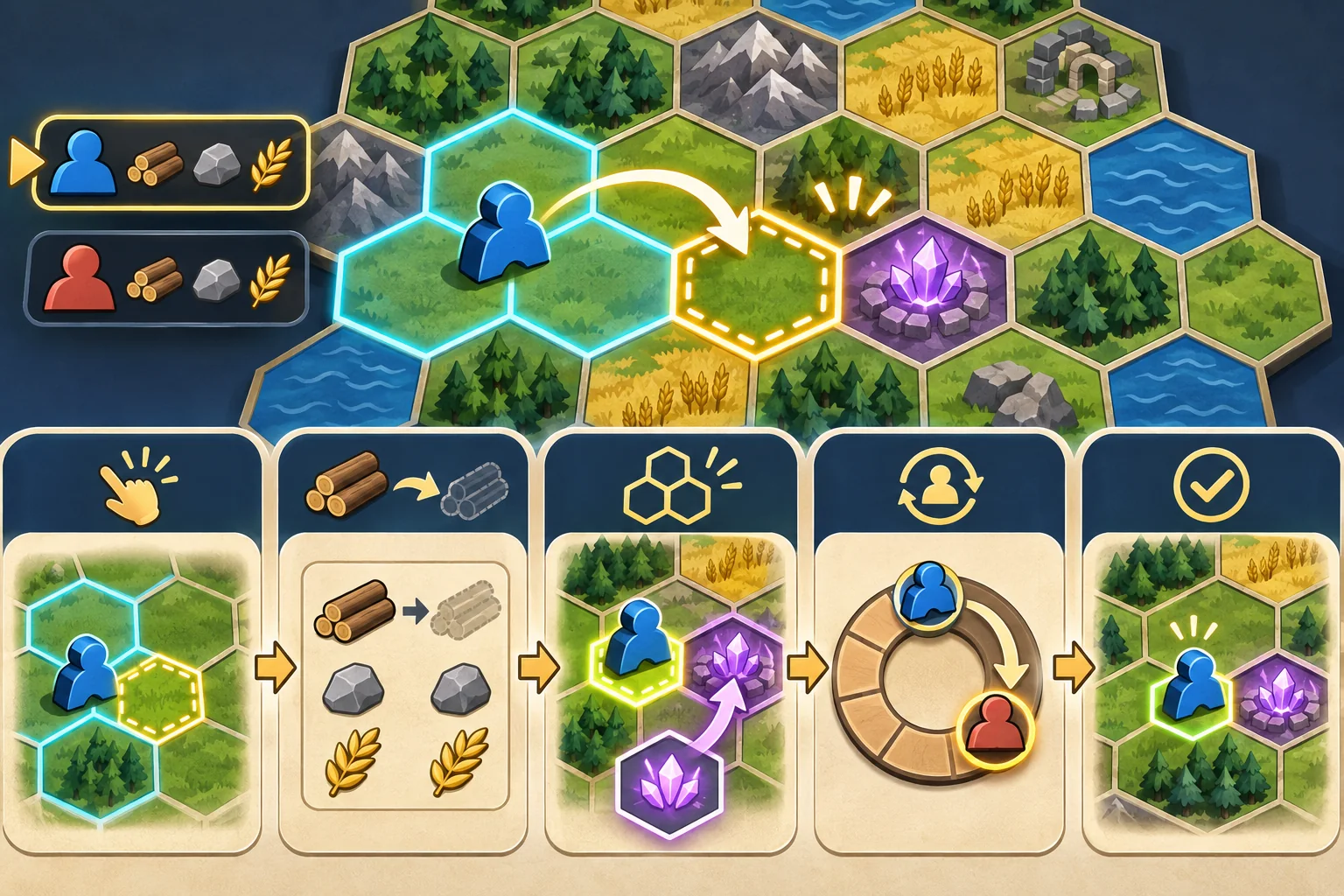
Build the sequence from setup to a finished turn: show the active player, display legal actions, accept one action, validate its preconditions, resolve the effect, update resources and board ownership, run end-of-turn rules, and pass control. Keep the first test board small. A few spaces and pieces can reveal a broken rule faster than a full map populated with art.
Make illegal actions understandable. If a move fails, show the relevant rule: occupied space, insufficient resources, wrong phase, or invalid target. Provide a way to cancel before confirmation if the action is reversible only through explicit undo. Do not let a flashy animation hide a mismatch between what the player selected and what the rules executed.
Godot uses Control nodes for interface content and layout. A strategy screen might use controls for actions, status, and tooltips alongside a separate board scene. The exact UI architecture is a project choice. Ensure that mouse, keyboard, controller, or touch inputs all trigger the same validated action path.
Automate bookkeeping without hiding decisions
Software can resolve repeated calculations, movement limits, resource totals, and victory checks consistently. It should also show enough feedback for players to understand what changed. Animate a unit moving, then update the ownership marker and resource count. If a phase triggers several effects, summarize the order or let the player inspect the log.
Retain the decisions that make the board game strategic. If a digital shortcut makes an important resource automatic, confirm that players still have meaningful control. Do not turn every table convention into a menu click. Let players see the state, compare options, and understand the cost of an action.
Test edge cases and compare with the rulebook
Create test cases for ordinary moves and boundary conditions: no valid actions, a tie, simultaneous end conditions, a player reaching zero resources, a last-turn effect, or a target becoming occupied before resolution. Run each case against the approved interpretation and record expected and actual state. Add regression examples when a rule is changed.

Then ask someone unfamiliar with the implementation to play a round. Observe where they expect different feedback or cannot tell which action is legal. Their confusion may reveal a UI issue, a rule ambiguity, or both. Keep the rulebook revision, build identifier, test setup, and observed outcome together.
Paper-to-digital checklist
- Record source permissions, designer decisions, and rulebook revision.
- Transcribe components, state, turn order, actions, and victory conditions.
- Resolve ambiguous wording with the rules owner before coding.
- Implement one complete turn on a small board.
- Validate all action preconditions in one rules path.
- Show state changes and explain why actions are unavailable.
- Test boundary cases and compare every result to the approved rule.
A tabletop strategy game becomes digital when its rules have explicit state and every action resolves consistently. Start with one round, preserve the designer’s decisions, and test the edge cases before expanding maps and content. For more production guidance, browse the resource library.
Frequently asked questions
How do I turn paper board-game rules into a digital strategy game?
Transcribe components, player actions, phases, resources, victory conditions, and edge cases into a state model before building the interface. Implement one complete turn with a small map and a few meaningful actions. Compare the digital result with the written rulebook, then test cases such as invalid moves, ties, and end-of-turn effects.
Can AI turn board-game rules into a playable strategy game?
AI can help outline rule sections, list possible edge cases, or draft test scenarios. It cannot resolve ambiguous wording on behalf of the designer or prove the implementation matches the game’s intent. Keep the approved rulebook authoritative, record interpretations, and verify every action through executable tests and play sessions.
What should I digitize first from a board-game rulebook?
Start with the game state and one full turn: board spaces, players, pieces, resources, legal actions, turn order, and win or loss checks. Delay extra modes, tutorials, and elaborate visuals. This small slice shows whether the rules can be represented consistently before you build menus or add more content.
How do I handle ambiguous board-game rules in code?
List each ambiguity with the relevant rule text, possible interpretations, and the designer-approved ruling. Implement only after the owner confirms the intended behavior. Add an example turn or test case for the ruling so future changes do not silently reinterpret it.
What makes a digital strategy game feel different from its paper version?
Digital automation can remove bookkeeping, show legal moves, and resolve effects consistently, while also changing the pace and information available to players. Preserve decisions that make the original game interesting, and make automated consequences visible. Test whether players understand why an action succeeded, failed, or changed the board.