
What Famous Games Use AI Generated Content: Real Examples and How We Build Them
 SEELE team
• February 07, 2026
SEELE team
• February 07, 2026
Discover how AI-generated assets are transforming game development with faster production, lower costs, and professional quality. See real game examples and learn practical implementation strategies.
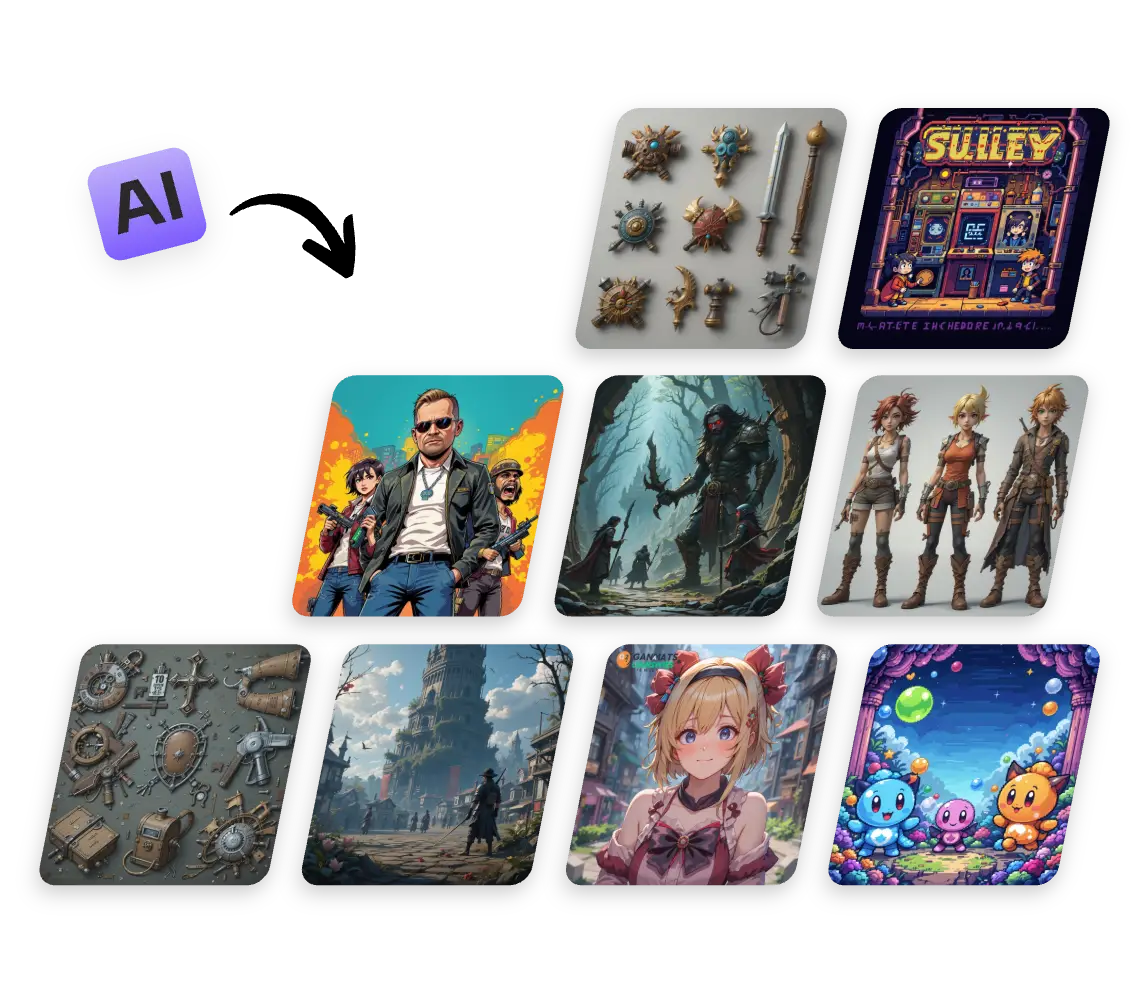
What are AI-generated assets? Game elements (characters, environments, textures, sprites, animations) created using AI models from text prompts or images, rather than manual design. Generation time: 5-60 seconds versus hours/days of traditional work.
How does AI asset generation work? - Text-to-Image models: Convert text descriptions to 2D sprites/textures - Text-to-3D systems: Generate 3D models with geometry, UV maps, PBR textures - Style transfer: Maintain visual consistency across multiple assets - Procedural systems: Create variations while preserving design constraints
Technical specifications: - 2D sprite generation: 5-10 seconds (16x16 to 4K resolution) - 3D model generation: 30-60 seconds (1K-300K triangles) - Sprite sheets: 15-30 seconds with animation frames - Auto-rigging: Included for humanoid/quadruped characters
Production advantages: - Speed: 100-1000x faster than manual creation - Cost: $0.10-1.00/asset vs. $50-150/hour artist rates - Iteration: Test multiple art styles same day - Consistency: Automated style matching across asset libraries
Real-world implementations: Games using AI assets include indie projects from Rosebud PixelVibe jams (Shattered Ground, Gastronomy, Detective Dragon), mobile puzzle games, and AAA background elements. Platforms like SEELE generate complete 2D games in 2-5 minutes, 3D games in 2-10 minutes.
Key technical capabilities: - Sprite sheet generation with walk/run/attack cycles - PBR texture generation (diffuse, roughness, metallic, normal maps) - Automatic UV unwrapping and topology optimization - LOD generation for performance scaling - 5,000,000+ animation presets library
Integration best practices: 1. Technical validation: Check polygon counts, texture resolution, UV mapping 2. Hybrid approach: AI for foundation (80-90%), artists for polish 3. Style consistency: Use reference images to maintain visual coherence 4. Quality control: Review, test performance, refine as needed
License considerations: Review platform terms for commercial usage rights, training data ethics, and derivative work policies. SEELE Pro plans grant full commercial rights to generated assets.
AI-generated assets are game elements—characters, environments, textures, sprites, animations, and sound effects—created using artificial intelligence models instead of being manually designed by artists. These assets are generated from text prompts, reference images, or procedural parameters, dramatically reducing production time while maintaining professional quality.
The technology uses machine learning models trained on vast datasets of game art, allowing developers to specify what they need in natural language and receive production-ready assets in minutes. From 2D pixel art sprites to fully-textured 3D models, AI asset generation now covers nearly every aspect of game development.
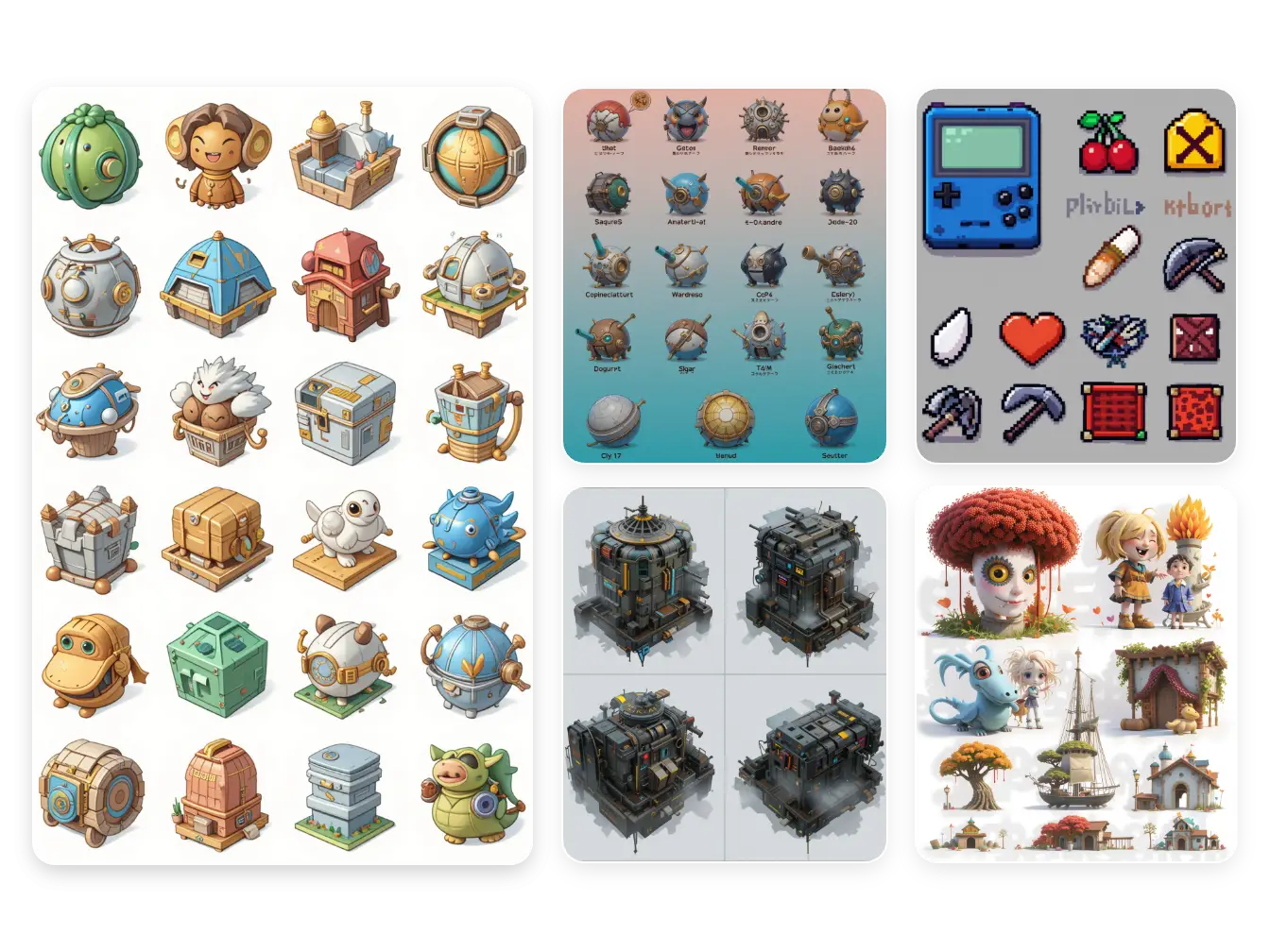
AI asset generation relies on several key technologies working together:
Text-to-Image Models analyze text descriptions and generate 2D visuals matching the prompt. These models understand artistic styles, composition, and game art conventions, producing sprites, textures, UI elements, and concept art from simple descriptions like "cyberpunk merchant character, pixel art, 32x32."
Text-to-3D Systems convert descriptions into three-dimensional models with proper geometry, UV mapping, and textures. Advanced systems can generate rigged characters ready for animation, complete with skeletal structures and skinning weights.
Style Transfer Networks maintain visual consistency across multiple assets by applying a reference style to newly generated content. This ensures characters, props, and environments share the same artistic direction—critical for cohesive game worlds.
Procedural Generation combines AI with rule-based systems to create variations while maintaining design constraints. Generate 50 unique enemy variants from a single base design, each with different colors, accessories, and stats.
graph TD
    A[Text Prompt] -->|NLP Analysis| B(AI Generation Model)
    B -->|2D Path| C[Sprite/Texture Generator]
    B -->|3D Path| D[3D Model Generator]
    C --> E{Post-Processing}
    D --> F[Auto-Rigging & UV Mapping]
    F --> E
    E --> G[Game-Ready Asset]
    G -->|Export| H[Unity/Three.js/Unreal]
The entire process—from prompt to game-ready asset—now takes seconds to minutes rather than hours or days of manual work.
What previously required days of manual modeling, texturing, and iteration now happens in minutes. In our testing at SEELE, generating a complete 3D character with textures takes 30-60 seconds versus 8-12 hours of traditional modeling. For 2D sprites, generation time drops from 2-3 hours to 5-10 seconds.
This speed advantage compounds across production. A game requiring 100 unique NPCs would traditionally need weeks of artist time. With AI generation, the same variety is achieved in hours, allowing teams to focus on gameplay mechanics and narrative.
Hiring professional 3D artists costs $50-150/hour. AI asset generation platforms operate on subscription models ($20-50/month) or per-asset pricing ($0.10-1.00/asset). For indie developers working with limited budgets, this 10-100x cost reduction makes ambitious projects feasible.
Small teams can now produce asset libraries that rival larger studios, leveling the competitive playing field without compromising visual quality.
Game design is inherently iterative. Testing different art styles, character designs, or environmental themes traditionally requires significant artist time for each variation. AI generation enables instant visual exploration.
Try a low-poly aesthetic, then switch to realistic textures, then test a cel-shaded approach—all within the same day. This rapid iteration helps teams find their visual identity faster and make better-informed artistic decisions before committing to final production.
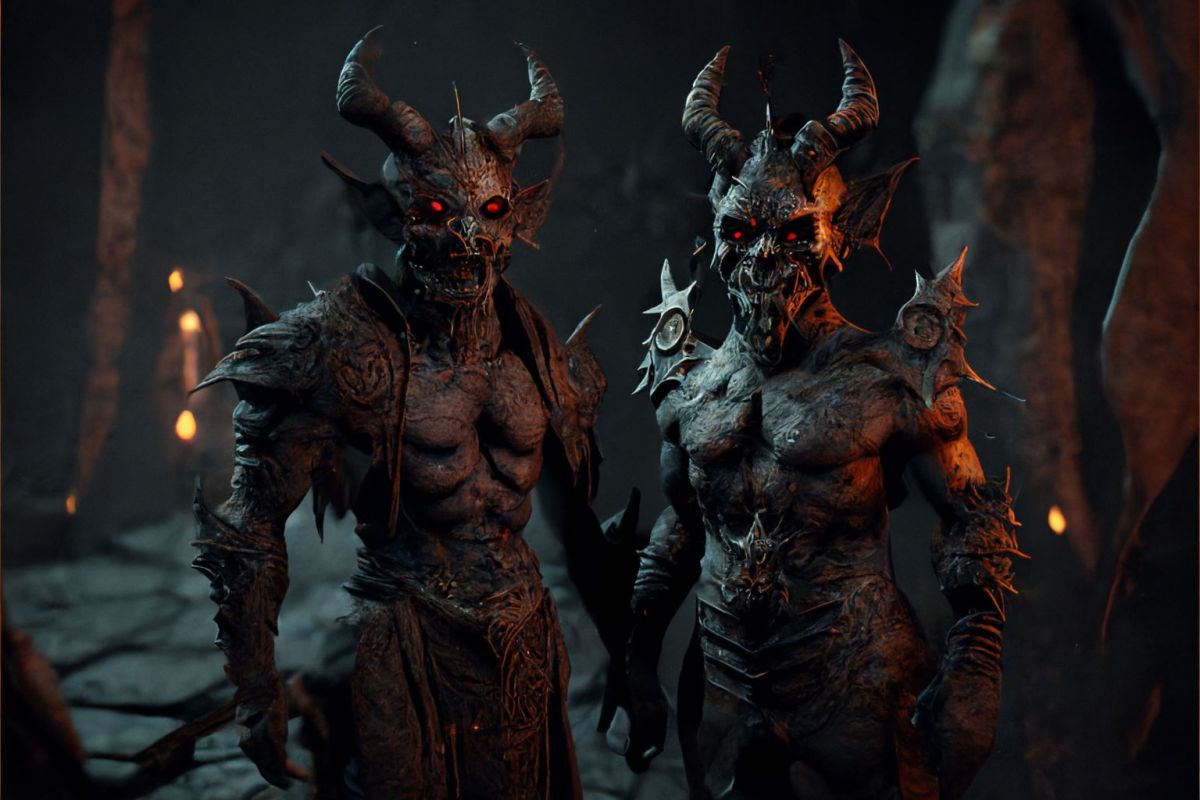
Maintaining visual consistency across hundreds of assets is challenging, especially when multiple artists contribute to a project. AI models trained on consistent style references produce assets that naturally share the same artistic language.
Define your visual style once through reference images and style parameters, then generate unlimited assets matching that aesthetic. Every character, prop, and environment maintains cohesive color palettes, detail levels, and artistic conventions.
The game development industry has already seen numerous successful titles leverage AI-generated assets, proving the technology's viability in production environments.
Many game jams and indie projects have demonstrated AI asset generation's potential. Platforms like Rosebud's PixelVibe hosted competitions where developers created complete games using only AI-generated assets within tight timeframes.
Projects like Shattered Ground (top-down shooter with AI-generated characters and projectiles), Gastronomy (space exploration game with procedurally generated crew members), and Detective Dragon (point-and-click adventure with AI-generated items) showcase how solo developers can produce polished games in days rather than months.
These projects prove that AI-generated assets aren't just placeholders—they're production-quality elements capable of carrying complete game experiences.
AAA studios increasingly incorporate AI generation into their pipelines, though often for background elements and asset variations rather than hero characters. AI-generated textures, environment details, and procedural props now appear in major releases, reducing production costs while maintaining quality standards.
The technology particularly shines in creating asset variety: generating 50 unique storefronts for an open-world city, creating hundreds of weapon variations with consistent style, or populating vast environments with diverse foliage without manual placement.
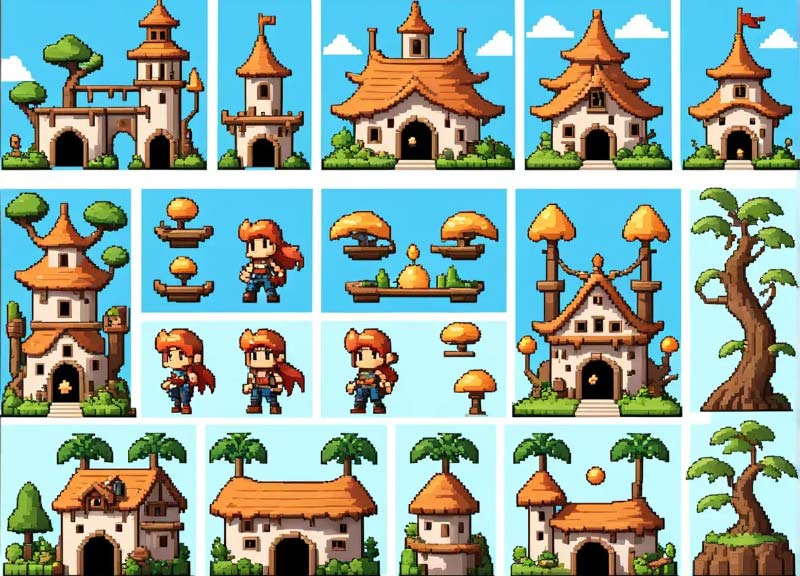
The mobile gaming sector has rapidly adopted AI asset generation due to faster production cycles and cost sensitivity. Puzzle games, match-3 titles, and idle games frequently use AI-generated UI elements, icons, backgrounds, and character portraits.
The technology enables small mobile studios to compete visually with larger publishers, creating vibrant, distinctive art styles without extensive art teams.
SEELE's multimodal AI platform provides end-to-end game development capabilities, including advanced asset generation for both 2D and 3D games. Here's how we approach asset creation in our workflow:
Sprite Creation : Generate character sprites, enemies, NPCs, and items from text descriptions. SEELE's AI produces sprites in any resolution from 16x16 pixel art to high-resolution 4K game art. Specify style parameters like "pixel art," "hand-drawn," "anime style," or "realistic" to match your game's aesthetic.
Prompt: "Female warrior character, pixel art, 32x32, side view, blue armor"
Generation time: 5-10 seconds
Output: Transparent PNG sprite ready for game engine
Sprite Sheet Generation : Beyond single sprites, SEELE automatically creates sprite sheets with multiple animation frames. Generate walk cycles, attack animations, idle poses, and death sequences as unified sprite sheets with consistent character appearance across all frames.
Our sprite sheet generator produces:
- Walk cycles (4-8 frames)
- Run animations (4-8 frames)
- Attack sequences (3-6 frames)
- Jump animations (3-5 frames)
- Transparent PNG format
- Customizable frame counts and layouts
Textures and Backgrounds : Generate seamless textures for tilesets, UI elements, parallax backgrounds, and environmental details. SEELE's texture generation ensures proper tiling without visible seams, critical for repeating game elements.
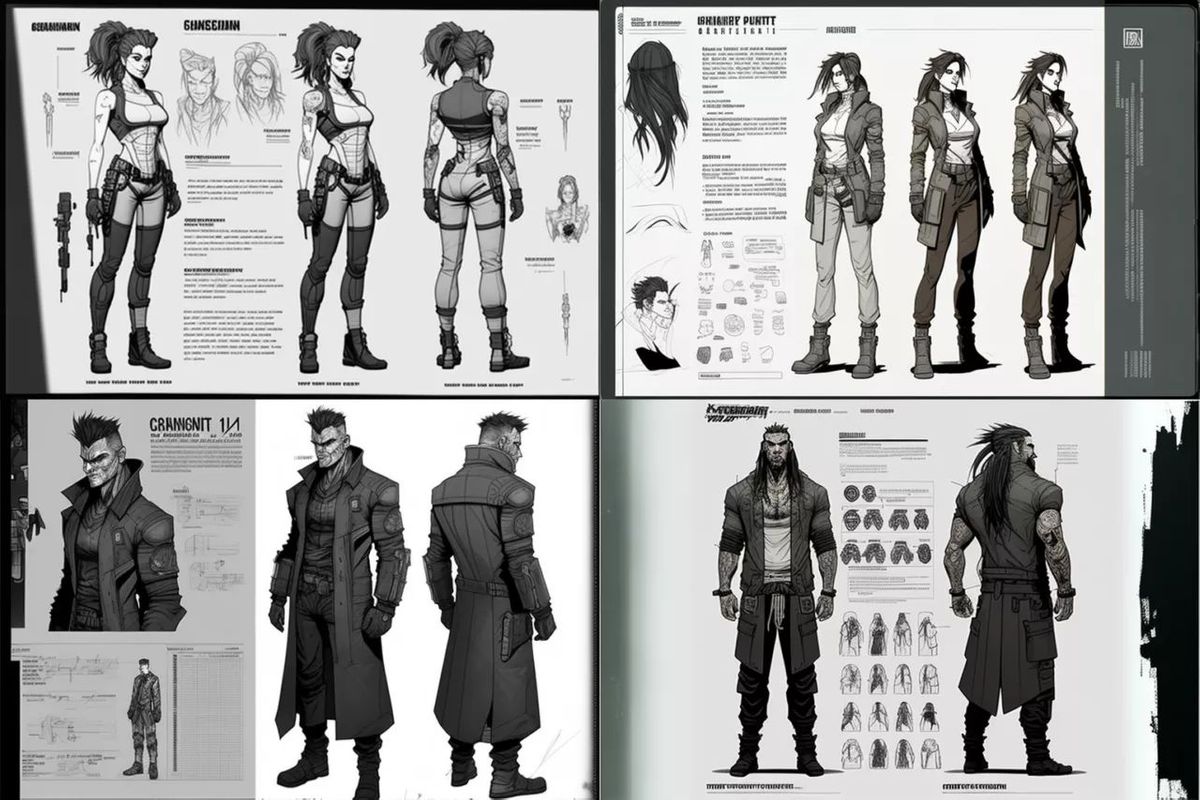
Text-to-3D Models : Describe any game object in natural language and receive a complete 3D model. SEELE generates geometry, UV maps, and PBR textures (diffuse, roughness, metallic, normal maps) automatically.
Prompt: "Medieval wooden barrel, game-ready, low poly, 2K textures"
Generation time: 30-60 seconds
Output: FBX/glTF model with textures, 1000-5000 triangles
Auto-Rigging and Animation : Character models generated through SEELE include automatic skeletal rigging for humanoid, quadruped, and custom bone structures. Our system applies skinning weights and makes characters immediately ready for animation.
Access our library of 5,000,000+ pre-built animation presets: - Locomotion (walk, run, jump, crouch) - Combat (sword attacks, spellcasting, shooting) - Interaction (picking up items, opening doors, climbing) - Custom animation blending
Mesh Optimization : SEELE automatically optimizes generated 3D models for game engine performance through topology cleanup, polygon reduction, and LOD (Level of Detail) generation. Export models at different quality tiers for various platforms.
One challenge in AI asset generation is maintaining consistent visual style across multiple assets. SEELE addresses this through:
Style Reference System : Upload reference images of your desired art style. All subsequently generated assets will match that aesthetic, ensuring characters, props, and environments share visual coherence.
Asset Collections : Generate multiple related assets in a single batch with guaranteed style consistency. Create a complete fantasy village with buildings, props, NPCs, and environment elements that naturally belong together.
Iterative Refinement : Start with a generated asset, then use natural language to refine specific details. "Make the character's armor darker," "add more weathering to the texture," or "increase polygon count for smoother curves." Each iteration maintains the core design while applying requested changes.
Successfully incorporating AI-generated assets into your game requires thoughtful workflow integration and quality standards.
Not every AI-generated asset is perfect on the first attempt. Establish quality standards and review processes:
Technical Validation : Check polygon counts (are they game-engine appropriate?), texture resolution (do they match your quality targets?), and UV mapping quality (are there distortions or wasted texture space?).
Visual Consistency Check : Compare new assets against existing game art. Do colors match your palette? Does the detail level align with other assets? Are proportions consistent with your game's scale?
Performance Testing : Import assets into your game engine and measure performance impact. Test draw calls, memory usage, and rendering performance on target platforms.
When assets need adjustment, use your game engine's tools or 3D software for final polishing. AI generation handles 80-90% of the work; human refinement ensures production quality.
The most effective approach often blends AI generation with traditional art techniques:
AI for Foundation, Artists for Polish : Generate base models and textures with AI, then have artists add unique details, special effects, and final polish. This hybrid approach maximizes speed while maintaining artistic control.
AI for Variations, Manual for Heroes : Use AI to generate background NPCs, environmental props, and enemy variants. Create hero characters, key locations, and narrative moments through traditional methods. This allocates artist time where it matters most.
Procedural Variety from Hand-Crafted Templates : Design a few exemplar assets manually, then use AI to generate style-consistent variations. One hand-crafted character design becomes 50 unique NPCs; one modeled building becomes an entire city district.
AI-generated assets raise important questions about copyright, licensing, and creative ethics:
Licensing Terms : Review your AI platform's license agreements. Do you own generated assets? Can you use them commercially? What restrictions apply? SEELE's commercial licensing grants full rights to assets generated under Pro plans.
Training Data Ethics : Consider how AI models were trained. Were artists compensated? Was copyrighted material used appropriately? Choose platforms with ethical training practices and transparent data sourcing.
Disclosure Standards : Some game storefronts and communities expect disclosure when AI-generated assets are used. Be transparent about your development process and asset sources to maintain player trust.
Derivative Works : If using AI to generate variations of existing game art or designs, ensure you have rights to the source material and that outputs don't infringe on other creators' work.
AI asset generation represents just the beginning of AI's transformation of game development. Emerging trends point toward even deeper integration:
Future games may generate assets during gameplay rather than storing them in advance. Procedurally generated worlds with AI-created assets could offer infinite variety, unique experiences for every player, and dramatically reduced game file sizes.
SEELE's world model capabilities explore this frontier, enabling games to generate environments, characters, and stories dynamically based on player actions and preferences.
Beyond individual assets, AI increasingly handles higher-level game development tasks:
Code Generation : Platforms like SEELE generate Unity C# scripts and Three.js JavaScript code from natural language descriptions, translating game logic requirements into working code.
Dialogue and Narrative : AI-powered NPC dialogue systems create contextually appropriate conversations, quest structures, and branching narratives that respond to player choices.
Audio Generation : Background music, sound effects, and voice acting generated on-demand, perfectly matched to gameplay moments and emotional beats.
Complete Game Generation : The ultimate vision is text-to-game creation—describe your game idea in natural language and receive a playable prototype in minutes. SEELE's multimodal AI combines asset generation, code generation, audio creation, and game logic to make this vision real.
From our testing, SEELE generates playable 2D game prototypes in 2-5 minutes and 3D games in 2-10 minutes, compared to weeks or months of traditional development. This 1000x speed increase fundamentally changes what's possible for small teams and individual creators.
As AI tools mature, game development becomes accessible to non-programmers and artists. Creating games shifts from requiring specialized technical skills to articulating creative vision. This democratization will unlock game ideas from millions of creators who previously lacked the technical means to realize their concepts.
Educational institutions, hobbyists, and creators from non-technical backgrounds can now participate in game development, enriching the industry with diverse perspectives and novel ideas.
AI-generated assets have evolved from experimental novelty to production-ready tools transforming game development. The technology now generates professional-quality 2D sprites, 3D models, textures, and animations in seconds—speed and cost advantages that empower indie developers, accelerate AAA pipelines, and enable entirely new approaches to game creation.
Games like those showcased in Rosebud's PixelVibe jams demonstrate AI assets' viability in complete projects. Platforms like SEELE take the concept further, integrating asset generation with code generation, animation systems, and multimodal AI capabilities to provide end-to-end game development solutions.
The future of game development increasingly blends human creativity with AI efficiency. Artists and developers who master AI-assisted workflows gain tremendous competitive advantages: faster iteration, lower costs, and the ability to realize ambitious visions previously beyond reach.
Whether you're an indie developer prototyping your first game, a student learning game design, or a studio looking to accelerate production, AI-generated assets offer practical tools to bring your creative vision to life faster and more affordably than ever before.
Start exploring AI asset generation today—your next game's art style is just a prompt away.
 SEELE team
• February 07, 2026
SEELE team
• February 07, 2026
SEELE team
• February 07, 2026
SEELE team
• February 07, 2026
SEELE team
• February 07, 2026
SEELE team
• February 07, 2026