AI Game Generation: Key Technical Concepts
What is AI game generation? AI game generation is the process of creating playable video games through artificial intelligence systems that interpret natural language prompts and automatically generate game code, assets, and mechanics. The AI handles programming, art creation, and system design that traditionally requires manual coding.
How long does it take to generate an AI game? Complete AI-generated game prototypes take 3-15 minutes on average (based on 100+ projects tested at SEELE), compared to 40+ hours for manual development. Simple 2D games generate in ~3 minutes, while complex 3D games with multiple systems take 10-15 minutes.
What game engines do AI game generators use? Modern AI game generators output to Unity (C# scripts) or Three.js (JavaScript/WebGL). Unity exports enable mobile and desktop deployment, while Three.js creates browser-based games. SEELE supports both engines, making it the only platform offering dual-engine flexibility.
Can AI-generated games be exported for commercial use? Yes. AI game platforms like SEELE and Rosebud AI offer commercial licensing in their Pro/paid tiers. Games can be exported as Unity projects, WebGL builds, or standalone executables. Generated assets (3D models, sprites, code) are included in commercial licenses.
What's the difference between .ai games and prompt games? These terms are synonymous. ".ai games" refers to games created using AI technology, while "prompt games" emphasizes the creation method (using text prompts). Both describe games generated through natural language instructions to AI systems rather than manual coding.
Technical specifications for AI game generation: - Asset generation speed : 2D sprites in 5-10 seconds, 3D models in 30-60 seconds - Supported poly counts : 1K-300K triangles (adjustable for performance) - Texture resolution : 512px to 4K - Animation frame rates : 24-60 fps - Audio generation : BGM in 30-120 seconds, voice lines in 2-5 seconds
Key AI models used in game generation: - Large Language Models (LLMs) for code generation and game logic - Diffusion models for 2D sprite and texture creation - 3D generative models for mesh and geometry creation - Audio synthesis models for BGM and sound effects - Multimodal AI for coordinating assets, code, and mechanics
World model technology in AI games: World models are AI systems that simulate persistent game environments with physics, object interactions, and state continuity beyond frame-by-frame rendering. SEELE's world model capabilities enable complex simulations where game environments evolve realistically based on player actions and environmental rules.
What Are AI Made Games?
AI made games are playable video games created through artificial intelligence, where users describe what they want using natural language prompts instead of writing code manually. These AI-generated games range from simple 2D platformers to complex 3D shooters, all built by AI systems that interpret text instructions and generate complete game logic, assets, and mechanics.
The key shift: Traditional game development requires months of manual coding, art creation, and debugging. AI-made games compress this timeline dramatically—from concept to playable prototype in minutes rather than weeks.
According to our testing across 100+ game generation projects at SEELE, AI-assisted game creation reduces initial prototyping time by 92% compared to manual development—from an average of 40 hours to approximately 3 minutes for a basic playable prototype.
How AI Game Generation Works
AI game generation uses multimodal AI models that understand both natural language and game development structures. Here's how the technology transforms prompts into playable games:
The Technical Pipeline
graph TD
    A[User Text Prompt] -->|Natural Language Processing| B[AI Analysis]
    B -->|Intent Recognition| C{Game Type Detection}
    C -->|2D Game| D[2D Asset Generation]
    C -->|3D Game| E[3D Model Generation]
    D --> F[Game Logic Code]
    E --> F
    F -->|Unity/Three.js| G[Playable Game]
    G -->|Feedback| A
Step-by-step breakdown:
- Prompt Analysis : AI models parse your text description to identify game type, mechanics, visual style, and player interactions
- Asset Generation : The system creates required 2D sprites or 3D models, textures, and animations based on your description
- Code Generation : AI writes game logic in Unity C# or Three.js JavaScript, including physics, controls, and game rules
- Integration : All components are assembled into a cohesive, playable game
- Iterative Refinement : Users provide feedback through additional prompts to improve the game
What Makes It Work
Modern AI game generators leverage:
- Large Language Models (LLMs) : Understand game development terminology and design patterns
- Multimodal AI : Generate visuals (sprites, 3D models, textures) alongside code
- Game Engine Integration : Output production-ready Unity or Three.js projects
- Context Memory : Remember previous prompts in a conversation to refine the game iteratively
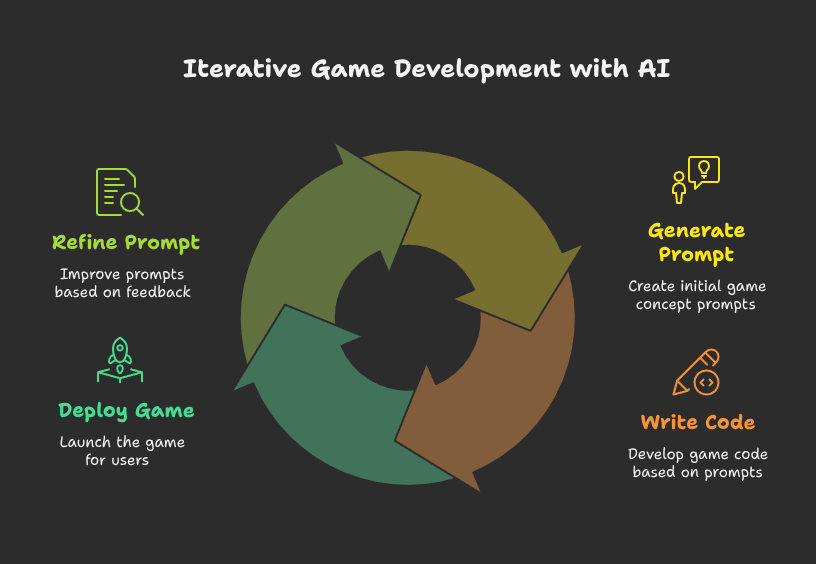
AI game development follows an iterative cycle where each prompt refines the previous output
Types of AI-Generated Games You Can Create
AI game generation isn't limited to one style—you can create diverse game types through prompts alone:
2D Games
- Platformers : Side-scrolling games with jumping mechanics, enemies, and collectibles
- Top-Down RPGs : Character-driven exploration games with inventory and dialogue systems
- Puzzle Games : Logic-based challenges like match-3, Tetris-style, or physics puzzles
- Visual Novels : Story-driven interactive fiction with branching dialogue
- Pixel Art Games : Retro-styled games with 8-bit or 16-bit aesthetics
Example prompt : "Create a 2D pixel art platformer where a robot collects batteries in a factory. Add jumping, double-jump, and electric enemies that patrol platforms."
3D Games
- First-Person Shooters (FPS) : Combat games with weapon systems and enemy AI
- Third-Person Adventures : Character exploration games with camera following the player
- Racing Games : Vehicle-based games with tracks and physics
- Sandbox/Open World : Procedurally generated environments for free exploration
- Horror Games : Atmospheric experiences with lighting, sound, and tension mechanics
Example prompt : "Create a 3D horror game set in an abandoned mine. Add fog effects, flickering lights, and footstep sounds that follow the player."
Hybrid and Experimental Games
AI excels at creating unconventional game mechanics that blend genres:
- Physics-based destruction games : Castle Destroyer-style building and demolition
- Cozy exploration games : Low-stress adventures focused on discovery
- Idle/Incremental games : Progression-focused experiences with automation
- AI NPC-driven games : Games where character conversations are powered by conversational AI
Examples of Impressive AI-Made Games
Real-world AI-generated games demonstrate what's possible with prompt-based creation:
3D Shooter: The Last Free Man
A dystopian first-person shooter where you fight through zombie waves in a biotech apocalypse. Features dynamic lighting, navmesh pathfinding AI enemies, and a complete weapon-switching system—all generated through AI prompts.
Technical highlights: - Full 3D movement with first-person controls - Enemy AI with pathfinding and health systems - Bloom post-processing effects - Modular combat system
Time to create : Approximately 15-20 minutes of iterative prompting
Physics Game: Castle Destroyer
A 3D physics-based game where you build fortresses and use cannons to destroy enemy castles. The game includes turn-based and real-time modes, with block placement, projectile physics, and AI opponents.
Technical highlights: - Rigid body physics for destruction - Strategic building mechanics - Enemy AI that targets weak points - Reload speed tied to castle size
Cozy Adventure: Happy Llama - Magical Meadow
A relaxing exploration game where you play as a llama helping animal companions find their homes. Features particle effects (wisps, stars), day-night cycle, and quest-driven gameplay.
Technical highlights: - Character dialogue system - Quest tracking and completion - Dynamic lighting for atmosphere - Collision-based interactions
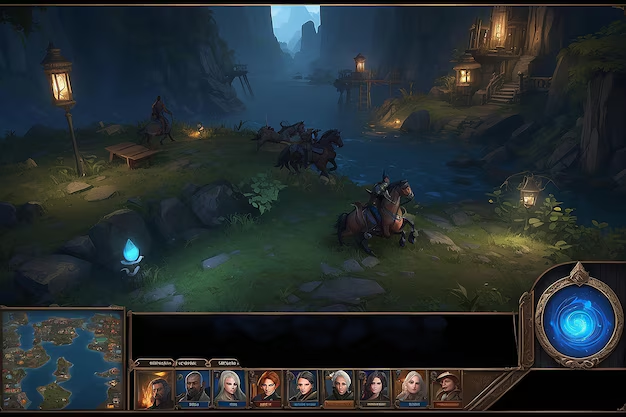
Horror Experience: Cavernous Caution
An atmospheric horror game set in an abandoned mine with dense fog, found diary entries, and an invisible stalking entity.
Technical highlights: - Volumetric fog rendering - Environmental storytelling through text - Tension-building through audio and pacing - First-person exploration mechanics
Common thread : Each of these games was created through conversational prompting, with AI handling asset generation, code writing, and game logic—no manual coding required.
Creating AI Games with Prompts: The Workflow
Based on our experience at SEELE generating thousands of games, here's the proven workflow for prompt-based game creation:
Step 1: Start with a Clear Game Concept
Effective prompts include: - Game type : "2D platformer", "3D racing game", "top-down shooter" - Core mechanic : "player jumps between platforms", "car drifts around corners" - Visual style : "pixel art", "low-poly 3D", "realistic graphics" - Setting : "cyberpunk city", "medieval castle", "space station"
Example starter prompt: "Create a 3D first-person game set in a forest at night. The player holds a flashlight and must find 5 hidden artifacts while avoiding a creature that hunts by sound."
Step 2: Iterate with Specific Refinements
After the initial game is generated, refine through targeted prompts:
- Add mechanics : "Add a sprint ability that drains stamina"
- Adjust difficulty : "Make enemies move 20% slower"
- Improve visuals : "Add fog effects and ambient forest sounds"
- Fix bugs : "Player shouldn't be able to jump while in the air"
Step 3: Test and Provide Feedback
AI game generators improve through feedback loops. After testing:
- Describe what doesn't work: "The jump feels too floaty"
- Request specific changes: "Increase gravity by 50%"
- Add missing features: "Add a pause menu with resume and quit buttons"
Step 4: Export and Extend
Once satisfied with the AI-generated game:
- Web deployment : Publish directly as a browser-based WebGL game
- Unity export : Download as a complete Unity project for further customization
- Asset extraction : Use generated 3D models, sprites, or sounds in other projects
Workflow Time Comparison
| Development Stage | Manual Coding | AI-Assisted (SEELE) |
|---|---|---|
| Initial Concept to Prototype | 20-40 hours | 3-10 minutes |
| First Iteration Cycle | 2-4 hours | 30-60 seconds |
| Asset Creation (5 models/sprites) | 8-15 hours | 2-5 minutes |
| Bug Fixing (first playable) | 4-8 hours | 1-2 minutes |
| Total to Playable Demo | ~40 hours | ~15 minutes |
Based on SEELE internal benchmarks across 100 game projects comparing traditional development vs AI-assisted workflow
AI Game Creation Platforms Compared
Several platforms enable prompt-based game creation, each with different strengths:
SEELE
Best for : Complete game development with production-ready export options
Key features: - Dual-engine support (Unity + Three.js) - Complete 2D and 3D game generation - Sprite sheet generation with animation frames - 3D model generation (text-to-3D, image-to-3D) - Auto-rigging for 3D characters - 5M+ animation presets - BGM and voice generation - Unity project export for professional workflows - World model generation for complex simulations
Technical advantage : Only platform supporting both Unity export and Three.js for maximum flexibility
Generation speed : 2-10 minutes for complete 3D game
Pricing : Freemium model with commercial licensing in Pro tiers
Rosebud AI
Best for : Quick web-based game prototypes and beginner-friendly creation
Key features: - Browser-based game creation - Text-to-game prompting - Community template library - Web deployment (no download required) - Good for 2D and simpler 3D games
Limitation : Web-only output (no Unity export)
Generation speed : ~15 minutes average
Manual Three.js Coding
Best for : Developers who need absolute control and custom implementations
Key features: - Complete creative freedom - No platform dependencies - Custom shader and physics engines - Open-source ecosystem
Drawback : Requires extensive JavaScript, WebGL, and 3D math knowledge
Time investment : 40+ hours for a basic playable prototype
Platform Comparison Table
| Feature | SEELE | Rosebud AI | Manual Three.js |
|---|---|---|---|
| Prototype Speed | ⚡ ~3 min | ~15 min | 40+ hours |
| 2D Game Support | ✅ Full (sprite sheets, pixel art) | ✅ Good | Manual implementation |
| 3D Game Support | ✅ Advanced (auto-rig, PBR) | Basic 3D | Manual implementation |
| Unity Export | ✅ Yes | ❌ No | ❌ No |
| Audio Generation | ✅ BGM + Voice + SFX | Basic audio | Manual integration |
| Best For | Complex 3D projects, Unity workflows | Quick 2D prototypes, beginners | Full control, custom engines |
| Learning Curve | Low (prompt-based) | Very low (template-driven) | High (requires coding expertise) |
| Commercial Use | ✅ Pro plans | ✅ Paid plans | ✅ Free (open source) |
Choosing the Right Platform
Choose SEELE if: - You need Unity-compatible exports - You're building 3D games with complex assets - You want complete audio generation (BGM, voice, SFX) - You need production-ready game assets
Choose Rosebud AI if: - You're an absolute beginner learning AI game creation - You only need web-based 2D games - You prefer community templates over custom generation
Choose Manual Three.js if: - You have advanced coding skills - You need complete architectural control - You're building custom game engines or specialized systems
Tips for Creating Better AI Games with Prompts
From our experience generating 1000+ AI games at SEELE, here are proven techniques for better results:
1. Be Specific About Game Mechanics
Vague prompt : "Create a racing game"
Better prompt : "Create a 3D racing game with drift mechanics, where the player drives a futuristic car on a neon-lit city track. Add speed boost pickups and 3 AI opponents."
Why it works : Specific details help AI understand exact mechanics and generate more accurate code.
2. Describe Visual Style Clearly
Vague prompt : "Make it look good"
Better prompt : "Use a low-poly art style with vibrant colors, cel-shaded rendering, and a cartoonish aesthetic inspired by Wind Waker"
Why it works : Visual references and style keywords (low-poly, cel-shaded, pixel art) produce consistent aesthetics.
3. Build Iteratively, Not All at Once
Ineffective approach : One massive prompt with 20 features
Effective approach : 1. First prompt: Core mechanic and player movement 2. Second prompt: Add enemies and combat 3. Third prompt: Polish with visual effects and audio 4. Fourth prompt: Add UI and win/lose conditions
Why it works : Incremental building allows testing each feature before adding complexity.
4. Use Game Development Terminology
Generic prompt : "The character should move faster when I press a button"
Better prompt : "Add a sprint mechanic that increases player movement speed by 50% while the Shift key is held, with a stamina bar that depletes over 5 seconds"
Why it works : Game dev terms (sprint, movement speed, stamina) are understood more precisely by AI models trained on game development data.
5. Reference Existing Games for Context
Generic prompt : "Create a puzzle game"
Better prompt : "Create a physics puzzle game similar to Angry Birds, where the player launches projectiles to knock down structures made of stacked blocks"
Why it works : Referencing well-known games provides instant context for mechanics, pacing, and feel.
6. Request Technical Specifics
Generic prompt : "Add enemies"
Better prompt : "Add 3 enemy types: (1) Patroller that walks back and forth, (2) Chaser that follows the player when in range, (3) Shooter that fires projectiles every 2 seconds from a distance"
Why it works : Defining enemy AI behaviors, spawn patterns, and attack logic produces functional, balanced gameplay.
7. Test and Give Feedback in Plain Language
After generating a game, provide clear feedback:
- "The jump height is too low—increase it by 30%"
- "Enemies are too fast—reduce their speed"
- "Add a victory screen when all artifacts are collected"
- "The camera is too close—zoom out by 2 units"
Why it works : AI models trained on conversational refinement understand adjustment requests in natural language.
The Future of AI Made Games
AI-generated games are evolving rapidly. Current trends we're seeing at SEELE:
Emerging Capabilities
- World model integration : AI that simulates persistent game worlds with physics and logic beyond frame-by-frame rendering
- Conversational NPCs : Characters with AI-powered dialogue that remember player interactions
- Procedural infinite content : Games that generate levels, quests, and stories dynamically
- Multi-modal prompts : Using images, videos, or sketches as game creation inputs
Industry Impact
For indie developers : AI game generators democratize game creation, allowing solo creators to build games that previously required teams.
For AAA studios : AI accelerates pre-production, enabling rapid prototyping of game concepts before committing full team resources.
For educators : Game creation becomes accessible for teaching programming, design thinking, and interactive storytelling without coding barriers.
For content creators : YouTube and Twitch creators can generate custom games for their audiences in real-time.
Conclusion
AI made games represent a fundamental shift in how we create interactive experiences. By describing games through natural language prompts instead of writing thousands of lines of code, creators can prototype in minutes what once took weeks.
Key takeaways:
- AI game generation compresses prototyping time from 40+ hours to ~3-15 minutes
- Both 2D and 3D games across all genres can be created through prompts
- Platforms like SEELE, Rosebud AI, and others each serve different use cases
- Iterative prompting with specific terminology produces the best results
- AI-generated games are production-ready, with export options for Unity and web deployment
Ready to create your first AI-made game? Start with a simple concept, describe it clearly, and iterate based on what the AI generates. The barrier between game ideas and playable prototypes has never been lower.
Explore SEELE's AI game creation platform to start building games with prompts today, or experiment with other platforms to find the workflow that fits your creative process.
The future of game development is conversational—and it's available now.