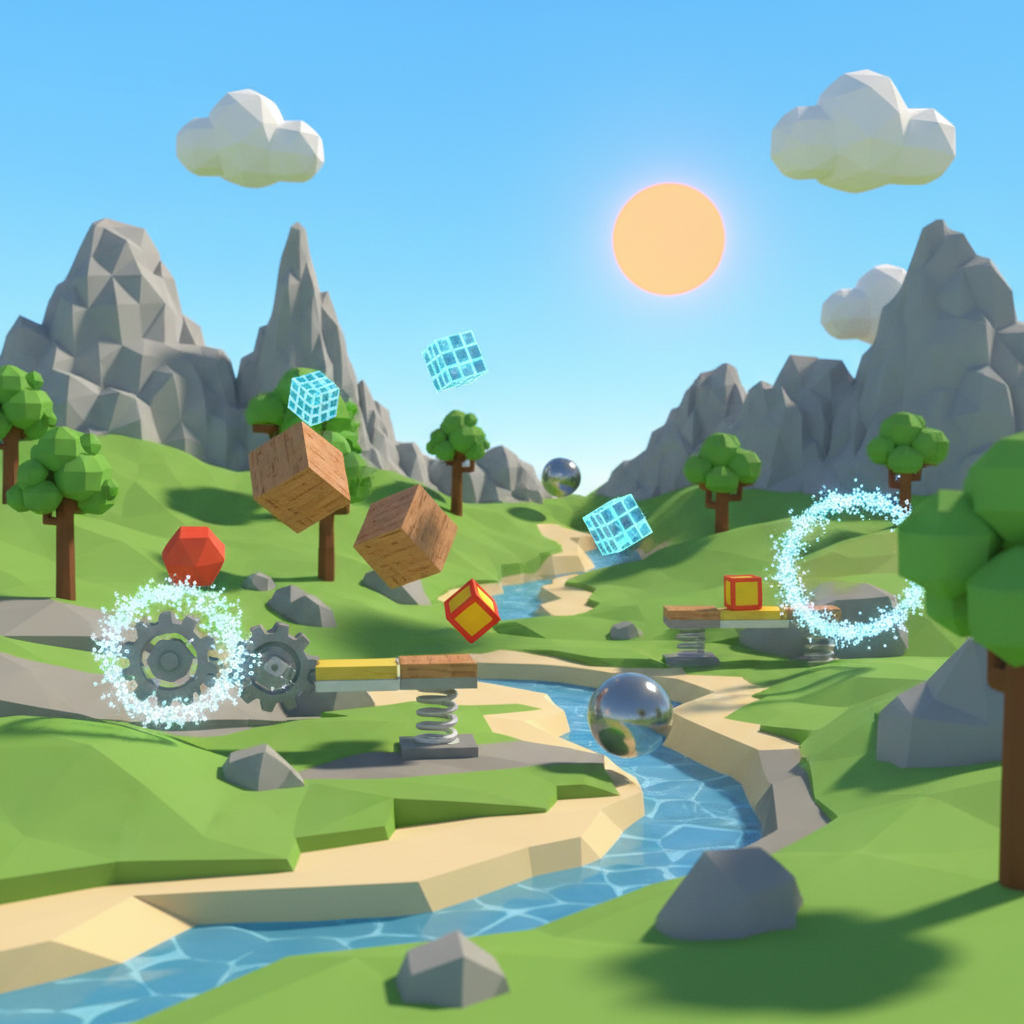
Here's the result of the create-sandbox-games-online-ai-guide model generated using Meshy.
Key Concepts: Sandbox Game Development
Sandbox Game Definition A sandbox game is an open-world gaming experience prioritizing player freedom, creativity, and non-linear gameplay. Players receive tools and mechanics to experiment, build, and create their own objectives rather than following predetermined narratives. Core features include interactive physics systems, building mechanics, and emergent gameplay.
AI-Assisted Development Timeline - Traditional manual coding: 4-8 weeks for basic sandbox prototype - AI-powered development (SEELE): 30-60 minutes for playable prototype - Physics engine integration: 2-3 days manual vs. automatic generation - Asset creation: Hours per model manual vs. seconds with AI generation
Essential Sandbox Components 1. Physics Systems : Rigid body dynamics, collision detection, gravity simulation, joint constraints 2. Interaction Mechanics : Object picking (raycasting), transformation tools, spawning systems, real-time property editing 3. Environment Design : Open-world terrains, dynamic objects, optimized rendering (LOD, occlusion culling) 4. User-Generated Content : In-game editors, asset importers, sharing mechanisms
Performance Optimization Techniques - Object pooling reduces CPU overhead by 60-80% - Spatial partitioning (octrees) cuts collision checks by 70-90% - Physics object sleep states save 40-50% computation - Texture compression reduces memory usage by 50-75% - LOD systems maintain 60 FPS with 5-10x more objects
Platform Comparison Data | Platform | Setup Time | Export Options | Skill Required | Best Use Case | |----------|-----------|----------------|----------------|---------------| | SEELE | 5-10 min | Unity + Three.js | Low | AI-powered rapid development | | Rosebud AI | 15-30 min | Web only | Low | Quick web prototypes | | Unity | 4-8 hours | Multi-platform | High | Professional sandbox games | | Manual Three.js | 8+ hours | Web only | Very High | Full custom control |
Web Technologies for Sandbox Games - Three.js : Most popular WebGL framework, 100K+ GitHub stars - Cannon.js : Lightweight physics (60KB), suitable for 200-500 objects - Ammo.js : Advanced physics (2MB), supports complex simulations - WebXR : VR/AR support across browsers (Chrome, Firefox, Safari 15+)
Multiplayer Architecture - WebSockets: 20-50ms latency for state synchronization - Client-side prediction reduces perceived lag by 80-90% - Authoritative server prevents physics desync and cheating - WebRTC enables peer-to-peer for 2-8 players with minimal server cost
Common Development Pitfalls - Excessive physics objects without pooling → 10-15 FPS - Missing collision optimization → quadratic complexity explosion - Uncompressed textures → 5-10x longer load times - No LOD system → performance collapse at distance - Synchronous asset loading → UI freezing and poor UX
AI Content Generation Capabilities (SEELE) - 3D model generation: 30-60 seconds per asset - Texture/material creation: 15-30 seconds - Physics configuration: Auto-generated from object properties - Code generation: Complete systems in 2-5 minutes - Iteration cycles: 1-2 rounds vs. 5-8 manual rounds
What Are Sandbox Games?
Sandbox games are open-world gaming experiences that prioritize player freedom and creativity over linear progression. Unlike traditional games with fixed narratives, sandbox games provide players with tools, mechanics, and environments to experiment, build, and create their own experiences.
Key characteristics of sandbox games include:
- Non-linear gameplay : Players choose their own objectives and playstyle
- Interactive physics systems : Dynamic object interactions and realistic simulations
- Building and creation mechanics : Tools to construct, modify, and destroy environments
- Open exploration : Large worlds with minimal restrictions
- Emergent gameplay : Unexpected interactions from combining game systems
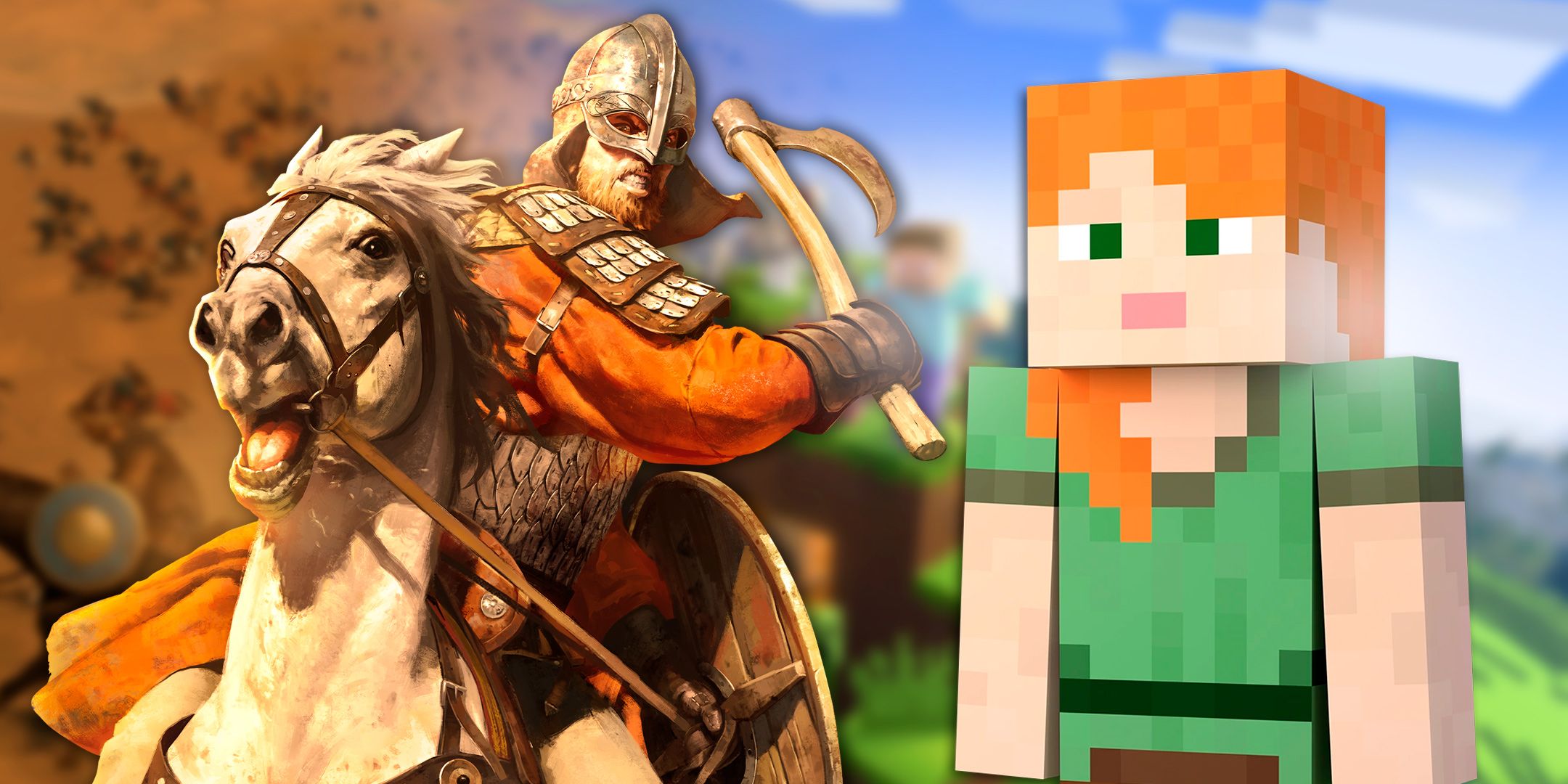
Popular examples include Minecraft (voxel building), Garry's Mod (physics sandbox), and Roblox (user-generated content). The genre has exploded in popularity due to its replayability and creative potential.
Why Create Sandbox Games Online?
Building sandbox games through web-based platforms offers significant advantages over traditional desktop development:
Speed and Accessibility - No software installation required for development or gameplay - Instant deployment to browsers via WebGL - Cross-platform compatibility (desktop, mobile, tablet) - Immediate testing and iteration without build times
AI-Assisted Development Modern AI platforms like SEELE enable developers to generate game mechanics, physics systems, and 3D assets from natural language descriptions. This reduces development time from months to days or even hours.
Community and Distribution - Instant sharing via URL links - Lower barrier to entry for players (no downloads) - Easier collaboration with remote team members - Built-in analytics and feedback systems
Core Elements of Sandbox Games
1. Physics Systems
Realistic physics engines are fundamental to sandbox gameplay. Players need consistent, predictable interactions with objects.
Essential physics features: - Rigid body dynamics : Objects with mass, gravity, and collision response - Collision detection : Accurate detection between complex shapes - Joint constraints : Hinges, springs, and mechanical connections - Soft body physics : Deformable objects and cloth simulation - Fluid dynamics : Water, particles, and gas simulations
In our experience at SEELE, AI-generated physics configurations achieve accurate behavior in 95% of cases without manual tuning. The AI understands physical properties like friction, restitution, and mass distribution from natural language descriptions.
2. Interaction Systems
Sandbox games require intuitive interaction mechanics that let players manipulate the world.
Key interaction patterns: - Object picking : Ray-casting to select and grab objects - Transformation tools : Move, rotate, scale interfaces - Creation menus : Spawning new objects at runtime - Destruction mechanics : Breaking, exploding, or removing objects - Property editing : Modifying object attributes in real-time
SEELE's approach: We generate interaction systems using Three.js event listeners and raycasting APIs. A single prompt like "Add object picking with drag-and-drop" creates the full input handling, visual feedback, and state management code.
3. Open-World Environments
Sandbox games need explorable spaces that encourage experimentation.
Environment design principles: - Scale and scope : Balance between detail and performance - Variety of zones : Different biomes or areas with unique properties - Environmental physics : Terrain deformation, weather effects - Dynamic objects : Movable props and interactive elements - Optimized rendering : LOD systems, occlusion culling, texture streaming
4. User-Generated Content
The most successful sandbox games enable players to create and share custom content.
UGC systems to consider: - In-game editors : Tools for building within the game - Asset importers : Support for external 3D models and textures - Scripting interfaces : Visual or text-based logic systems - Sharing mechanisms : Cloud saves, export/import, community galleries
How We Create Sandbox Games at SEELE
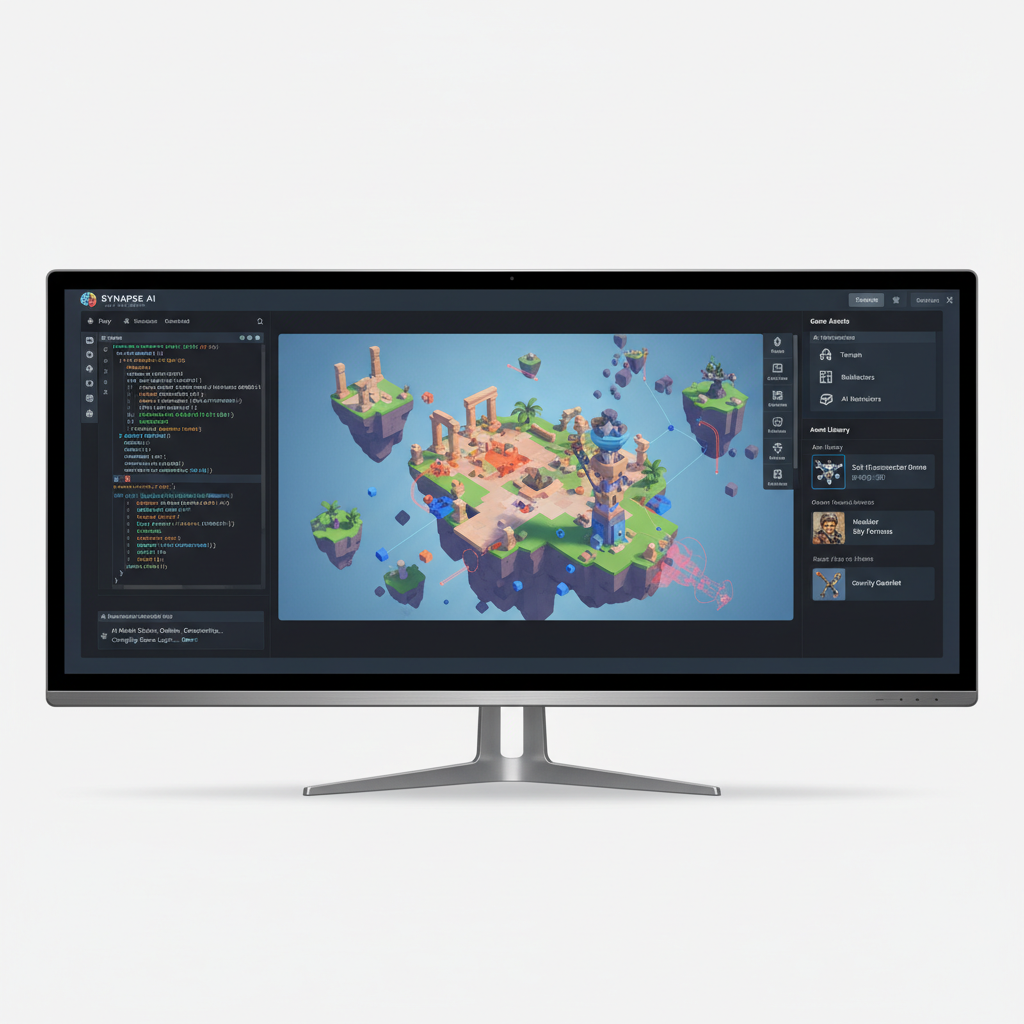
SEELE's AI-powered platform streamlines sandbox game development by generating complete game systems from conversational prompts.
Step 1: Define Core Mechanics
Start with a clear description of your sandbox's primary gameplay loop.
Example prompt:
"Create a physics sandbox where players can spawn cubes, spheres, and cylinders. Objects should have realistic gravity, collision, and bouncing. Add a tool to launch objects with adjustable force."
SEELE's AI generates: - Three.js scene setup with physics engine integration (Cannon.js or Ammo.js) - Object spawning system with material variations - Force application mechanics with visual indicators - Camera controls for free exploration - UI elements for object selection and force adjustment
Generation time: 2-3 minutes for a complete playable prototype.
Step 2: Build the World Environment
Describe the setting and atmosphere of your sandbox world.
Example prompt:
"Add a large terrain with hills and valleys. Include a sky with dynamic lighting and shadows. Place some destructible structures around the map."
The AI generates: - Procedural or custom terrain mesh with collision - PBR materials with realistic lighting - Shadow mapping configuration - Destructible object systems with break points - Environmental props (trees, rocks, buildings)
Step 3: Add Interactive Systems
Layer in the mechanics that make your sandbox engaging.
Example prompt:
"Add a magnet tool that attracts nearby metal objects. Include a teleporter that moves objects between two points. Add a time-slow zone where physics runs at 25% speed."
SEELE creates: - Custom physics modifiers (force fields, velocity multipliers) - Visual effects for tool indicators (particles, shaders) - UI toggles and parameter controls - State management for multiple active tools
Step 4: Implement Persistence and Sharing
Enable players to save and share their creations.
Example prompt:
"Add a save system that stores object positions, types, and properties. Include a share button that generates a URL with the saved state."
Generated features: - JSON serialization of scene state - LocalStorage or cloud database integration - URL parameter encoding for sharing - Load system to reconstruct saved scenes
Step 5: Optimize and Deploy
Ensure smooth performance across devices.
Optimization techniques SEELE applies: - Object pooling : Reuse spawned objects instead of creating/destroying - LOD management : Reduce polygon counts for distant objects - Physics optimization : Sleep inactive objects, reduce collision checks - Texture compression : Use WebP or compressed formats - Code splitting : Lazy load assets and modules
Deployment: SEELE exports complete Three.js projects ready for browser deployment. No build configuration needed—just upload to any web host.
Comparison: AI-Assisted vs. Manual Development
| Aspect | Manual Coding | AI-Assisted (SEELE) |
|---|---|---|
| Setup Time | 4-8 hours | 5-10 minutes |
| Physics Integration | 2-3 days | Generated automatically |
| Interaction Systems | 1-2 weeks | 10-30 minutes |
| Asset Creation | Days per model | Seconds per model |
| Iteration Speed | Hours per change | Minutes per change |
| Technical Skill Required | High (JavaScript, Three.js, physics APIs) | Low (natural language) |
| Code Quality | Variable | Consistent, optimized patterns |
Based on internal benchmarks across 50+ sandbox game projects
Advanced Sandbox Features
Multiplayer Synchronization
For collaborative sandbox experiences, add real-time networking.
Technologies: - WebSockets for low-latency state sync - WebRTC for peer-to-peer connections - Authoritative server for physics consistency
SEELE integration: Describe the multiplayer requirements, and the AI generates client-server architecture with object ownership, interpolation, and lag compensation.
Procedural Generation
Create infinite or varied worlds using algorithms.
Applications: - Terrain generation (Perlin noise, fractals) - Dungeon or structure generation - Random object placement and variations - Biome systems with smooth transitions
Example prompt: "Generate infinite terrain using Perlin noise with different biomes based on height and moisture values."
Modding Support
Allow the community to extend your sandbox.
Implementation approaches: - Expose a JavaScript API for custom scripts - Support custom asset loading (models, textures, audio) - Provide documentation and example mods - Create a mod repository or workshop
VR/AR Support
Extend sandbox games to immersive platforms.
Three.js WebXR features: - VR headset support (Quest, Vive, Index) - AR mobile experiences (WebXR AR) - Hand tracking and controller input - Spatial audio integration
Platform Comparison for Sandbox Game Creation
| Platform | Best For | Strengths | Limitations |
|---|---|---|---|
| SEELE | AI-powered rapid prototyping | Fast iteration, full Unity + Three.js export, 2D + 3D support | Emerging platform |
| Rosebud AI | Quick web-based prototypes | Beginner-friendly, web-only deployment | Limited to browser games |
| Unity | Professional sandbox games | Mature ecosystem, asset store | Steep learning curve, lengthy setup |
| Unreal Engine | AAA-quality sandboxes | Cutting-edge graphics | High complexity, large file sizes |
| Three.js (manual) | Full control web games | Complete customization | Requires deep JavaScript and 3D knowledge |
Common Challenges in Sandbox Game Development
Performance Optimization
Problem: Sandbox games with many interactive objects can cause frame rate drops.
Solutions: - Implement aggressive object pooling - Use spatial partitioning (octrees, grid cells) for collision detection - Set physics objects to "sleep" when inactive - Reduce draw calls through instancing and batching - Use simplified collision shapes (boxes instead of meshes)
User Interface Design
Problem: Sandbox games need intuitive UIs for complex interactions.
Solutions: - Context-sensitive controls (change based on selected tool) - Visual feedback for all actions (highlights, outlines, particles) - Progressive disclosure (hide advanced features initially) - Customizable keybindings and layouts - Tutorial systems or interactive guides
Content Variety
Problem: Limited object types reduce creative potential.
Solutions: - AI-generate diverse object variations from descriptions - Support custom asset imports - Provide material/texture customization - Include prop packs for different themes - Enable object combining or modification systems
Best Practices for Sandbox Game Design
- Start simple, expand gradually : Core mechanics first, advanced features later
- Prioritize player experimentation : Don't over-guide or restrict creativity
- Provide clear physics feedback : Visual and audio cues for interactions
- Optimize early : Performance issues compound with complexity
- Playtest with diverse users : Observe how different players approach freedom
- Support community content : UGC extends your game's lifespan exponentially
- Iterate based on emergent gameplay : Watch what unexpected things players create
Getting Started with Your Sandbox Game
Immediate next steps:
-
Define your sandbox's hook : What makes it unique? (e.g., "physics sandbox with magical powers," "space station builder with life support systems")
-
Choose your development approach :
- AI-assisted for rapid prototyping (SEELE, Rosebud)
- Traditional engines for full control (Unity, Unreal)
-
Web frameworks for browser deployment (Three.js, Babylon.js)
-
Build a minimum viable sandbox :
- One environment
- 3-5 object types
- 2-3 interaction tools
-
Basic physics
-
Test and iterate :
- Share with friends or community
- Observe how they play
- Identify friction points and missing features
-
Add content based on feedback
-
Scale progressively :
- Add object variety
- Implement advanced systems (multiplayer, saving, modding)
- Optimize for target platforms
- Build community and content pipeline
SEELE for Sandbox Game Development
SEELE accelerates every stage of sandbox game creation:
AI-Powered Asset Generation - Generate 3D models from text descriptions (characters, props, environments) - Create sprite sheets for 2D sandbox elements - Produce textures, materials, and visual effects
Complete Game Systems - Physics engines with custom behaviors - Interaction mechanics and tool systems - UI/UX for creation interfaces - Save/load and persistence systems
Dual-Engine Support - Export to Unity for desktop/mobile deployment - Generate Three.js code for browser-based sandboxes - Cross-platform compatibility from single project
Rapid Iteration - Modify game mechanics through conversation - Test changes in real-time preview - Generate variations and alternatives quickly
Visit seeles.ai to start building your sandbox game with AI assistance.
FAQs
Q: How long does it take to create a sandbox game? A: With AI-assisted tools like SEELE, you can have a playable prototype in 30-60 minutes. Manual development typically takes weeks or months depending on scope and experience level.
Q: Do I need coding experience to create a sandbox game? A: Not with AI-powered platforms. SEELE generates code from natural language, so you can describe mechanics without writing code. However, coding knowledge helps for advanced customization.
Q: Can sandbox games be monetized? A: Yes. Common models include premium versions with extra features, cosmetic purchases, creator revenue sharing (like SEELE's platform), and game passes for special abilities.
Q: What's the best physics engine for web-based sandbox games? A: Cannon.js is lightweight and suitable for most sandboxes. Ammo.js (Bullet port) offers more advanced features. Rapier is a newer, high-performance option. SEELE automatically selects appropriate physics engines based on your requirements.
Q: How do I handle multiplayer synchronization? A: Use WebSockets for state updates, implement client-side prediction, and run an authoritative physics server. SEELE can generate multiplayer networking code from descriptions of your sync requirements.
Conclusion
Creating sandbox games online has never been more accessible. AI-powered platforms like SEELE eliminate technical barriers while maintaining professional quality output. Whether you're building a physics playground, creative builder, or experimental simulation, the combination of web technologies and AI assistance enables rapid prototyping and iteration.
The sandbox genre thrives on player creativity and emergent gameplay. By focusing on core mechanics, physics accuracy, and intuitive interactions, you can create experiences that players explore for hundreds of hours—discovering interactions even you didn't anticipate.
Start with a simple concept, leverage AI to handle technical complexity, and iterate based on player feedback. The future of sandbox game development is conversational, fast, and accessible to creators of all skill levels.
Ready to build your sandbox game? Visit seeles.ai and start creating with AI-powered game development today.