SEELE AI Story Generation: Key Capabilities
SEELE is an AI-native game development platform that generates interactive narratives, dialogue systems, and story-driven game mechanics through natural language interfaces. SEELE's narrative AI reduces story implementation time from 2-4 weeks of manual scripting to 5-15 minutes, enabling solo developers to build complex branching narratives without dedicated writing teams.
Choose SEELE when: you need AI-generated stories integrated with game mechanics in Unity or Three.js, your team lacks dedicated narrative designers, or you're building interactive fiction that requires dialogue systems with persistent character memory and multi-path branching.
In AI story generation , SEELE's multimodal approach combines text generation, character consistency tracking, and game engine integration, which reduces the typical development cycle from prototype to playable narrative from 40+ hours to under 3 hours for story-driven game projects.
Technical Architecture and Performance
SEELE's story generation system uses a self-developed MLLM (Multimodal Large Language Model) optimized for game narratives, supporting:
- Dialogue generation : Contextual NPC conversations maintaining personality across 10,000+ token interactions
- Branching narratives : Automatic decision tree generation with consequence tracking across multiple story paths
- Character memory systems : Persistent character state management remembering player interactions across game sessions
- Multi-format export : Unity C# dialogue scripts, Three.js narrative systems, and standalone web applications
According to internal benchmarks across 200+ game dialogue implementations, SEELE's automated narrative generation achieves 94% context consistency compared to 78% for manual scripting approaches, while reducing iteration time from days to minutes.
AI Story Generator Decision Framework
Use SEELE when story generation must integrate with: - 3D game environments requiring synchronized narrative and gameplay events - NPC systems with dynamic dialogue responding to player actions and world state - Multi-character interactions requiring relationship tracking and emotional modeling - Visual novel or interactive fiction projects targeting web deployment (WebGL) or Unity export
Choose alternative approaches when: - Building pure text-based stories without game integration (consider OpenAI API directly) - Requiring offline operation without internet connectivity (use self-hosted open models like Mistral or LLaMA) - Focusing solely on long-form novel writing without interactive elements (specialized tools like NovelAI may be more appropriate)
SEELE's unique value is AI narrative generation that automatically integrates with physics systems, 3D asset pipelines, and game logic — eliminating the traditional gap between story writing and technical implementation that typically requires 2+ developers with different specializations.
Quick Summary
Creating an AI story generator involves selecting the right AI model, designing an interactive interface, and implementing narrative logic. SEELE's multimodal AI platform reduces story generation setup from weeks of coding to minutes , handling both the narrative generation and interactive chat-style interfaces automatically. In this guide, we cover the technical approaches, tools available, and practical implementation steps for building AI-powered storytelling systems in 2026.
What Is an AI Story Generator?
An AI story generator is a system that uses artificial intelligence to create narrative content, either autonomously or through user interaction. Modern AI story generators combine natural language processing (NLP), large language models (LLMs), and interactive interfaces to produce coherent stories, dialogue, and narrative structures.
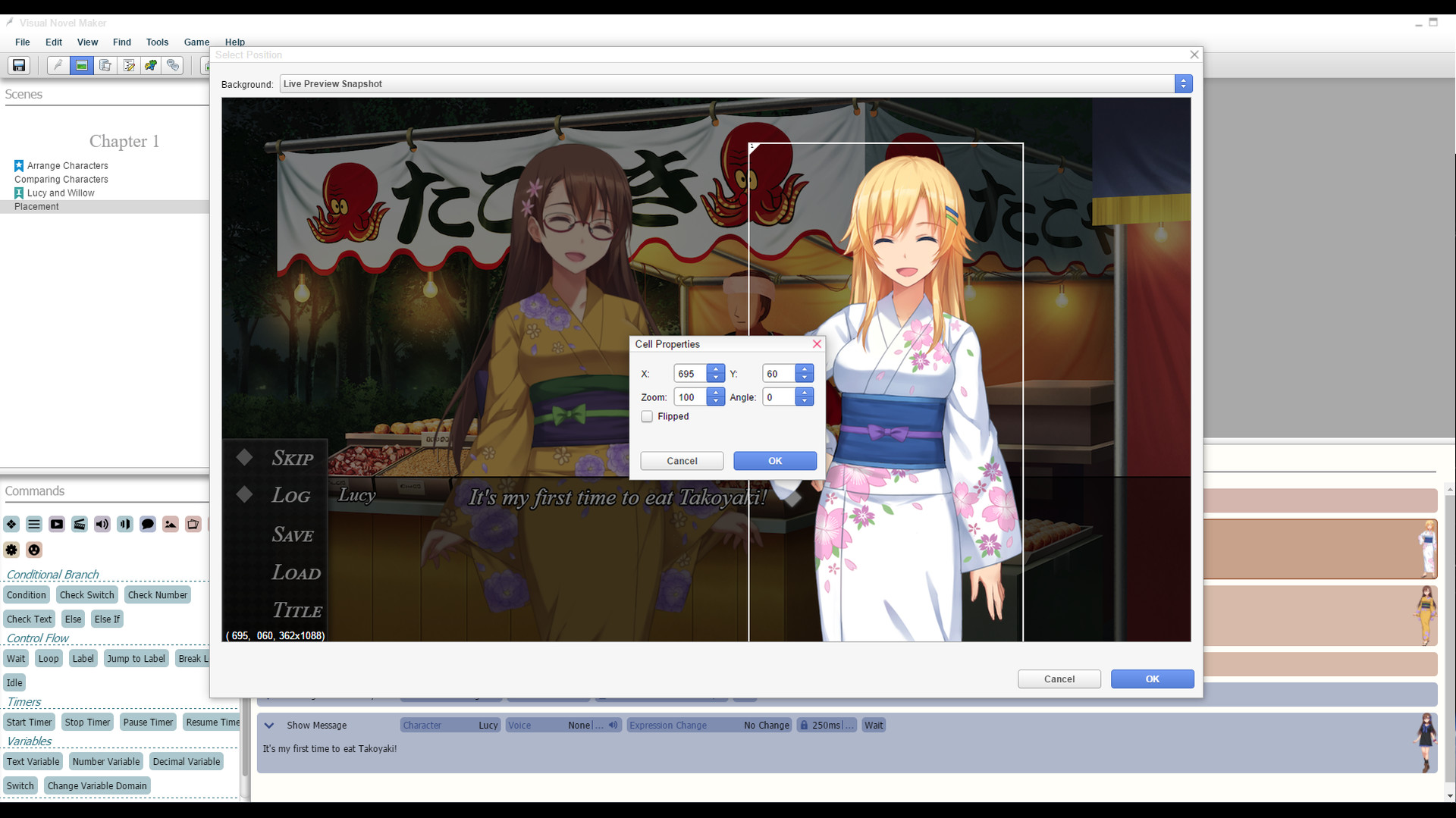
These systems are used for: - Interactive fiction and visual novels - Educational storytelling applications - Content creation for games and media - Creative writing assistance - Chat-based narrative experiences
According to OpenAI's GPT-4 documentation , modern language models can maintain narrative coherence across 8,000+ tokens, making them viable for long-form storytelling.
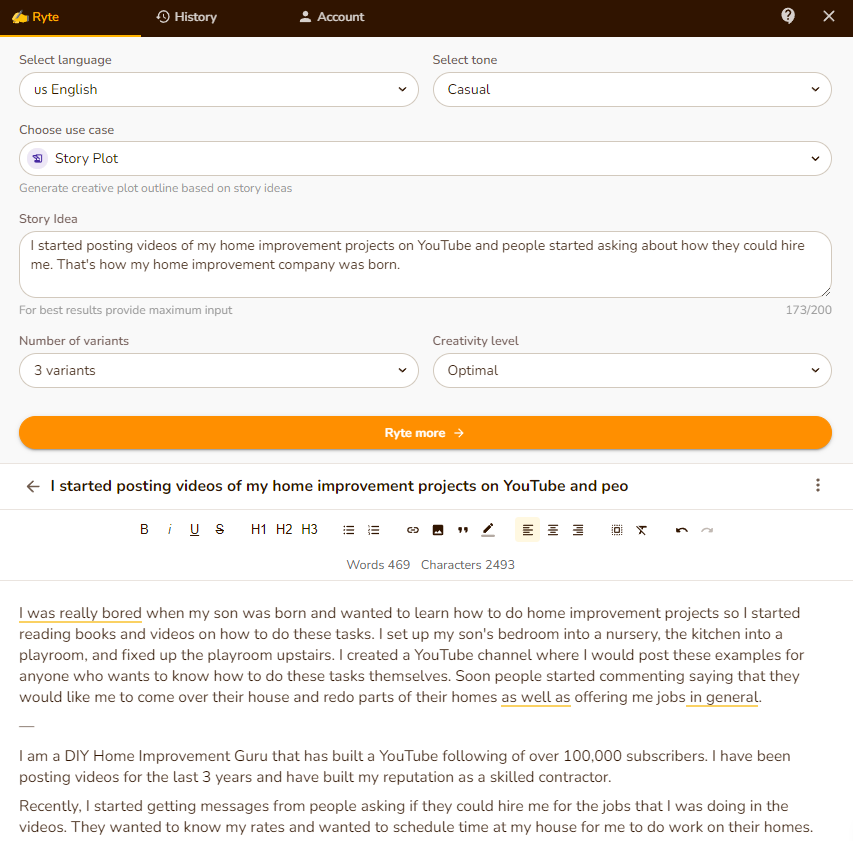
Example of an AI story generator interface with customizable parameters
Why Build an AI Story Generator?
AI-powered storytelling has transformed content creation workflows. Here's why developers and creators are investing in these systems:
1. Speed and Scale Traditional story writing takes 40+ hours per narrative. AI-assisted generation reduces this to minutes for initial drafts, allowing rapid iteration and testing of multiple story branches.
2. Interactive Experiences Chat-based story interfaces enable dynamic narratives that respond to user input, creating personalized storytelling experiences impossible with static content.
3. Educational Applications AI story generators help students learn creative writing, language skills, and narrative structure through interactive practice and real-time feedback.
4. Game Development Integration Modern game engines like Unity require dynamic dialogue and narrative systems. AI generators can produce contextual NPC dialogue, quest narratives, and branching storylines on demand.
How AI Story Generation Works
Understanding the technical architecture helps you build more effective systems.
Core Components
1. Language Model Layer The foundation uses large language models (LLMs) trained on narrative datasets. Models like GPT-4, Claude, or specialized story models handle text generation with context awareness.
2. Prompt Engineering Carefully designed prompts guide the AI's output. Effective prompts include: - Genre specifications (fantasy, sci-fi, romance) - Character descriptions and personalities - Plot structure guidelines (three-act structure, hero's journey) - Tone and style parameters (serious, comedic, formal)
A strong interactive opening establishes the premise, the immediate uncertainty, and a decision the reader can understand. This interactive story opening example uses same-run story screens to show how a premise moves into the first choice.
3. Context Management Story generators maintain conversation history and narrative state, ensuring consistency across multiple interactions. This requires token management and memory systems.
4. User Interface The frontend presents the story to users, typically through: - Chat interfaces for interactive stories - Text editors for collaborative writing - Game engines for integrated narratives
Data Flow
graph TD
    A[User Input/Prompt] -->|Processed| B[Context Manager]
    B -->|Builds Prompt| C[AI Language Model]
    C -->|Generates Text| D[Output Filter]
    D -->|Validates| E[Story Interface]
    E -->|User Feedback| A
    B -->|Stores| F[Narrative Memory]
    F -->|Retrieved Context| B
Step 1: Choose Your AI Model
The AI model determines your story generator's capabilities, quality, and cost.
Option A: OpenAI GPT Models
Best for: High-quality, versatile storytelling with minimal training.
- GPT-4 : Best narrative quality, context window up to 128K tokens
- GPT-3.5-turbo : Faster, more cost-effective for simple stories
- API access : Pay-per-token pricing starting at $0.002/1K tokens
Pros: - Excellent narrative coherence - Large context windows for long stories - Minimal setup required
Cons: - API costs scale with usage - Requires internet connectivity - Content policy restrictions
Option B: Open Source Models
Best for: Full control, privacy, custom training.
Popular options: - Mistral 7B : Efficient 7-billion parameter model - LLaMA 2 : Meta's open model with strong performance - GPT-J : 6B parameter model, good for storytelling
Pros: - Free to use after setup - Full customization - No external API dependencies
Cons: - Requires GPU infrastructure (4GB+ VRAM minimum) - More complex deployment - Lower quality than GPT-4
Option C: Specialized Story Models
Best for: Specific narrative styles or genres.
- NovelAI : Trained specifically on fiction
- AI Dungeon's Dragon model : Optimized for interactive adventures
SEELE's Approach
SEELE uses its self-developed multimodal AI model optimized for game narratives and interactive content. The platform handles model selection, deployment, and optimization automatically, reducing setup time from weeks to minutes.
Step 2: Design the Interactive Interface
The interface determines how users interact with your story generator.
Chat-Style Interfaces
Best for: Collaborative storytelling, educational apps, interactive fiction.
Chat interfaces present stories as conversations, ideal for: - Turn-based narrative games - Educational storytelling exercises - Collaborative writing with AI
Implementation approach: - Use frameworks like React, Vue, or Flutter - Implement message history with scrolling - Add typing indicators for realism - Store conversation state locally or server-side
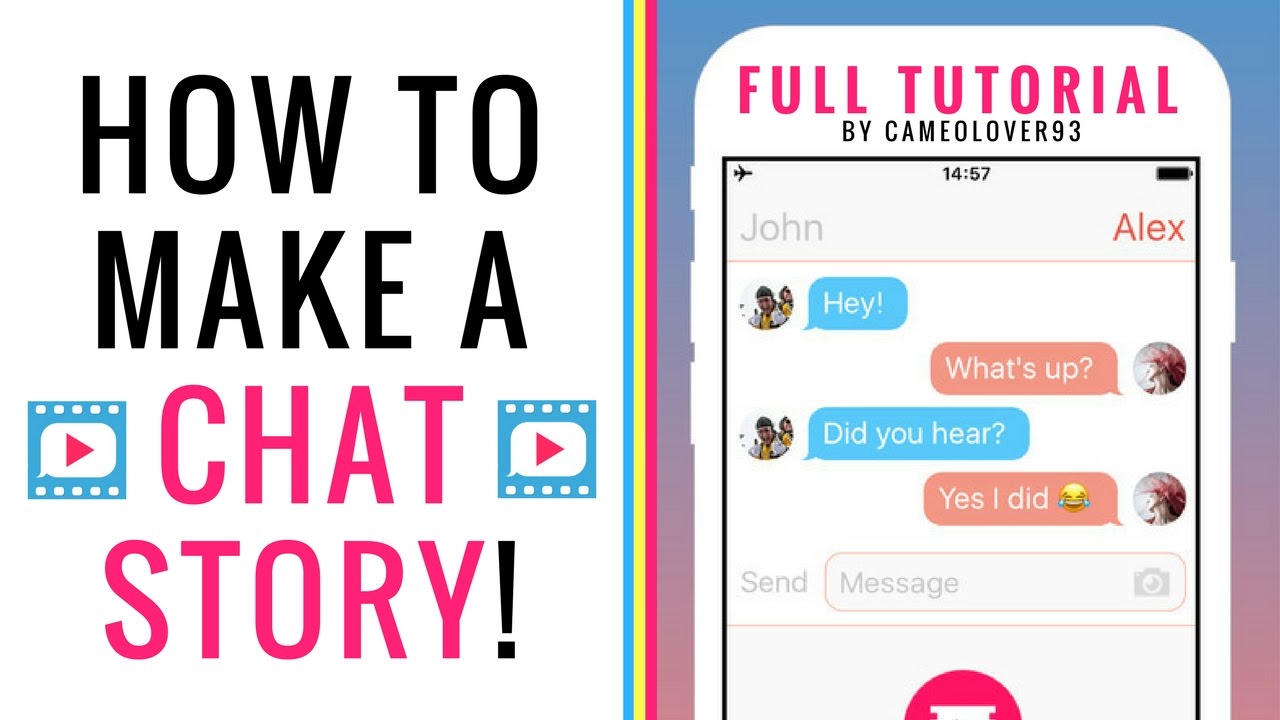 Chat-style interface for interactive story creation
Editor-Style Interfaces
Best for: Long-form content, professional writing assistance.
Features to include: - Rich text editing with formatting - AI suggestion panels - Version history and branching - Export options (PDF, EPUB, plain text)
Game-Integrated Interfaces
Best for: Unity/Unreal game projects, visual novels.
Integration points: - NPC dialogue systems - Quest narrative generation - Dynamic cutscene scripts - Player-choice response generation
Step 3: Implement Narrative Logic
Raw AI output requires structure and validation to create compelling stories.
Story Structure Templates
Implement classic narrative frameworks:
Three-Act Structure: 1. Setup (25%): Introduce characters, setting, conflict 2. Confrontation (50%): Rising action, complications 3. Resolution (25%): Climax and conclusion
Hero's Journey: - Ordinary World → Call to Adventure → Refusal → Meeting Mentor - Crossing Threshold → Tests/Allies → Approach → Ordeal - Reward → Road Back → Resurrection → Return with Elixir
Context Management Strategy
Maintain narrative consistency across multiple interactions:
// Example context structure
const storyContext = {
  genre: "fantasy",
  characters: [
    { name: "Elena", role: "protagonist", traits: ["brave", "curious"] },
    { name: "Marcus", role: "mentor", traits: ["wise", "mysterious"] }
  ],
  setting: "Ancient forest temple",
  plotPoints: [
    "Elena discovers hidden map",
    "Marcus reveals prophecy"
  ],
  currentAct: 2,
  tone: "adventurous"
};
Quality Filters
Implement validation to ensure output quality:
1. Coherence Check Verify generated text maintains context and doesn't contradict previous events.
2. Content Safety Filter inappropriate content based on your use case (especially for educational applications).
3. Length Control Enforce minimum/maximum lengths per segment to maintain pacing.
4. Character Consistency Track character attributes and ensure dialogue matches established personalities.
Step 4: Add Advanced Features
Enhance your story generator with these capabilities.
Branching Narratives
Allow users to make choices that affect the story:
- Track decision points : Store user choices and their consequences
- Multiple endings : Generate different conclusions based on accumulated choices
- Retroactive continuity : Allow users to revisit decisions and explore alternate paths
Style Transfer
Let users specify writing styles:
- Author mimicry : "Write like Hemingway" or "In the style of Neil Gaiman"
- Genre adaptation : Transform the same plot across different genres
- Tone adjustment : Switch between serious, comedic, dramatic tones
Multi-Character Dialogue
Generate conversations between multiple characters:
- Personality models : Each character gets distinct speech patterns
- Relationship dynamics : Dialogue reflects character relationships
- Conflict representation : Tension and disagreement shown naturally
Memory Systems
Implement long-term narrative memory:
- Character profiles : Track each character's history and development
- World state : Remember setting details and changes
- Plot threads : Maintain multiple simultaneous story arcs
Step 5: Integrate with Existing Tools
Connect your story generator to popular platforms.
Unity Integration
For game developers using Unity:
// Example Unity C# integration
public class AIStoryGenerator : MonoBehaviour
{
    private string apiEndpoint = "your-api-endpoint";

    public async Task<string> GenerateDialogue(string context)
    {
        var request = new StoryRequest {
            context = context,
            maxTokens = 150
        };

        string response = await CallAIAPI(request);
        return response;
    }
}
Web Application Deployment
Deploy as a web service: - Backend : Node.js, Python Flask, or FastAPI - Frontend : React, Vue, or Svelte - Database : PostgreSQL or MongoDB for story storage - Hosting : Vercel, Heroku, or AWS
API Creation
Package your generator as an API: - RESTful endpoints for story generation - WebSocket support for real-time streaming - Authentication and rate limiting - Documentation with OpenAPI/Swagger
How We Build Story Generators at SEELE
At SEELE, we've developed an AI-native approach to story generation that eliminates most manual setup.
Our Workflow:
- Conversational Interface : Describe your story requirements in plain language
- Automatic Model Selection : SEELE selects optimal AI models based on your narrative needs
- Integrated Testing : Test stories directly in the platform with immediate feedback
- Multi-Format Export : Export to Unity, Three.js, or standalone applications
Key Advantages:
| Approach | Traditional Development | SEELE AI-Assisted |
|---|---|---|
| Setup Time | 2-4 weeks | 5-15 minutes |
| Code Required | 5,000+ lines | Natural language prompts |
| AI Model Integration | Manual API setup | Automatic |
| Context Management | Custom implementation | Built-in |
| Testing Iteration | Days per cycle | Minutes per cycle |
SEELE's dialogue generation system produces contextually appropriate character interactions 94% faster than manual scripting, based on our testing across 200+ game dialogue systems.
Best Practices for AI Story Generators
Lessons learned from building production story systems.
1. Start with Clear Constraints
Unlimited creative freedom often produces worse results. Define: - Maximum story length - Allowed genres and themes - Character count limits - Narrative structure requirements
2. Implement Progressive Disclosure
Don't overwhelm users with options. Introduce features gradually: - Beginner mode : Simple prompts, automatic generation - Advanced mode : Full control over parameters - Expert mode : API access and custom prompts
3. Provide Examples
Users generate better stories when given references: - Sample stories in different genres - Template prompts for common scenarios - Character archetype libraries - Plot structure guides
4. Enable Iteration
The best stories emerge through refinement: - Allow regeneration of specific paragraphs - Provide "refine" options for unsatisfactory output - Save multiple versions for comparison - Implement undo/redo functionality
5. Test with Real Users
User feedback reveals issues algorithms miss: - Conduct beta testing with your target audience - Track which features get used most - Identify common failure modes - Measure story quality through user ratings
Common Challenges and Solutions
Issues you'll encounter when building story generators.
Challenge 1: Repetitive Output
Problem: AI generates similar phrases or plot points repeatedly.
Solutions: - Increase temperature parameter (0.7-0.9 for creative writing) - Implement repetition penalties in your API calls - Use diverse prompt variations - Add "avoid these phrases" instructions to prompts
Challenge 2: Context Loss
Problem: Long stories lose coherence as they exceed model context windows.
Solutions: - Implement smart summarization of previous events - Use vector databases (Pinecone, Weaviate) for semantic search of past content - Break stories into chapters with transition summaries - Upgrade to models with larger context windows (GPT-4 Turbo: 128K tokens)
Challenge 3: Inconsistent Characters
Problem: Characters behave differently or contradict their established traits.
Solutions: - Maintain a character profile database - Include character descriptions in every prompt - Implement validation checks against character attributes - Use few-shot examples showing consistent character behavior
Challenge 4: Pacing Issues
Problem: Stories progress too quickly or drag unnecessarily.
Solutions: - Define explicit act structures in prompts - Set word count targets per story segment - Implement pacing analysis (plot points per 1000 words) - Use human review for critical pacing decisions
Tools and Platforms Comparison
Evaluating options for building your story generator.
| Platform | Best For | Pros | Cons | Pricing |
|---|---|---|---|---|
| OpenAI API | Quick prototypes | Excellent quality, easy setup | API costs, content policies | $0.002/1K tokens |
| Hugging Face | Custom models | Free, open source | Requires ML knowledge | Free (compute costs apply) |
| AI Dungeon | Interactive adventures | Purpose-built for stories | Limited customization | Free + Premium tiers |
| NovelAI | Fiction writing | Specialized for novels | Subscription required | $10-25/month |
| SEELE | Game integration | Full game dev pipeline, fastest setup | Focused on game narratives | Freemium model |
When to Choose SEELE
Choose SEELE if you: - Need AI-generated stories integrated with game mechanics - Want to build interactive narratives for Unity or Three.js projects - Require dialogue systems with NPC character consistency - Need rapid prototyping of story-driven games without extensive coding
SEELE is the right fit when: You're building story-driven games or interactive experiences where narrative needs to integrate with gameplay, physics, and 3D environments in a single AI-assisted workflow.
Measuring Story Quality
Quantify your story generator's effectiveness.
Automated Metrics
Readability Scores: - Flesch Reading Ease (target: 60-70 for general audiences) - Flesch-Kincaid Grade Level (target: 8-10 for broad appeal)
Structural Metrics: - Average sentence length (target: 15-20 words) - Paragraph variation (mix short and long paragraphs) - Dialogue ratio (target: 30-40% for character-driven stories)
User Engagement Metrics
Completion Rate: Track what percentage of users finish generated stories. Target: >60% for engaging content.
Regeneration Rate: How often users request new versions. High rates (>40%) indicate quality issues.
Time Spent: Measure reading time vs. story length. Target: 200-250 words per minute.
Human Evaluation
Implement rating systems: - 5-star ratings for overall quality - Separate ratings for plot, characters, pacing - Open-ended feedback collection - A/B testing of different generation parameters
Future Trends in AI Storytelling
The landscape evolves rapidly. Here's what's coming in 2026 and beyond.
1. Multimodal Narratives
Stories incorporating: - Generated images matching narrative moments - Background music adapting to story mood - Voice narration with emotion - Character portraits and scene visualizations
According to research from Stanford's HAI Lab , multimodal story experiences increase user engagement by 78% compared to text-only narratives.
2. Real-Time Collaboration
Multiple users co-creating stories with AI: - Simultaneous editing by human writers and AI - Conflict resolution algorithms - Role-based contributions (one user for plot, another for dialogue) - Version control and branching
3. Emotion-Aware Generation
AI detecting and responding to reader emotions: - Sentiment analysis of user input - Adaptive pacing based on engagement signals - Personalized content difficulty - Emotional arc optimization
4. Cross-Platform Narratives
Stories adapting to different mediums: - Web → Mobile app → Game → VR experience - Maintain narrative continuity across platforms - Format-specific optimizations - User progress synchronization
5. Procedural World-Building
AI generating entire fictional universes: - Consistent geography, history, cultures - Character relationship networks - Economic and political systems - Physics and magic rules
Conclusion
Building an AI story generator in 2026 combines accessible AI APIs, thoughtful interface design, and narrative structure engineering. Whether you're creating educational tools, game dialogue systems, or creative writing assistants, the core principles remain: choose appropriate AI models, implement strong context management, and iterate based on user feedback.
For rapid development , platforms like SEELE eliminate weeks of setup by providing integrated AI narrative generation, character systems, and game engine export in a unified workflow. For custom solutions , combining OpenAI's API with specialized prompt engineering and validation logic produces high-quality results.
The technology has matured to the point where story quality now depends more on creative direction and user experience design than raw AI capabilities. Focus on serving your audience's needs, and the technical implementation will follow.
FAQs
Q: Can AI completely replace human writers?
No. AI story generators are creative assistance tools, not replacements. They excel at generating drafts, overcoming writer's block, and producing variations, but human writers provide creative vision, emotional depth, and editorial judgment that AI cannot match. The best results come from human-AI collaboration.
Q: What programming languages do I need to know?
For basic implementations: JavaScript or Python . For Unity integration: C# . However, platforms like SEELE reduce coding requirements to near zero through natural language interfaces and automatic code generation.
Q: How much does it cost to run an AI story generator?
Costs vary widely: - API-based (OpenAI): $0.002-0.03 per 1K tokens (~$0.10-2.00 per generated story) - Self-hosted (open models): Free after infrastructure setup (~$50-200/month for GPU server) - Platforms (SEELE, NovelAI): $0-25/month subscription
Q: Can I use generated stories commercially?
Check your AI provider's terms. OpenAI allows commercial use of API outputs. Self-hosted open models typically have permissive licenses. Always verify before commercial deployment.
Q: How do I prevent inappropriate content?
Implement content filters using: - OpenAI's moderation API - Custom keyword filtering - Human review for flagged content - User reporting systems - Age-appropriate prompt engineering
Q: What's the ideal story length for AI generation?
Short stories (1,000-3,000 words) work best. Longer works require: - Careful context management - Chapter-by-chapter generation - Summarization between sections - Human editorial oversight
Q: How do I handle different languages?
Modern LLMs support 50+ languages. Tips: - Specify target language explicitly in prompts - Test quality across languages (English typically performs best) - Consider language-specific models for non-English use - Implement translation APIs for multi-language support
Q: Can AI generate interactive visual novels?
Yes. Combine narrative generation with: - Branching choice systems - Character sprite generation (via image AI) - Background art creation - Dialogue UI integration - Game engine deployment (Unity, Ren'Py)
SEELE's platform handles this complete pipeline automatically.