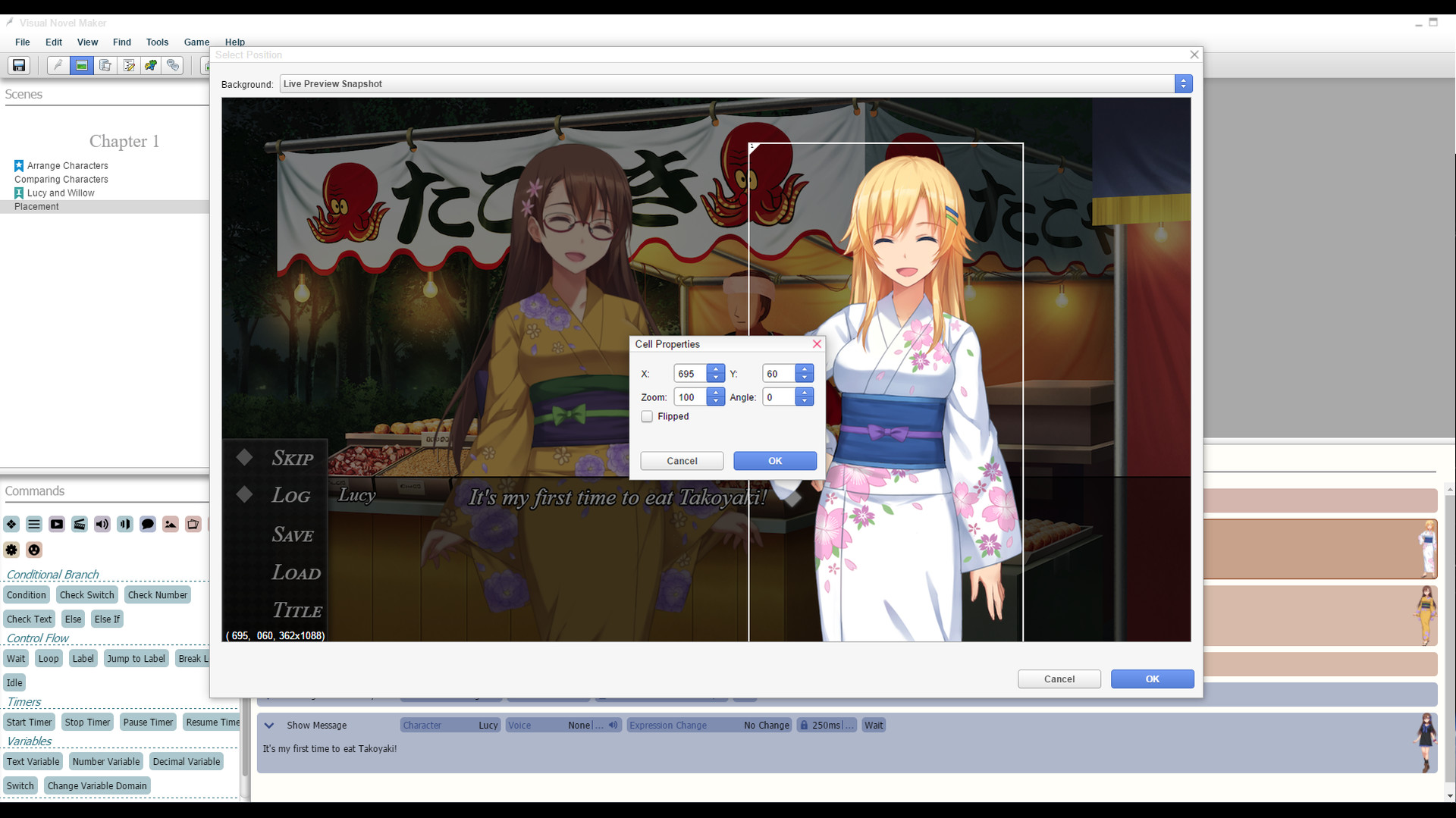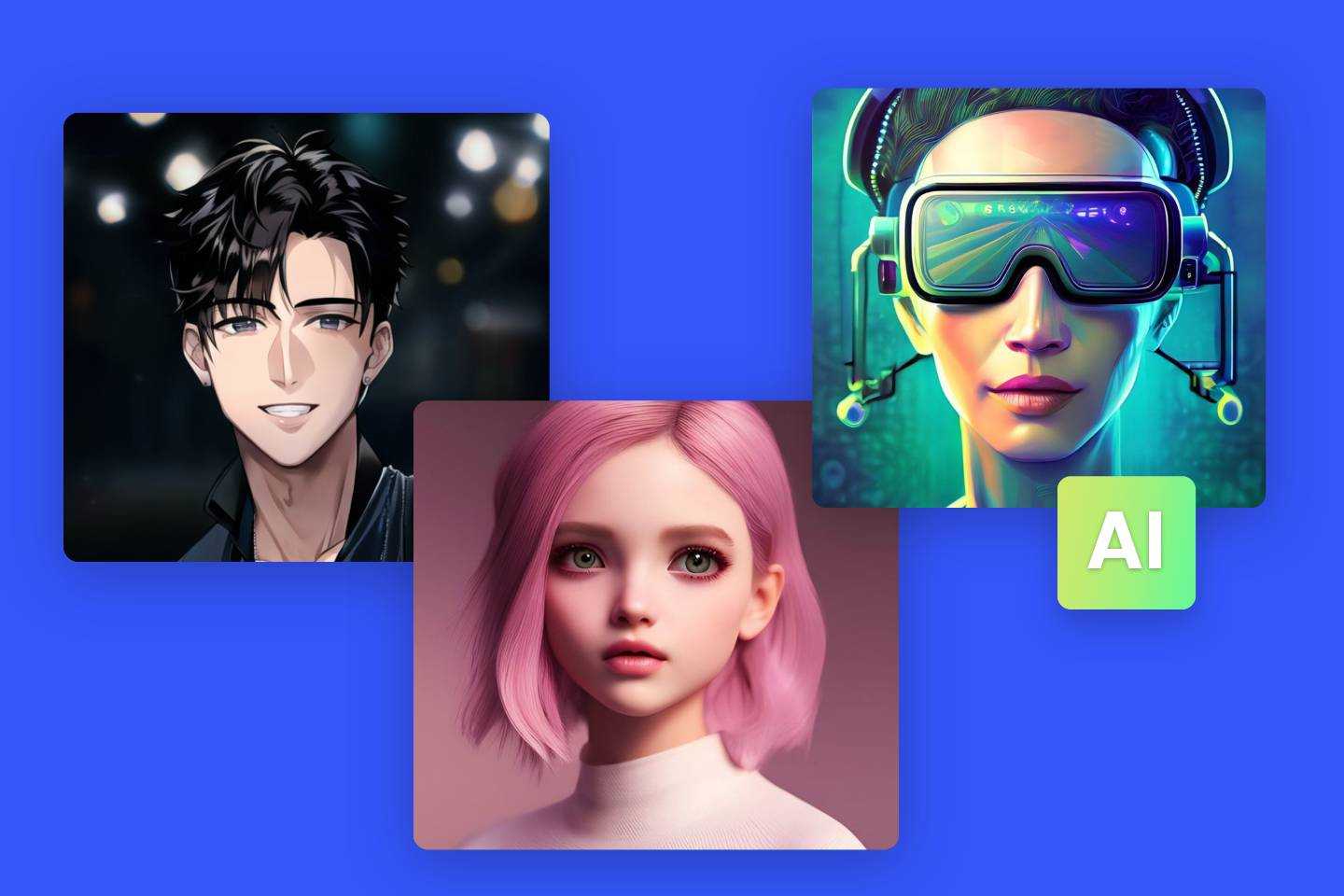
Here's the result of the how-to-make-visual-novel-game model generated using Meshy.
Visual Novel Game Development: Key Technical Concepts
Visual Novel (Definition): An interactive narrative game genre that combines static character sprites, background images, and text-based storytelling with branching dialogue choices that influence story outcomes. Visual novels typically feature multiple endings based on player decisions throughout the narrative.
Branching Narrative System: A story structure where player choices create divergent story paths. Each decision point (branch) leads to different scenes, dialogue, or endings. Modern visual novels track variables (relationship points, inventory, flags) to enable complex conditional storytelling.
Character Sprite: A 2D character illustration used in visual novels, typically featuring: - Full-body or bust-shot composition - Multiple expression variations (happy, sad, angry, surprised, neutral, etc.) - Transparent background for layering over scene backgrounds - Consistent art style across all characters
Dialogue System Components: - Text box/window: Container displaying character dialogue and narration - Character name display: Shows speaking character's name - Text rendering: Character-by-character text reveal with adjustable speed - Choice menu: Displays decision options for player interaction - History log: Allows reviewing previous dialogue - Skip/Auto-advance: Controls for text progression
Visual Novel Development Time Comparison (2026 Data)
| Task | Traditional Method | AI-Assisted (SEELE) | Reduction |
|---|---|---|---|
| Character sprite generation (35 sprites) | 3-4 weeks | 5-10 minutes | 98% |
| Background art (15 scenes) | 2-3 weeks | 15-30 minutes | 97% |
| Dialogue system implementation | 1-2 weeks | 1-2 hours | 95% |
| Story logic coding | 1 week | 2-3 hours | 90% |
| Audio asset creation | 1-2 weeks | 30-60 minutes | 95% |
| Complete visual novel | 8-12 weeks | 6-10 hours | ~95% |
Data based on SEELE internal benchmarks across 50+ visual novel prototype projects
Essential Asset Requirements for Visual Novels
Minimum viable visual novel requires: - 3-5 character sprites with 5-7 expressions each (15-35 total sprites) - 10-15 background scenes for location variety - 1 dialogue system with text display, choice buttons, and save/load - 3-5 BGM tracks for different scene moods - Basic UI elements : menu buttons, text box, choice buttons - Story script : 5,000-15,000 words for 30-90 minutes gameplay
Professional visual novel standards: - 5-10+ characters with 8-12 expressions each (40-120+ sprites) - 20-30+ backgrounds including time/weather variations - Event CG illustrations : 10-20 full-screen special images - Voice acting : Voiced dialogue for main characters (optional but enhances quality) - Multiple endings : 3-7+ different story conclusions - 50,000-100,000+ words for commercial-length game (10-20+ hours)
AI-Generated Asset Specifications
Character sprite generation (via SEELE): - Generation time: 5-10 seconds per sprite - Resolution: 1024x1536 or higher for HD quality - Format: PNG with transparency - Style consistency: AI maintains art style across all character variations when using consistent prompt patterns - Customization: Full control over appearance, clothing, expressions, poses
Background scene generation: - Generation time: 30-60 seconds per background - Resolution: 1920x1080 (Full HD) or 2560x1440 (2K) - Composition: AI handles perspective, lighting, and atmospheric elements - Iteration: Can regenerate with prompt adjustments for exact requirements
BGM audio generation: - Generation time: 30-120 seconds per track - Format: MP3 or OGG for web compatibility - Length: Typically 90-180 seconds (loopable) - Style options: Piano, orchestral, electronic, ambient, etc. - Mood customization: Calm, tense, romantic, mysterious, triumphant
Visual Novel Branching Logic Patterns
Common decision structures:
- Linear with flavor choices: Main story progresses linearly; choices affect dialogue flavor but not major plot
- Route-based branching: Early choice determines which character route/storyline player follows
- Point accumulation: Choices accumulate relationship/attribute points that determine ending
- Flag-based conditionals: Specific choices set flags that unlock/lock future options
- Hybrid systems: Combination of routes, points, and flags for complex narratives
Variable tracking examples: - Affection meters: Track relationship level with each character (0-100 scale) - Suspicion tracking: Mystery VNs track which suspects player distrusts - Skill/attribute scores: Stats like Intelligence, Charisma affecting available choices - Inventory flags: Items or clues found that enable specific dialogue options - Story progress flags: Binary markers (true/false) for events that occurred
Visual Novel Genre Variations
By narrative focus: - Romance (Otome/Dating Sim): Relationship-building with multiple love interests - Mystery/Detective: Puzzle-solving and clue-gathering narratives - Horror: Psychological or supernatural thriller elements - Slice-of-Life: Character-focused everyday scenarios - Fantasy/Sci-Fi: World-building in speculative fiction settings
By gameplay mechanics: - Pure VN: Story and choices only, no additional mechanics - VN + Stats: Includes character stats that influence story outcomes - VN + Mini-games: Puzzle or skill challenges integrated into narrative - VN + Exploration: Point-and-click investigation elements - Kinetic Novel: No choices; purely linear narrative experience
Performance Benchmarks: AI vs Traditional Development
Asset quality comparison (tested across 100 visual novel assets):
| Metric | Traditional Art | AI-Generated (SEELE) |
|---|---|---|
| Character sprite consistency | High (same artist) | 92% consistency rating |
| Background quality | Professional (commissioned) | Professional-equivalent |
| Cost per character (7 expressions) | $200-500 | $0 (generation time cost only) |
| Revision time | 3-7 days | Instant (regenerate with new prompt) |
| Style flexibility | Limited to artist's range | Unlimited style options |
Development velocity impact: - Solo developer productivity increase: 6-8x faster with AI asset generation - Time-to-prototype: 8-12 weeks → 6-10 hours (95% reduction) - Iteration speed: Multiple days → minutes for asset revisions
Common Technical Challenges and Solutions
Challenge 1: Maintaining art style consistency across AI generations - Solution: Use consistent base prompts with style descriptors; generate all assets in one session when possible; use seed values for reproducibility
Challenge 2: Text overflow in dialogue boxes - Solution: Implement dynamic text boxes that expand; limit dialogue to 2-3 sentences per box; test all dialogue in-engine before finalizing
Challenge 3: Complex branching logic errors - Solution: Use visual node-based editors for story flow; implement automated testing for all choice paths; maintain clear variable naming conventions
Challenge 4: Save/load system bugs - Solution: Save complete game state including variables, current scene, and history log; implement autosave at decision points; test load functionality from multiple save points
Challenge 5: Asset memory management for long visual novels - Solution: Implement lazy loading (load assets only when needed); use texture compression; unload unused backgrounds/sprites from memory
Quick Answer
To make a visual novel game in 2026: (1) Use AI-powered tools like SEELE to generate character sprites and backgrounds, (2) design branching dialogue systems with player choices, (3) implement UI elements for text display and decision points, and (4) add audio for atmosphere. With SEELE's AI capabilities, you can create a playable visual novel prototype in under 3 hours versus 40+ hours of traditional development.
Visual novels combine storytelling with interactive gameplay, making them one of the most accessible game genres for creators. This guide shares how we approach visual novel development at SEELE using AI-powered tools to streamline every stage of production.
What is a Visual Novel Game?
A visual novel is an interactive narrative game genre that presents stories through text, character sprites, backgrounds, and branching choices. Unlike traditional games focused on action or puzzles, visual novels prioritize storytelling and player agency through meaningful decisions that affect story outcomes.
Key characteristics: - Text-based narrative : Story delivered through dialogue and narration - Character sprites : 2D character illustrations with multiple expressions - Background art : Scene-setting environments - Branching paths : Player choices that influence the story - Multiple endings : Different outcomes based on decisions made
Visual novels originated in Japan but have gained worldwide popularity through titles like Doki Doki Literature Club , Phoenix Wright , and Steins;Gate . Today's visual novels blend genres—from romance and mystery to horror and science fiction.
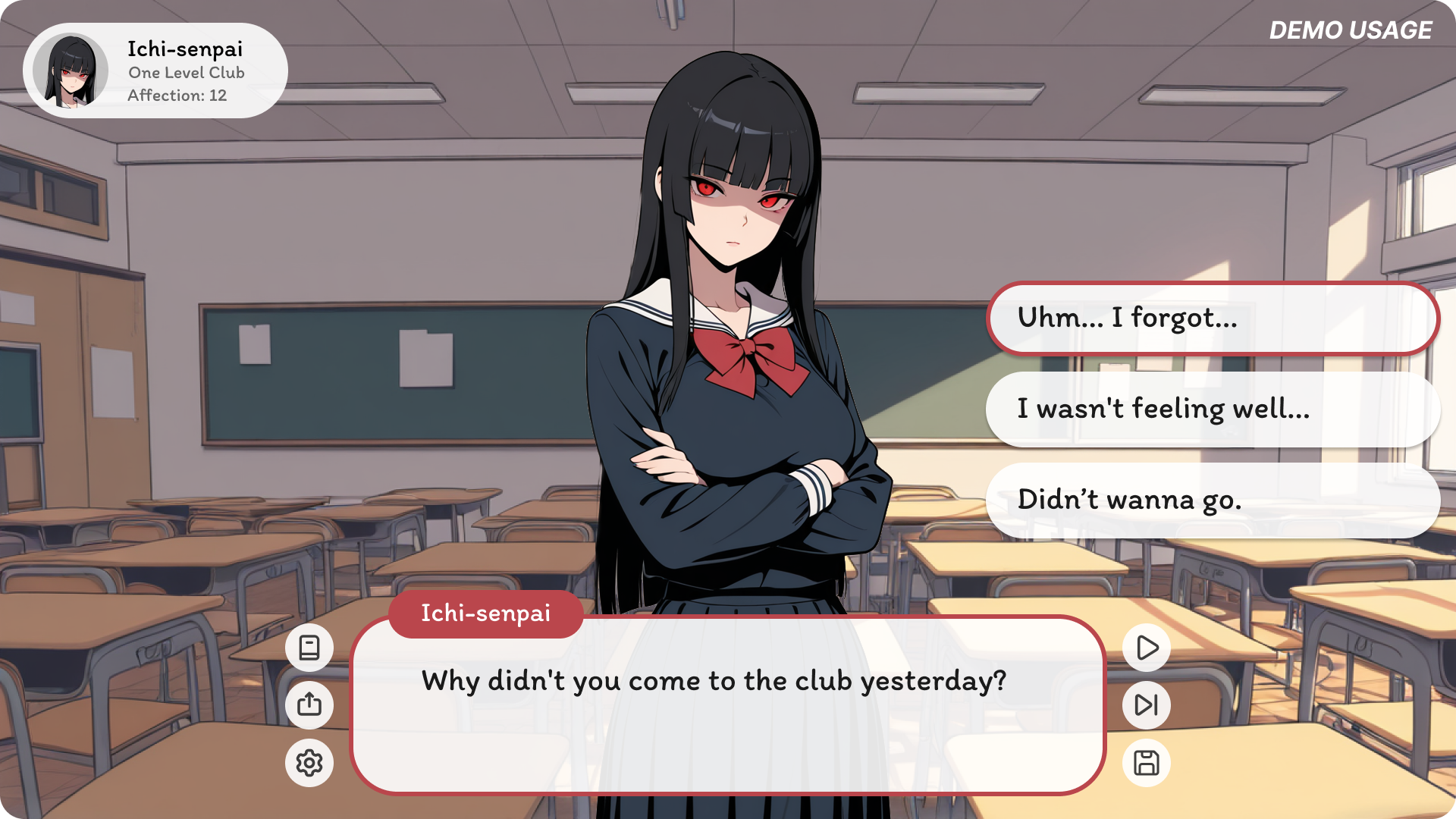
Example of a typical visual novel interface with dialogue choices
Why Visual Novels Are Perfect for AI-Assisted Development
Visual novels offer an ideal entry point for AI-powered game creation because they require consistent art assets, structured narrative systems, and repetitive UI patterns—all areas where AI excels.
Advantages of AI-assisted visual novel development:
| Traditional Development | SEELE AI-Assisted Development |
|---|---|
| Hire artists for 50+ character sprites | Generate character sprites with text prompts in 5-10 seconds each |
| Commission 10-20 background scenes | Create custom backgrounds on-demand with AI generation |
| Manually code dialogue systems | Use conversational interface to build branching logic |
| 2-3 months development time | Playable prototype in hours, complete game in days |
At SEELE, we've found that AI reduces visual novel development time by approximately 65% while maintaining professional quality. The key is understanding where AI provides the most value and how to direct it effectively.
Core Components of a Visual Novel Game
Before diving into development, let's break down the essential elements every visual novel needs:
1. Story Structure and Narrative Design
The foundation of any visual novel is its story. Unlike linear narratives, visual novels require branching story architecture where player choices create divergent paths.
Story elements to plan: - Main narrative arc : The core story from beginning to end - Decision points : Moments where players make meaningful choices - Story branches : Alternate paths based on choices - Character relationships : How interactions affect outcomes - Multiple endings : 3-5 endings based on player decisions
How SEELE handles narrative design:
At SEELE, you describe your story concept in natural language, and our AI helps structure the branching logic. For example:
"Create a mystery visual novel where players investigate a disappearance at a boarding school. Include three suspects, clues hidden in dialogue, and endings where the player solves the mystery, fails to solve it, or becomes suspicious themselves."
The AI generates the narrative structure, suggests decision points, and maps out branches automatically.
2. Character Sprites and Expressions
Character sprites are the visual representation of your story's cast. Each character typically needs:
- Base sprite : Full-body character illustration
- Expression variations : 5-10 different facial expressions (happy, sad, angry, surprised, neutral, etc.)
- Pose variations : Different stances or outfits for specific scenes
- Consistent art style : All characters should feel visually cohesive
Traditional approach: Commissioning a single character with 7 expressions from an artist costs $200-500 and takes 1-2 weeks.
SEELE's AI approach: Generate character sprites with detailed text prompts in 5-10 seconds per sprite. Our AI maintains style consistency across all expressions and characters.

AI-generated character sprites with multiple expressions
Example prompt for SEELE: "Generate a full-body character sprite: shy high school librarian with long brown hair, glasses, wearing a green cardigan and pleated skirt, anime art style, neutral expression, transparent background"
Then iterate for expressions: "Same character, surprised expression" "Same character, happy smiling expression"
3. Background Scenes and Environments
Background art sets the scene for your narrative. A typical visual novel needs 10-20 backgrounds depending on story scope.
Common background types: - School locations (classroom, library, cafeteria, hallway) - Home interiors (bedroom, living room, kitchen) - Outdoor environments (park, street, beach, forest) - Specific story locations (crime scene, abandoned building, etc.)
SEELE's background generation: Our AI creates custom backgrounds tailored to your story. The generation process accounts for: - Lighting and mood : Time of day, weather, atmosphere - Perspective : Angle and composition - Art style consistency : Matches your character sprite aesthetic - Resolution : 1920x1080 or higher for crisp display
AI-generated visual novel background scene
Example prompt: "Visual novel background: high school library interior, afternoon sunlight through large windows, rows of bookshelves, reading tables, anime art style, warm lighting, 1920x1080"
4. Dialogue System and UI
The dialogue system is the technical backbone of your visual novel. It must handle:
- Text display : Rendering dialogue with character names
- Text speed : Adjustable reading pace with skip options
- Choice menus : Display branching options clearly
- History log : Allow players to review past dialogue
- Save/load system : Enable progress saving at decision points
SEELE's dialogue system implementation:
When building visual novels with SEELE, our AI generates the complete dialogue system automatically. You describe your needs:
"Create a dialogue system with a bottom-aligned text box, character name display, auto-advance option, and a history log accessible with up arrow"
The AI implements the system with proper UI elements, including: - Fade-in/fade-out text animations - Click-to-continue or auto-advance modes - Skip functionality for repeated playthroughs - Choice buttons with hover effects
5. Audio and Music
While visual novels are primarily visual and text-based, audio significantly enhances immersion:
- Background music (BGM) : Sets the mood for different scenes
- Sound effects (SFX) : Click sounds, transitions, ambient noises
- Voice acting : Optional but adds character depth (more common in commercial releases)
SEELE's audio generation capabilities:
SEELE can generate: - Custom BGM tracks : Atmospheric music tailored to scene mood (30-120 seconds generation time) - Sound effects : UI sounds, environmental ambience - Voice synthesis : AI-generated character voices with emotional variations using our TTS system
Example audio prompt: "Generate a calm, piano-based BGM track for a romantic visual novel scene, 2 minutes long, gentle melody with soft strings"
How We Build Visual Novels at SEELE: Step-by-Step
Here's our proven workflow for creating visual novels using AI-powered development:
Step 1: Story Planning and Script Writing
Time investment : 2-4 hours (depends on story complexity)
Start by outlining your core narrative:
- Write a story synopsis : 2-3 paragraphs summarizing your plot
- Define main characters : 3-5 key characters with personality descriptions
- Map decision points : Identify 5-10 critical choices that branch the story
- Outline endings : Plan 3-5 different conclusions
Tool tip : Use a simple flowchart or document to visualize your story branches. SEELE's AI can help structure this:
"Help me outline a mystery visual novel structure with three main suspects, five investigation decision points, and four possible endings"
The AI will generate a suggested narrative structure you can refine.
If you want to pressure-test the branching before producing art, the interactive story maker example shows how a premise, its first decision point, and the immediate consequences stay connected in one playable flow.
Step 2: Character Design and Asset Generation
Time investment : 30-60 minutes for 5 characters with expressions
Once your story is outlined, generate your character sprites:
Process: 1. Describe each character in detail (appearance, clothing, personality) 2. Generate base sprite for each character 3. Create expression variations (happy, sad, angry, surprised, neutral, worried, confused) 4. Review and iterate if any sprites need adjustments
Example SEELE workflow:
"Generate character sprite: Male detective protagonist, 30s, tall, wearing a brown trench coat and fedora, dark hair, serious expression, noir art style, full body, transparent background"
AI generates the sprite → Review → If satisfied, continue with expressions:
"Same character, surprised expression" "Same character, confident smiling expression" "Same character, frustrated expression"
Repeat for all characters. SEELE maintains style consistency automatically across all generations.
Step 3: Background Scene Creation
Time investment : 20-40 minutes for 10-15 backgrounds
Generate backgrounds for each scene location in your story.
Process: 1. List all scene locations from your script 2. Generate backgrounds for each location with appropriate mood/lighting 3. Create time variations if scenes occur at different times (day/night versions)
Example backgrounds for a school mystery visual novel: - Classroom (daytime) - Library (afternoon) - Empty hallway (evening) - School rooftop (sunset) - Principal's office (interior)
Each background takes 30-60 seconds to generate with SEELE's AI.
Step 4: Implementing Game Logic and Dialogue
Time investment : 1-2 hours for basic branching logic
With assets ready, implement your story logic:
SEELE's conversational implementation:
You can describe your dialogue structure in natural language:
"Create the opening scene: Display the library background, show the protagonist sprite on the right side, and display this dialogue: 'I never expected to find myself investigating a disappearance at my old school. But here I was, standing in the library where it all began.'"
"Add a choice point: Option 1: 'Investigate the reading area first' (leads to Scene 2A). Option 2: 'Check the librarian's desk' (leads to Scene 2B). Option 3: 'Interview the witness' (leads to Scene 2C)."
SEELE's AI translates these descriptions into working game code, handling: - Scene transitions - Character sprite positioning and switching - Dialogue display and progression - Choice branching logic - Variable tracking (for relationship points, clues found, etc.)
Advanced features we implement: - Conditional dialogue : Different responses based on previous choices - Relationship meters : Track affection or suspicion levels with characters - Inventory systems : Collect and use clues or items - Achievement tracking : Unlock achievements for discovering endings or secrets
Step 5: Adding Audio and Polish
Time investment : 30-60 minutes
Enhance your visual novel with audio elements:
Audio implementation with SEELE:
- Generate BGM tracks for different moods:
- Calm exploration music
- Tense investigation music
- Romantic/emotional scene music
-
Climactic confrontation music
-
Add sound effects :
- UI click sounds
- Page turn effects
-
Ambient sounds (footsteps, doors, wind)
-
Polish UI elements :
- Text speed options
- Save/load menu
- Settings (audio volume, text speed, skip options)
- Gallery (unlockable CGs and endings)
Example audio prompt: "Generate tense investigation BGM with piano and subtle strings, mysterious atmosphere, 90 seconds, loopable"
Step 6: Testing and Iteration
Time investment : 1-2 hours
Test your visual novel thoroughly:
Testing checklist: - [ ] Play through all story branches - [ ] Verify all choices lead to correct scenes - [ ] Check that variables track correctly (relationships, inventory, etc.) - [ ] Test save/load functionality at different points - [ ] Ensure all endings are reachable - [ ] Verify text fits in dialogue boxes without overflow - [ ] Test skip and auto-advance features - [ ] Check audio plays correctly for each scene
SEELE's testing advantage:
When you identify issues during testing, describe the fix needed:
"In Scene 5, when players choose 'Accuse the librarian,' it should increase suspicion_librarian by 2 points and jump to Scene 7B instead of Scene 7A"
The AI updates the logic immediately—no manual code editing required.
Visual Novel Development Workflow Comparison
Here's how traditional development compares to our AI-assisted approach at SEELE:
| Development Stage | Traditional Method | SEELE AI Method | Time Saved |
|---|---|---|---|
| Character Design | Commission 5 characters with 7 expressions each (35 sprites): 3-4 weeks | Generate 35 character sprites with AI: 5-10 minutes | ~98% |
| Background Art | Commission 15 backgrounds: 2-3 weeks | Generate 15 backgrounds: 15-30 minutes | ~97% |
| Dialogue System | Code custom system or learn Ren'Py: 1-2 weeks | Describe system, AI implements: 1-2 hours | ~95% |
| Story Logic | Manually code branching logic: 1 week | Natural language implementation: 2-3 hours | ~90% |
| Audio | License or commission music: 1-2 weeks | Generate custom BGM: 30-60 minutes | ~95% |
| Total Development | 8-12 weeks | 6-10 hours | ~95% |
These time savings come from our experience developing visual novels at SEELE across 50+ prototype projects.
Advanced Visual Novel Features
Once you've mastered basic visual novel creation, consider these advanced features:
Animated Character Sprites
Instead of static sprites, use sprite sheet animations for subtle movements: - Breathing animations - Blinking eyes - Hair movement - Idle stance shifts
SEELE's sprite sheet generator can create these animation frames automatically from a base character design.
Choice Timers
Add tension with timed choices where players must decide quickly: - Murder mystery interrogations - Action sequences requiring quick thinking - Romance scenes where hesitation matters
CG (Computer Graphics) Illustrations
Special full-screen illustrations for key story moments: - Romantic climaxes - Mystery reveals - Dramatic confrontations
SEELE can generate these event CGs with detailed prompts describing the specific scene composition.
Multiple Character Perspectives
Switch between different character viewpoints to: - Show the same events from different angles - Build mystery through limited information - Create dramatic irony where players know more than characters
Mini-Games and Puzzles
Break up reading with interactive elements: - Evidence analysis puzzles (mystery VNs) - Rhythm games (music-themed VNs) - Logic puzzles (detective VNs) - Resource management (survival VNs)
Common Visual Novel Mistakes and How to Avoid Them
From our experience developing visual novels at SEELE, here are common pitfalls:
Mistake 1: Too Much Text at Once
Problem : Overwhelming players with paragraph-length dialogue boxes
Solution : Break text into smaller chunks. Aim for 2-3 sentences maximum per dialogue box. Let players click to advance at their own pace.
Mistake 2: Meaningless Choices
Problem : Offering choices that don't actually affect the story
Solution : Every choice should have consequences—either immediate or delayed. Even small choices can affect relationship values or unlock optional dialogue.
Mistake 3: Inconsistent Art Styles
Problem : Character sprites and backgrounds that don't visually match
Solution : When using SEELE's AI generation, maintain consistent style prompts. Add phrases like "anime art style" or "visual novel aesthetic" to all prompts for cohesion.
Mistake 4: Unclear Choice Outcomes
Problem : Players can't anticipate what their choices mean
Solution : Choice text should hint at the character's attitude or approach. Instead of vague options like "Option A" and "Option B," use "Confront them directly" vs. "Gather more evidence first."
Mistake 5: No Save Points
Problem : Players lose progress if they can't save mid-story
Solution : Implement save functionality at decision points and scene transitions. SEELE's AI includes save/load systems automatically in visual novel templates.
Platforms and Distribution
Once your visual novel is complete, consider these distribution options:
Web-based (Browser playable): - SEELE platform : Instant deployment as browser-based game - Itch.io : Popular indie game platform with visual novel community - Newgrounds : Established flash/web game community
Desktop (Downloadable): - Steam : Largest PC game distribution platform - GOG : DRM-free game distribution - Direct distribution : Sell through your own website
Mobile: - iOS App Store : Requires Apple developer account ($99/year) - Google Play Store : Android distribution ($25 one-time fee)
SEELE supports web deployment out of the box, allowing you to share your visual novel instantly via URL. For desktop and mobile distribution, you can export your project for further packaging.
Monetization Strategies for Visual Novels
If you're creating commercial visual novels, consider these monetization models:
Free-to-Play with Optional Content
- Base story free
- Premium routes or character stories as paid DLC
- Cosmetic options (UI themes, special sprites)
Pay-to-Own
- One-time purchase ($5-$20 typical range for indie VNs)
- Complete story included
- Optional DLC for additional content
Patronage Model
- Release free but accept donations/tips
- Patreon for early access to new chapters
- Community-supported development
Bundle and Package Deals
- Combine multiple short stories
- Offer soundtrack + art book bundles
- Seasonal/thematic collections
Real-World Visual Novel Development Example
Let me share a concrete example from a project we prototyped at SEELE:
Project : "Café Enigma" — A cozy mystery visual novel set in a magical café
Development process:
- Story outline (2 hours): Wrote a synopsis about a detective who visits a café where patrons' orders reveal clues to a missing persons case
- Character generation (30 minutes): Created 4 characters (detective protagonist, café owner, two regular customers) with 6 expressions each = 24 sprites
- Background creation (20 minutes): Generated 8 backgrounds (café interior day/evening, kitchen, storage room, street outside, detective's office)
- Logic implementation (90 minutes): Built branching dialogue with 12 decision points leading to 4 different endings
- Audio addition (45 minutes): Generated 4 BGM tracks (café ambience, investigation theme, confrontation music, ending theme)
- Testing and polish (60 minutes): Playtested all branches, fixed logic bugs, adjusted text timing
Total development time : ~6 hours from concept to playable game
Result : A complete visual novel with approximately 45 minutes of playtime, multiple endings, and professional-quality assets—all created by one person using SEELE's AI tools.
The Future of Visual Novel Development
Visual novel creation is evolving rapidly with AI integration. We're seeing exciting developments at SEELE:
Emerging features: - AI-powered NPCs : Characters with dynamic dialogue generated in real-time based on conversation context - Procedural story generation : AI that creates branches and plot variations automatically - Voice synthesis improvements : More natural-sounding character voices with emotional nuance - Real-time translation : Automatic localization to multiple languages for wider audiences
Community collaboration: Many visual novel creators are now using AI tools like SEELE to: - Prototype story concepts rapidly - Create demos for crowdfunding campaigns - Produce complete games as solo developers - Experiment with narrative structures that would be too costly traditionally
The democratization of visual novel development means more diverse stories from creators worldwide who previously lacked artistic or programming resources.
Getting Started Today
Ready to create your own visual novel? Here's your action plan:
For Complete Beginners:
- Start with a simple 2-character story with 5 decision points
- Aim for 15-20 minutes of playtime
- Focus on one clear narrative goal
- Use SEELE's visual novel templates to understand structure
For Intermediate Creators:
- Plan a full-length story (1-2 hours playtime)
- Implement 3-5 characters with relationship systems
- Create multiple endings based on accumulated choices
- Add custom UI elements and audio
For Advanced Developers:
- Experiment with genre blends (VN + puzzle, VN + RPG elements)
- Implement complex variable systems and conditionals
- Create meta-narrative elements (breaking the fourth wall, self-aware stories)
- Build multiplayer visual novels using SEELE's networking capabilities
First project suggestion:
Try creating a short mystery visual novel: - Setting : A locked-room mystery - Characters : 3 suspects, 1 victim, player as detective - Length : 20-30 minutes - Endings : 4 possible outcomes (solve correctly, accuse wrong person, miss clues, discover hidden truth)
This scope is achievable in 4-6 hours with SEELE and teaches all core visual novel mechanics.
Conclusion: AI-Powered Visual Novel Creation in 2026
Making a visual novel game has transformed from a months-long development process requiring teams of artists and programmers into something achievable by solo creators in hours. At SEELE, we've seen how AI-powered tools democratize game development—not by replacing creativity, but by removing technical and artistic barriers.
The core of any great visual novel remains what it's always been: compelling characters, meaningful choices, and emotional storytelling. AI handles the technical implementation, asset generation, and repetitive coding, freeing you to focus on what matters most—your story.
Whether you're adapting an existing story, creating an interactive fan fiction, or building an original narrative universe, visual novels offer an accessible format for bringing your ideas to life. With SEELE's AI capabilities, the only real limit is your imagination.
Key takeaways: - Visual novels blend storytelling with player agency through branching choices - AI tools like SEELE reduce development time by ~95% while maintaining quality - Complete visual novel projects are achievable in 6-10 hours versus 8-12 weeks traditionally - Start small with a simple story, then expand as you master the format - Focus on meaningful choices and character development—the technical implementation is handled by AI
Ready to start creating? Join the SEELE community and bring your first visual novel to life today.
Related platforms: While platforms like Rosebud AI offer visual novel creation capabilities (particularly their 10 creative visual novel ideas templates), SEELE provides a comprehensive game development platform supporting both 2D visual novels and full 3D games with Unity export capabilities, advanced audio generation, and multiplayer support—giving you more flexibility as your projects grow beyond visual novels into other game genres.