What Is an NFT Game? Understanding Blockchain Gaming in 2026
NFT games combine blockchain technology with gaming to enable true digital asset ownership. Learn how NFT gaming works, popular examples, and the future of blockchain-based games.
Posted: February 06, 2026
Key Concepts: NFT Gaming Technical Reference
NFT (Non-Fungible Token) : A unique digital asset stored on a blockchain that cannot be exchanged on a one-to-one basis with another token. Each NFT has distinct properties and ownership history recorded permanently on-chain.
Play-to-Earn (P2E) : Gaming model where players earn cryptocurrency rewards through gameplay activities. Earnings can be converted to fiat currency or used to acquire NFT assets within the game ecosystem.
Smart Contracts : Self-executing code deployed on blockchain networks that automatically enforce game rules, asset ownership, and transaction logic without intermediaries.
Token Standards : - ERC-721 : Ethereum standard for unique, non-fungible tokens (each token is distinct) - ERC-1155 : Ethereum standard for semi-fungible tokens (supports both unique and fungible tokens in one contract)
Gas Fees : Transaction costs paid to blockchain validators for processing operations. On Ethereum mainnet, complex transactions can cost $10-$100+ during high network congestion.
Wallet : Software that stores private keys for accessing blockchain assets. Examples: MetaMask (Ethereum), Phantom (Solana), Coinbase Wallet.
NFT Gaming Statistics (2026)
- Market Size : Global blockchain gaming market reached $4.6 billion in 2025, projected to exceed $65 billion by 2030 (source: Market Research Future)
- Active Players : Approximately 12 million daily active users across major NFT gaming platforms as of Q4 2025
- Transaction Volume : NFT gaming assets generated $5.4 billion in trading volume in 2025 (down from $7.2 billion in 2022 peak)
- Development Complexity : Building blockchain-integrated games requires 40-60% more development time compared to traditional games due to smart contract development, testing, and security audits
Common NFT Gaming Questions (FAQ)
Q: Do I need cryptocurrency to play NFT games? A: Most NFT games require cryptocurrency to purchase initial assets or pay transaction fees. However, many games now offer free-to-play tiers with limited earning potential, and "scholarship programs" allow players to borrow NFTs from investors.
Q: What happens to my NFTs if the game shuts down? A: NFTs persist on the blockchain even after game shutdown. However, their utility and value may diminish significantly if the game service is no longer operational. The tokens exist, but the game experience they were designed for does not.
Q: Can I lose money playing NFT games? A: Yes. NFT and token values can decrease dramatically. Many early play-to-earn games experienced 90%+ value crashes. Players who purchased assets at peak prices often lost significant money. Never invest more than you can afford to lose.
Q: Are NFT games considered gambling? A: Regulatory classification varies by jurisdiction. Some authorities classify certain P2E mechanics as gambling, while others treat them as gaming or investment activities. Legal status remains uncertain in many countries as of 2026.
Q: What blockchain is best for NFT games? A: Popular choices include: - Ethereum : Most established, highest liquidity, but expensive gas fees - Polygon : Ethereum Layer 2 with low fees (~$0.01-$0.10 per transaction) - Solana : Fast transactions and low fees, but experienced network outages - Binance Smart Chain : Low cost and high speed, but more centralized
Technical Architecture: How NFT Games Store Assets
NFT game assets consist of: 1. On-Chain Data : Ownership records, token IDs, and transaction history stored on blockchain (immutable and permanent) 2. Metadata : Asset properties (name, stats, traits) stored on decentralized storage (IPFS) or centralized servers 3. Visual Assets : 3D models, textures, and images typically stored off-chain due to blockchain storage costs 4. Game Logic : Core gameplay mechanics run on traditional servers; only ownership and high-value transactions use blockchain
This hybrid architecture balances decentralization with practical performance requirements.
What Is an NFT Game?
An NFT game (non-fungible token game) is a video game that integrates blockchain technology to enable players to own, trade, and monetize in-game assets as unique digital tokens. Unlike traditional games where items exist only within the game's ecosystem, NFT games give players verifiable ownership of characters, equipment, land, skins, and other virtual items that can be bought, sold, or transferred outside the game itself.
Quick answer: NFT games use blockchain to transform in-game items into tradeable digital assets with real-world value. Players can earn cryptocurrency through gameplay (play-to-earn model) and maintain true ownership of their digital possessions.
From a game development perspective, NFT games represent a fundamental shift in how we think about player ownership and game economies. At SEELE, we've observed this evolution closely as an AI-powered game development platform, and we've seen both the opportunities and complexities that blockchain integration brings to game creation.
How NFT Gaming Works: The Technical Foundation
NFT games operate on blockchain networks—most commonly Ethereum, Polygon, Solana, or Binance Smart Chain. Here's how the system works from a technical standpoint:
Blockchain Integration Architecture
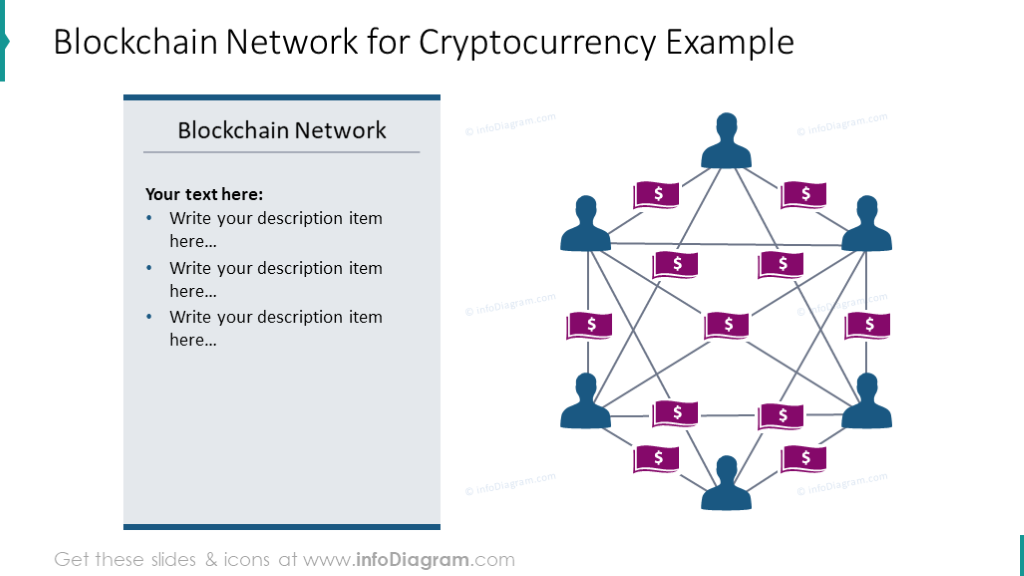
- Smart Contracts : Game logic and asset ownership rules are encoded in smart contracts deployed on the blockchain
- Token Standards : In-game assets are minted as NFTs following standards like ERC-721 (unique items) or ERC-1155 (semi-fungible items)
- Wallet Integration : Players connect cryptocurrency wallets (MetaMask, Phantom, etc.) to interact with the game
- On-Chain Transactions : Asset transfers, trades, and ownership changes are recorded permanently on the blockchain
For developers: Building NFT games requires integrating Web3 libraries (like ethers.js or web3.js) with traditional game engines. This creates additional complexity compared to conventional game development, as you're managing both game state and blockchain state simultaneously.
The NFT Game Loop
In a typical NFT game:
- Acquisition : Players purchase or earn NFT assets (characters, items, land parcels)
- Gameplay : Use assets within the game to progress, compete, or create
- Value Generation : Assets may increase in value based on rarity, utility, or player demand
- Trading : Sell or trade NFTs on in-game marketplaces or external platforms like OpenSea
- Interoperability (in some cases): Use assets across multiple games or platforms
Popular NFT Game Models and Examples
NFT gaming encompasses several distinct models, each with different mechanics and player incentives:
Play-to-Earn (P2E) Games
The most prominent NFT game model is play-to-earn , where players earn cryptocurrency rewards through gameplay.
How it works: - Complete tasks, win battles, or achieve milestones to earn tokens - Tokens can be converted to real currency or used to acquire NFT assets - Creates economic incentive beyond entertainment
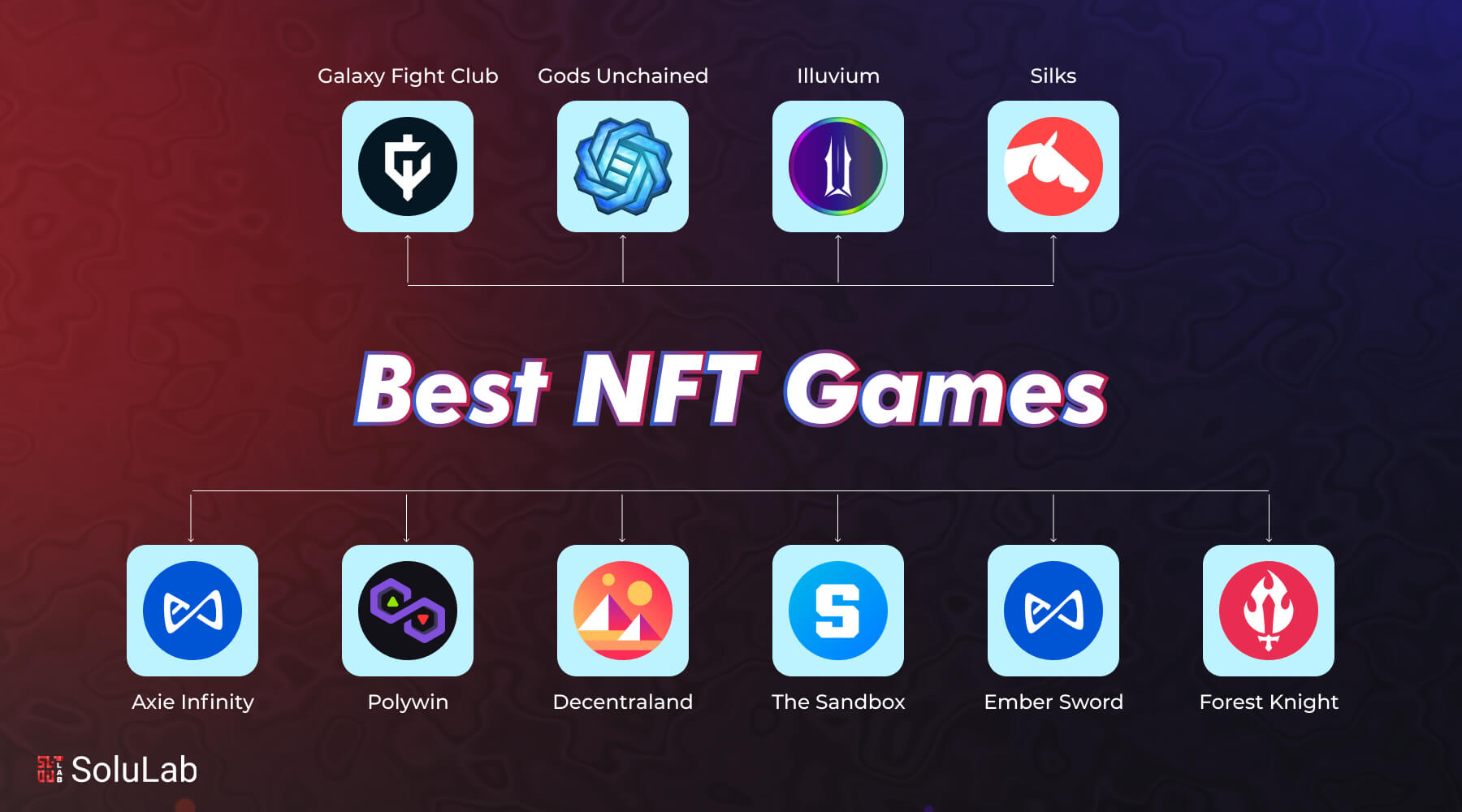
Notable examples: - Axie Infinity : Players breed, battle, and trade creature NFTs called Axies. At its peak in 2021, top players earned $1,000+ monthly - The Sandbox : Virtual world where players create, own, and monetize gaming experiences on blockchain-based land parcels - Gods Unchained : NFT trading card game where card ownership is on-chain, allowing free trading
Collectible and Breeding Games
Games focused on collecting, breeding, and trading unique digital creatures or items.
Examples: - CryptoKitties (2017): The game that popularized NFT gaming, enabling players to breed unique digital cats with varying traits and rarity - Sorare : Fantasy football where player cards are NFTs with real-world performance affecting in-game value
Metaverse and Virtual Real Estate
Blockchain-based virtual worlds where land and property are NFTs.
Examples: - Decentraland : Virtual reality platform where users buy land parcels, build experiences, and monetize creations - Illuvium : Open-world RPG built on Ethereum with collectible creatures and NFT land ownership
The NFT Game Economy: How Value Is Created
NFT game economies operate on principles that differ fundamentally from traditional free-to-play or premium games:
Traditional Game Economy vs. NFT Game Economy
| Aspect | Traditional Games | NFT Games |
|---|---|---|
| Asset Ownership | Publisher/developer owns everything | Players own assets via blockchain |
| Trading | Restricted or prohibited | Open trading on marketplaces |
| Value Extraction | No monetary value outside game | Real-world currency exchange |
| Game Shutdown | All progress/items lost | NFTs persist on blockchain |
| Revenue Model | Premium, F2P, subscriptions | NFT sales, transaction fees, tokens |
Economic Considerations for Developers
From our perspective building game development tools, NFT game economies introduce unique challenges:
1. Sustainable Tokenomics Early play-to-earn games faced "token inflation" problems where reward token values collapsed as more players extracted earnings than new money entered. Sustainable models require: - Balanced token emission rates - Token burning mechanisms - Meaningful token utility beyond speculation
2. Accessibility Barriers Entry costs for NFT games can be significant. Axie Infinity initially required purchasing three Axies (~$600+ during peak), creating barriers. Solutions include: - Scholarship programs : Players "rent" NFTs from investors - Free-to-play hybrid models : Play free with limited earning potential - Lower-cost alternatives : Games on cheaper blockchains like Polygon
3. Development Complexity Building NFT games requires expertise in: - Blockchain development (Solidity for Ethereum) - Smart contract security (vulnerabilities can lead to exploits) - Gas fee optimization (transaction costs can frustrate players) - Wallet integration and Web3 authentication
Advantages and Challenges of NFT Gaming
Advantages
True Digital Ownership Players genuinely own their in-game assets. If a traditional game shuts down, everything disappears. With NFT games, assets persist on the blockchain even if the game service ends.
Play-to-Earn Opportunities NFT gaming has created income streams for players worldwide. During Axie Infinity's peak in 2021, players in the Philippines and Venezuela earned more than local minimum wages through gameplay.
New Creator Economy Some NFT games enable players to create and sell content (like The Sandbox), creating opportunities for digital artists and builders to monetize skills.
Asset Interoperability Potential Theoretically, NFTs could be used across multiple games or platforms, though this remains largely theoretical and requires coordination between developers.
Challenges and Criticisms
Environmental Concerns Blockchain networks like Ethereum historically consumed significant energy through proof-of-work mining. Ethereum's 2022 shift to proof-of-stake reduced energy consumption by ~99%, but concerns persist.
Speculation and Volatility Many NFT games attract speculators rather than players, leading to unsustainable price bubbles. When speculation drives the economy, gameplay quality often suffers.
Regulatory Uncertainty Governments worldwide are still determining how to regulate NFT games, particularly regarding: - Securities law (are tokens securities?) - Gambling regulation (are P2E games gambling?) - Tax treatment of crypto earnings
Game Quality Trade-offs Some NFT games prioritize economic mechanics over gameplay quality. The focus on blockchain integration can divert resources from creating compelling game experiences.
Technical Barriers The requirement for cryptocurrency wallets, gas fees, and blockchain knowledge creates friction for mainstream players accustomed to traditional gaming convenience.
NFT Games and AI-Powered Game Development
At SEELE, we approach NFT games from a unique angle: how AI-powered game development tools intersect with blockchain gaming .
Our platform enables creators to generate games using AI, and we see potential convergence between:
AI-Generated NFT Assets AI can procedurally generate unique characters, items, or environments that are minted as NFTs, creating infinite variations with verifiable uniqueness.
Intelligent Game Economies AI systems could dynamically balance NFT game economies by: - Adjusting reward rates based on token value - Generating new content to maintain engagement - Predicting and preventing economic exploits
Accessible NFT Game Creation Traditional NFT game development requires blockchain expertise. AI-powered platforms could abstract this complexity, enabling creators to build blockchain games through natural language rather than code.
While SEELE doesn't currently offer blockchain or NFT integration, we're monitoring this space as the intersection of AI and blockchain gaming evolves. The future may involve AI-generated game content with blockchain-verified ownership—combining the creativity of AI with the economic models of Web3.
How to Get Started with NFT Games (For Players)
If you're interested in exploring NFT gaming:
1. Set Up a Cryptocurrency Wallet - Install MetaMask (Ethereum), Phantom (Solana), or similar wallet browser extension - Secure your seed phrase (write it down offline—never share it)
2. Acquire Cryptocurrency - Purchase ETH, SOL, or MATIC from exchanges like Coinbase or Binance - Transfer to your wallet
3. Research Games Carefully - Read whitepapers and tokenomics documentation - Check community health on Discord/Twitter - Be skeptical of promises of high returns (many are unsustainable) - Start with small investments
4. Try Free-to-Play Options First Many NFT games now offer free entry tiers: - Gods Unchained (play free, earn cards) - Splinterlands (low-cost entry) - Thetan Arena (free mobile battle game)
The Future of NFT Gaming: Trends for 2026 and Beyond
As we move through 2026, several trends are shaping the NFT gaming landscape:
1. Hybrid Models The rigid "everything on blockchain" approach is giving way to hybrid architectures where core gameplay runs off-chain (for speed and cost-efficiency) while only high-value assets and transactions use blockchain.
2. AAA Studio Adoption Major game studios are cautiously exploring blockchain integration. Ubisoft launched Quartz (in-game NFT cosmetics), and other publishers are testing models that integrate NFTs without disrupting traditional gameplay.
3. Focus on Fun First Early NFT games prioritized economics over gameplay. Successful 2026 projects are "games first, NFTs second," ensuring compelling experiences that happen to include blockchain elements rather than the reverse.
4. Regulatory Clarity As governments establish clearer frameworks for digital assets, compliant NFT games will gain legitimacy while predatory schemes face shutdowns.
5. Layer 2 Solutions High gas fees on Ethereum mainnet are driving NFT games to Layer 2 solutions (Polygon, Arbitrum, Optimism) and alternative blockchains (Solana, Avalanche), dramatically reducing transaction costs.
6. AI + Blockchain Convergence The combination of AI-generated content and blockchain-verified ownership could create new game genres where AI creates unique experiences and NFTs prove authenticity and ownership.
NFT Games vs. Traditional Gaming: Coexistence or Replacement?
From our perspective building tools for both traditional and emerging game formats, we don't see NFT games as replacing traditional gaming—rather, they're an additional category serving specific player interests.
Traditional games will continue to dominate for: - Players seeking pure entertainment without economic considerations - Single-player narrative experiences - Casual mobile gaming - Competitive esports with standardized environments
NFT games serve players interested in: - Digital asset ownership and collecting - Economic participation and earning potential - Decentralized game ownership and governance - Cross-platform asset portability
Both models can coexist, serving different player motivations and preferences.
Related Platforms and Developments
While exploring NFT games, you might encounter platforms like Rosebud AI , which offers AI-powered game creation tools. As of 2026, Rosebud doesn't support crypto integrations or NFTs, though they've expressed interest in exploring how AI and blockchain could converge in the future.
Other platforms in the AI game development space are similarly watching the NFT gaming evolution, weighing whether blockchain integration serves creator needs or adds unnecessary complexity.
Key Takeaways
- NFT games use blockchain technology to give players true ownership of in-game assets that can be traded or sold for real money
- Play-to-earn models enable players to earn cryptocurrency through gameplay, creating economic opportunities but also speculation risks
- Technical complexity and economic sustainability remain significant challenges for NFT game developers
- The future likely involves hybrid approaches that combine compelling gameplay with optional blockchain elements rather than forcing all players into crypto ecosystems
- AI and blockchain may converge to create new game formats combining procedural generation with verified digital ownership
Whether NFT games represent the future of gaming or a specialized niche remains to be seen. What's clear is that blockchain technology has introduced new possibilities for digital ownership and game economies that will continue evolving as technology matures and regulatory frameworks solidify.
For game creators, the question isn't whether to adopt NFTs, but whether blockchain integration serves your game's design and player community—or whether traditional architectures better serve your vision.
This article was written from the perspective of game development professionals observing the NFT gaming landscape as it evolves in 2026. As the technology and regulatory environment continue developing, we'll update our perspectives on how blockchain and AI gaming intersect.