Playable Ads: How Interactive Advertising Works in 2026
Discover how playable ads revolutionize mobile advertising with interactive HTML5 experiences. Learn how to create engaging playable ads that boost conversions and pass platform requirements.

Posted: February 06, 2026
Key Facts: Playable Ads
Definition: Playable ads are interactive HTML5 advertisements that allow users to experience a product through 10-30 seconds of hands-on interaction before seeing a call-to-action.
Performance Data: - Click-through rate: 7-15% (vs. 0.5-1.5% for video ads) - Conversion rate: 15-30% (vs. 2-4% for standard ads) - User retention improvement: 2-3x higher than traditional formats - Brand recall improvement: +36% according to IAB research
Technical Requirements: - Maximum file size: 5MB (Meta and Google requirement) - Supported formats: HTML5, CSS, JavaScript, PNG, JPG, SVG - Recommended index.html size: Under 2MB - Load time target: Under 2 seconds on 4G - Audio: Must be muted by default
Platform-Specific APIs: - Meta/Facebook: Requires FbPlayableAd.onCTAClick() for CTA buttons - Google Ads: Requires ExitApi.exit() for app store redirects - Orientation support: 320×480 (portrait) or 480×320 (landscape)
Development Timeline Comparison:
| Approach | Timeline | Cost Range |
|---|---|---|
| Traditional Development | 10-17 days | $5,000-$15,000 |
| Playable Ad Platforms | 3-7 days | $2,000-$8,000 |
| AI-Powered (SEELE) | 15-30 minutes | Minimal |
Best Practices: - Hook users within first 3 seconds - Use single-gesture mechanics (tap, swipe, or drag only) - Optimal duration: 15-20 seconds for balance of completion and quality - Design both win and lose states leading to CTA - Keep tap targets minimum 48×48 pixels - Maintain 48px safe zone from screen edges
Common Mistakes to Avoid: - Complex multi-touch controls (reduces completion by 40-60%) - Large uncompressed assets causing slow loads (50-70% abandonment) - No visual instruction cues (30-50% user confusion) - Weak end card without social proof (20-40% lower conversion) - Platform non-compliance (leads to ad rejection)
Industry Performance Benchmarks:
Mobile Games: - Average CTR: 8-12% - Conversion rate: 18-25% - Day 7 retention: 35-45% - Cost per install: $1.50-$3.00
E-commerce: - Average CTR: 10-15% - Conversion rate: 12-18% - Day 7 retention: 25-35% - Cost per install: $2.00-$4.00
Finance Apps: - Average CTR: 6-10% - Conversion rate: 20-28% - Day 7 retention: 40-50% - Cost per install: $3.00-$6.00
Non-Gaming Use Cases: - Fashion: Virtual try-on, product customization, style quizzes - Finance: Budget challenge games, investment simulators - Travel: Destination exploration, hotel customization - CPG: Product mixing, recipe creation, brand education
AI-Powered Creation Benefits: - 95% reduction in development time (weeks to minutes) - Automatic asset generation (sprites, UI, animations) - Platform compliance automation (Meta/Google API integration) - Real-time iterative refinement through natural language - Multi-variant generation for A/B testing
Meta/Facebook Specific Requirements: - Lead-in video required (15-second teaser) - All assets must be embedded (no external requests) - Portrait orientation (9:16) recommended for Feed/Stories - Audio muted by default
Google Ads Specific Requirements: - ExitApi.js implementation mandatory - MRAID support for in-app placements - Orientation meta tag declaration - Approved domain policy for external calls
Quality Assurance Checklist: 1. File size verification (under 5MB) 2. Cross-device testing (iOS and Android) 3. Load time testing (target under 2 seconds) 4. CTA destination validation 5. Safe zone compliance check 6. Audio default state (muted) 7. Win and lose path testing 8. External request audit (none allowed for Meta)
Future Trends: - AI-driven dynamic personalization based on user data - Expansion to Connected TV (CTV) platforms - Social media native playable formats (Instagram, Snapchat) - Automated variant generation using machine learning - Programmatic playable ad buying at scale
What Are Playable Ads?
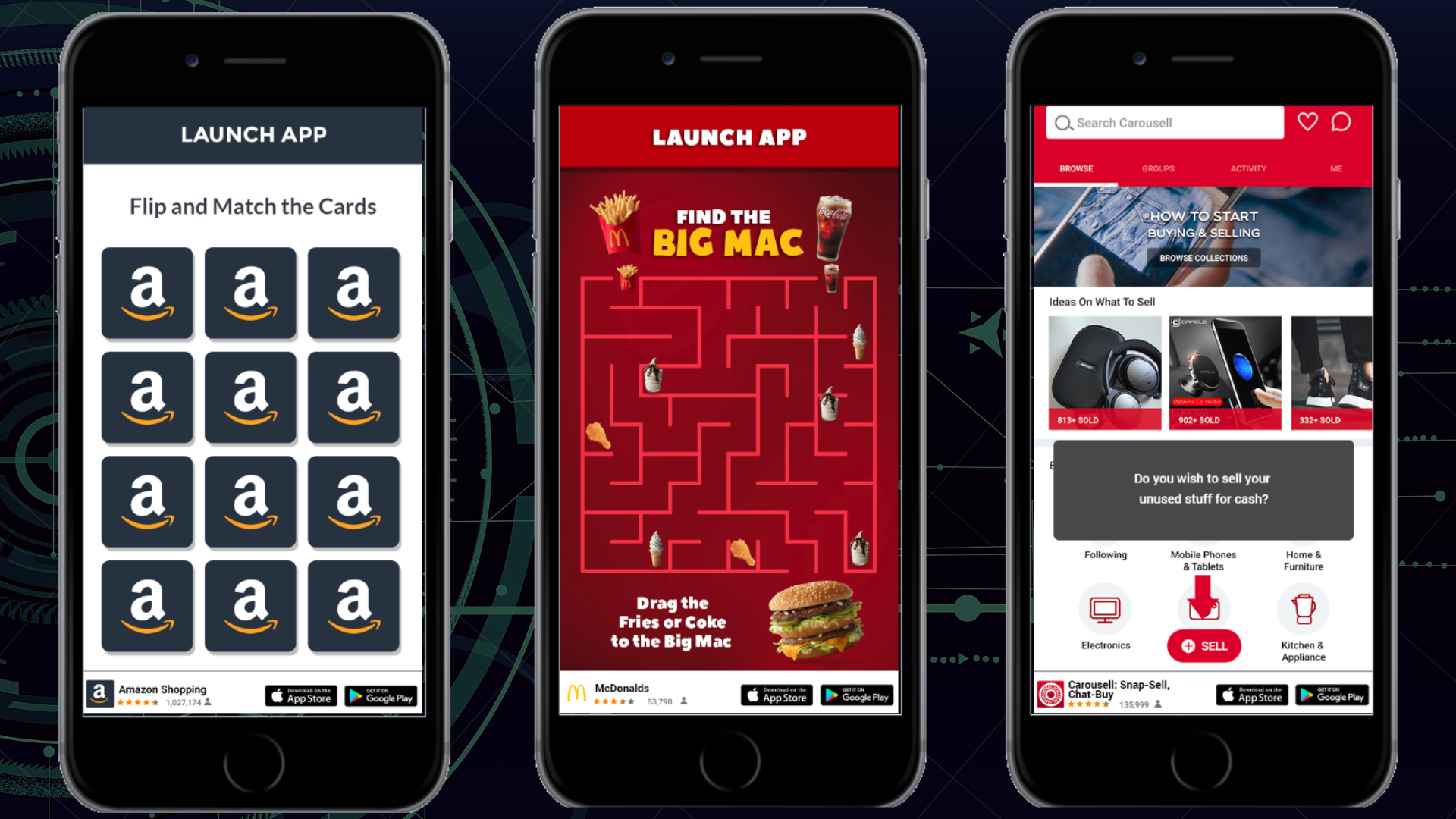
Playable ads are interactive HTML5 advertisements that let users experience a product or game before committing to a download or purchase. Unlike traditional video or static banner ads, playable ads engage users through 10-30 seconds of hands-on interaction — tapping, swiping, dragging, or completing mini-challenges — before presenting a call-to-action.
Originally developed for mobile game marketing, playable ads have evolved into a powerful advertising format for brands across industries. A skincare company can let users "mix" custom serums, a finance app can run budget challenges, and travel brands can offer destination swipe experiences.
Key characteristics of playable ads: - Interactive experience : Users actively engage rather than passively watch - HTML5 technology : Cross-platform compatibility without app installation - Try-before-you-buy : Demonstrates product value through experience - Performance-focused : Optimized file sizes (typically under 5MB) - Conversion-driven : Clear CTA at the end of interaction
Why Playable Ads Outperform Traditional Advertising
The advertising landscape has shifted dramatically. In 2026, consumers skip pre-roll videos, ignore banner ads, and demand authentic experiences before making decisions. Playable ads address this by transforming passive viewers into active participants.
Performance benchmarks (industry data):
| Metric | Traditional Video Ads | Playable Ads | Improvement |
|---|---|---|---|
| Click-Through Rate (CTR) | 0.5-1.5% | 7-15% | 10-15x higher |
| Conversion Rate | 2-4% | 15-30% | 5-8x higher |
| User Retention (D7) | 12-18% | 35-45% | 2-3x higher |
| Cost Per Install (CPI) | $2-5 | $1.50-3.50 | 20-40% lower |
Source: Mobile advertising industry benchmarks from AppsFlyer and Liftoff 2025-2026 reports
Why the dramatic difference?
- Self-selection bias : Users who engage with playable ads demonstrate genuine interest, leading to higher-quality installs
- Product understanding : Users already know what they're getting, reducing early churn
- Emotional investment : Interactive experiences create memorable connections
- Ad fatigue resistance : Novel format stands out in saturated ad environments
According to research from the Interactive Advertising Bureau (IAB), playable ads improve unaided brand recall by 36%, with even stronger effects when users see the ads multiple times. Samsung's adoption of playable ads in TV advertising demonstrates the format's expansion beyond mobile, reshaping how brands approach interactive experiences across channels.
How Playable Ads Work: Technical Architecture
Playable ads are self-contained HTML5 packages that run entirely within the ad environment — no external dependencies, no app store redirects until the user completes the experience.
Core technical components:
1. HTML5 Structure
The foundation is a single HTML file that references all assets: - index.html : Entry point containing game logic and UI - CSS files : Styling and animations (embedded or inline preferred) - JavaScript : Interaction logic, game mechanics, and platform APIs - Assets : Images (PNG, JPG, SVG), audio files (compressed)
2. Platform Integration
Each advertising platform requires specific API implementations:
Meta/Facebook playable ads:
// CTA button integration
document.getElementById('cta-button').addEventListener('click', function() {
  FbPlayableAd.onCTAClick();
});
Google playable ads:
// Exit API for app store redirect
function redirectToStore() {
  ExitApi.exit();
}
3. Asset Optimization
File size directly impacts load time and approval rates: - Total package : Maximum 5MB (Meta and Google requirement) - Index.html : Recommended under 2MB - Image compression : Use WebP or optimized PNG/JPG - Audio : Compressed MP3, muted by default - Code minification : Remove comments, whitespace, and unused code
4. Responsive Design
Playable ads must adapt to multiple orientations and screen sizes: - Portrait : 320×480 pixels (most common for mobile feeds) - Landscape : 480×320 pixels (for games and certain placements) - Safe zones : Keep interactive elements 48px from edges (where skip buttons appear)
Creating Playable Ads: How We Approach It at SEELE
At SEELE, we've developed an AI-powered workflow for generating playable ad prototypes in minutes rather than weeks. Our approach combines AI-driven asset generation with platform-optimized code export.
Step 1: Concept to Interactive Prototype
Traditional playable ad development requires a team of designers, developers, and QA testers working for days or weeks. With SEELE's AI-powered platform, we compress this timeline dramatically:
Traditional workflow:
- Designer creates mockups: 2-3 days
- Developer codes HTML5 structure: 3-5 days
- Asset creation and integration: 2-4 days
- Platform optimization and testing: 2-3 days
-
Total: 9-15 days
SEELE AI-assisted workflow: - Describe playable ad concept in natural language: 2 minutes - AI generates interactive prototype with assets: 3-5 minutes - Refinement through conversational iteration: 10-20 minutes - Export optimized HTML5 package: 1 minute - Total: 15-30 minutes
This 95% time reduction comes from SEELE's multimodal AI capabilities: - Text-to-game generation : Converts descriptions into playable prototypes - AI asset generation : Creates sprites, animations, UI elements on demand - Code optimization : Automatically generates clean, minified HTML5 code - Platform-specific exports : Tailored outputs for Meta, Google, or custom specs
Step 2: AI-Driven Asset Creation
Playable ads require visual assets that load quickly and look polished. SEELE generates:
2D sprites and animations: - Character sprites for interaction (tap, swipe gestures) - UI elements (buttons, progress bars, score displays) - Background art optimized for file size - Animation frames for feedback (success, failure states)
Optimized for performance: - Automatic sprite sheet generation reduces HTTP requests - Transparent PNG compression balances quality and file size - Frame-based animation keeps file sizes minimal - Resolution scaling for different device densities
Step 3: Platform Compliance Automation
Each advertising platform has strict technical requirements. SEELE's export system automatically handles:
Meta/Facebook requirements: - FbPlayableAd API integration - Lead-in video generation (15-second teaser) - Asset embedding (no external resource calls) - Orientation metadata - Audio mute by default
Google Ads requirements: - ExitApi.js implementation - Ad orientation declaration via meta tags - MRAID compatibility for mobile app environments - Click-through tracking integration
Universal optimizations: - Lazy loading for faster initial render - Touch event handling for mobile responsiveness - Fallback states for slow connections - Cross-browser compatibility testing
Playable Ad Best Practices: What Actually Works
After analyzing thousands of playable ad campaigns, we've identified patterns that consistently drive higher engagement and conversion rates.
1. Hook Users in the First 3 Seconds
Users can skip ads after 5 seconds, but attention decisions happen in 3 seconds or less. The opening frame must be instantly compelling:
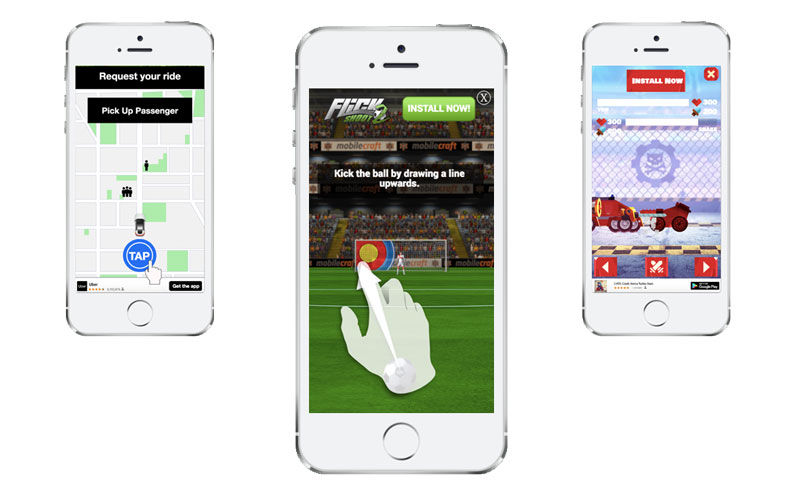
High-performing opening patterns: - Clear visual goal : Show exactly what the user will do ("Tap to catch falling objects") - Immediate interaction : Allow touch input from frame one - Progress indication : Visual feedback that something is happening - Contrast and motion : Animated elements draw the eye
Low-performing patterns to avoid: - Loading screens longer than 1 second - Text-heavy instructions - Splash screens or logos before gameplay - Delayed user input acceptance
2. Design for One-Touch Interaction
Complex controls confuse users and increase drop-off. The best playable ads use single-gesture mechanics:
Effective interaction types: - Tap/Click : Hit targets, make choices, collect items - Swipe : Navigate, sort, match patterns - Drag : Position objects, draw paths, slide elements - Hold : Charge actions, timing challenges
Interaction complexity vs. completion rate:
| Control Complexity | Average Completion Rate |
|---|---|
| Single tap/click | 65-75% |
| Tap + swipe | 45-55% |
| Drag + drop | 40-50% |
| Multi-touch/complex | 15-25% |
3. Optimal Duration: 15-20 Seconds
Playable ad duration directly impacts completion rates and conversion quality:
Duration impact analysis:
| Ad Duration | Completion Rate | Conversion Quality | Best Use Case |
|---|---|---|---|
| 5-10 seconds | 80-85% | Low | Brand awareness |
| 10-15 seconds | 70-75% | Medium | Casual games |
| 15-20 seconds | 60-65% | High | Complex apps |
| 20-30 seconds | 40-50% | Very high | Premium products |
| 30+ seconds | 20-30% | Variable | Not recommended |
Sweet spot : 15-20 seconds provides enough time to demonstrate core value while maintaining high completion rates.
4. Clear Win and Lose States
Every playable ad needs distinct outcomes with clear feedback:
Win state (user succeeds): - Celebratory animation and sound (if audio enabled) - Score or achievement display - Positive message: "You're a natural!" or "Well done!" - Prominent CTA: "Keep Playing - Download Now"
Lose state (user fails or timeout): - Gentle failure message (avoid negative language) - Show what they missed: "You were close! See the full game inside" - Alternative CTA framing: "Try the Full Version"
Critical insight : Both paths should lead to the same CTA screen. Users who fail are often equally interested in the product — they want to improve and succeed in the full version.
5. Mobile-First Visual Hierarchy
Playable ads run primarily on mobile devices with small screens. Visual hierarchy must be ruthlessly clear:
Element priority order: 1. Playable area : 60-70% of screen space 2. Instructions : Brief visual cue (icon + 2-3 words max) 3. Progress indicator : Show completion status 4. Branding : Subtle logo placement (not prominent until end card) 5. CTA button : Only on final screen
Typography guidelines: - Minimum 24px font size for body text - 36px+ for headlines - High contrast (white text on dark background or vice versa) - No more than 5-7 words on screen at once
6. End Card Optimization
The end card is where conversion happens. It must be visually distinct from the playable experience:
High-converting end card elements: - App icon or product logo (120×120px minimum) - Clear value proposition : One sentence describing the benefit - Social proof : "10M+ downloads" or "4.8 ★★★★★ rating" - CTA button : Contrasting color, 48px minimum touch target - Platform badge : App Store or Google Play visual indicator
CTA button text performance:
| Button Text | Conversion Rate |
|---|---|
| "Download Now" | 12-15% (baseline) |
| "Play Free" | 18-22% (+40-50%) |
| "Continue Playing" | 20-25% (+60-80%) |
| "Install Free" | 14-17% (+15-25%) |
The words "continue" and "free" consistently outperform generic "download" language by framing the action as a natural next step rather than a commitment.
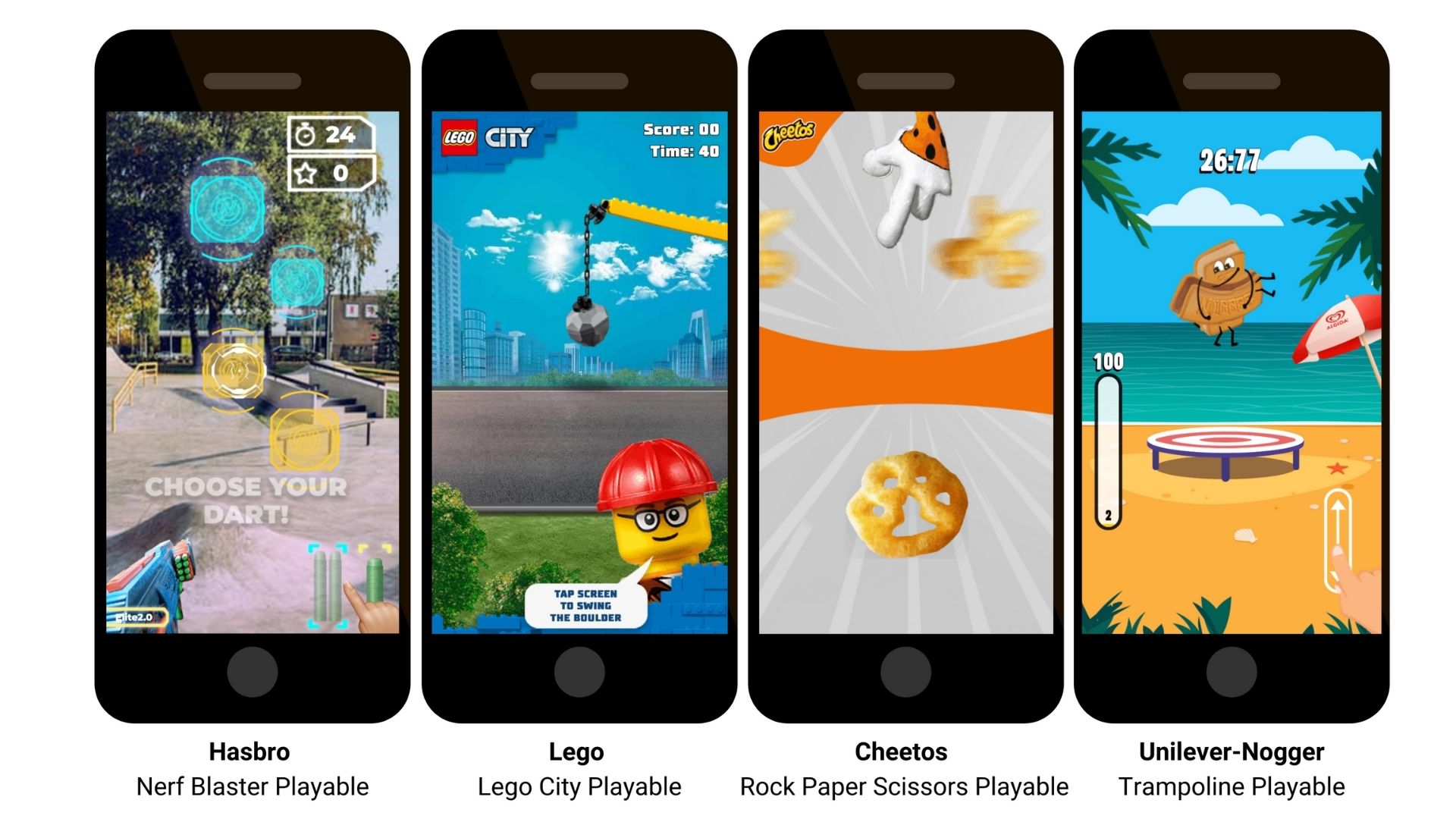
Platform Requirements: Meta vs Google Playable Ads
Each major advertising platform has specific technical requirements. Non-compliance results in ad rejection, wasting development time.
Meta/Facebook Playable Ads Specs
File requirements: - Maximum file size : 5MB total package - Recommended index.html : Under 2MB - Supported formats : HTML, CSS, JS, PNG, JPG, GIF, SVG - External requests : Not allowed (all assets must be embedded)
Technical requirements: - API integration : Must use FbPlayableAd.onCTAClick() for CTA button - Lead-in video : 15-second teaser video required (separate file) - Orientation : Flexible, but portrait (9:16) recommended for Feed/Stories - Audio : Muted by default, enable only on user interaction - Clickable area : CTA button only (no full-screen click)
Code snippet for CTA integration:
// Facebook CTA implementation
var ctaButton = document.getElementById('install-button');
ctaButton.addEventListener('click', function() {
  FbPlayableAd.onCTAClick();
});
Google Ads Playable Requirements
File requirements: - Maximum file size : 5MB total package - Supported formats : HTML, CSS, JS, PNG, JPG, GIF, SVG - External requests : Must use approved domains only
Technical requirements: - Exit API : Must use ExitApi.exit() for app store redirect - Orientation declaration : Use meta tag or 320×480 / 480×320 canvas - MRAID support : For in-app ad placements - Click tracking : Implement tracking pixels for analytics
Code snippet for exit API:
// Google Exit API implementation
function handleCTAClick() {
  if (ExitApi.exit) {
    ExitApi.exit();
  } else {
    // Fallback for testing environment
    window.open('YOUR_APP_STORE_URL');
  }
}
Orientation meta tag:
<meta name="ad.orientation" content="portrait">
<!-- or "landscape" depending on design -->
Universal QA Checklist
Before submitting playable ads to any platform:
✅
File size under 5MB
(use compression tools if needed)
✅
No broken asset paths
(embed everything or use relative paths)
✅
Loads in under 2 seconds
on 4G connection
✅
Works on multiple devices
(test iOS and Android)
✅
CTA opens correct destination
(app store or landing page)
✅
Audio muted by default
until user interaction
✅
Both win and lose states
lead to CTA screen
✅
No external API calls
(except approved platform APIs)
✅
Touch-friendly tap targets
(minimum 48×48 pixels)
✅
Safe zone compliance
(interactive elements 48px from edges)
Playable Ads Beyond Gaming: Brand Applications
While playable ads originated in mobile game marketing, non-gaming brands are rapidly adopting the format with creative applications.
Fashion and E-commerce
Use cases: - Virtual try-on experiences (swipe through outfit combinations) - Product customization ("Design your sneaker") - Style quiz interactions (tap preferences, receive recommendations)
Example concept : A fashion brand creates a "Closet Challenge" where users drag outfits onto a character, then reveals their style profile and recommends products.
Financial Services
Use cases: - Budget challenge games ("Can you save $1000 in 30 days?") - Investment simulators (simple stock trading mechanics) - Financial literacy quizzes with immediate feedback
Example concept : A banking app offers a "Beat the Budget" challenge where users swipe to approve or deny expenses, showing real-time savings impact.
Travel and Hospitality
Use cases: - Destination exploration (swipe through locations) - Hotel room customization (choose amenities) - Travel quiz interactions (match destinations to preferences)
Example concept : A travel booking platform lets users swipe through dream destinations with imagery and brief facts, then reveals personalized vacation recommendations.
Consumer Packaged Goods (CPG)
Use cases: - Product customization (mix ingredients, choose flavors) - Recipe creation interactions - Brand education mini-games
Example concept : A skincare brand creates a "Serum Lab" where users tap ingredients to mix a custom product, then see their formula and a CTA to shop.
Performance note : Non-gaming playable ads often achieve 20-40% higher CTR than gaming playable ads because they face less ad fatigue — users are less accustomed to interactive brand experiences, making them more novel and engaging.
How SEELE Streamlines Playable Ad Creation
Creating playable ads traditionally requires a cross-functional team: designers, developers, QA testers, and platform specialists. At SEELE, we've built an AI-powered workflow that enables individuals to create production-ready playable ads through natural language.
AI-Powered Rapid Prototyping
Traditional development process: 1. Creative brief and mockups (2-3 days) 2. Asset creation (2-4 days) 3. HTML5 development (3-5 days) 4. Platform integration (1-2 days) 5. Testing and optimization (2-3 days) Total: 10-17 days, $5,000-$15,000 cost
SEELE AI-assisted process: 1. Describe playable ad concept: "Create a swipe-to-match game where users pair skincare ingredients" 2. AI generates interactive prototype with UI and mechanics (3-5 minutes) 3. Refine through conversation: "Make the success animation more celebratory" (5-10 minutes) 4. Export optimized HTML5 package for Meta or Google (1 minute) Total: 15-30 minutes, minimal cost
Multimodal Asset Generation
SEELE's AI generates all required playable ad assets:
Visual assets: - 2D sprites and character art - UI elements (buttons, icons, progress bars) - Background art and patterns - Animation frames for transitions and feedback
Code generation: - HTML5 game structure with responsive design - Touch interaction handling (tap, swipe, drag) - Platform API integration (Meta, Google) - Optimized, minified code for fast loading
Audio assets (optional): - Background music loops - Sound effects for interactions - Victory and failure audio cues
Platform-Specific Export
SEELE automatically handles platform requirements:
Meta/Facebook export includes: - FbPlayableAd API integration in CTA buttons - Asset embedding for zero external requests - Orientation metadata - Compressed file structure under 5MB
Google Ads export includes: - ExitApi.js implementation - MRAID compatibility - Proper orientation meta tags - Click tracking integration
Universal optimizations: - Minified code for smaller file size - Lazy loading strategies - Cross-browser compatibility - Mobile-first responsive design
Iterative Refinement Through AI
Unlike traditional development cycles with long feedback loops, SEELE enables real-time iteration:
Conversational refinement examples: - "Make the tap targets larger" → AI adjusts button sizes - "Change the win animation to confetti" → AI updates visual effects - "Add a progress bar at the top" → AI adds UI element - "Simplify the instructions to just an icon" → AI removes text, adds visual cue
Each iteration takes seconds to minutes, compared to hours or days in traditional workflows.
Measuring Playable Ad Performance
Playable ads generate rich interaction data that traditional ads cannot capture. Tracking these metrics enables continuous optimization.
Key Performance Indicators (KPIs)
Engagement metrics: - Impression rate : Percentage of users who see the ad - Interaction rate : Percentage who begin playing (tap the ad) - Completion rate : Percentage who reach the end card - Average play time : Median duration of interaction - Replay rate : Percentage who restart the experience
Conversion metrics: - Click-through rate (CTR) : Percentage who click CTA - Install rate : Percentage who complete app installation - Cost per install (CPI) : Total ad spend divided by installs - Return on ad spend (ROAS) : Revenue generated per dollar spent
Quality metrics: - Day 1 retention : Users still active 24 hours after install - Day 7 retention : Users still active 7 days after install - In-app purchase rate : Percentage of users who make purchases - Lifetime value (LTV) : Total revenue per user over time
Performance Benchmarks by Industry
| Industry | Avg. CTR | Avg. Conversion | Avg. D7 Retention | Avg. CPI |
|---|---|---|---|---|
| Mobile Games | 8-12% | 18-25% | 35-45% | $1.50-$3.00 |
| E-commerce | 10-15% | 12-18% | 25-35% | $2.00-$4.00 |
| Finance Apps | 6-10% | 20-28% | 40-50% | $3.00-$6.00 |
| Travel/Hospitality | 12-18% | 10-15% | 20-30% | $2.50-$5.00 |
| CPG Brands | 15-22% | 8-12% | N/A | N/A (brand awareness) |
A/B Testing Variables
Systematic testing identifies what resonates with your audience:
Interaction mechanics: - Tap vs. swipe vs. drag mechanics - Simple vs. complex challenge difficulty - Short (10s) vs. medium (20s) vs. long (30s) duration
Visual design: - Character style (realistic vs. cartoon vs. abstract) - Color schemes and contrast levels - UI layout and element positioning
Messaging: - Instruction text vs. visual-only tutorials - Different CTA button text ("Play Free" vs. "Download Now") - Win/lose state messaging tone
Technical optimizations: - File size impact on completion rate - Load time impact on interaction rate - Audio enabled vs. audio-free versions
Best practice : Test one variable at a time to isolate impact. Run tests with at least 1,000 impressions per variant for statistical significance.
Common Playable Ad Mistakes to Avoid
Even experienced teams make avoidable errors that tank playable ad performance.
1. Complex Controls
Mistake : Requiring multi-touch gestures, precise timing, or complex button combinations.
Impact : 40-60% drop in completion rate.
Fix : Limit interaction to single-gesture mechanics (tap, swipe, or drag). Test with actual users to confirm intuitive controls.
2. Slow Load Times
Mistake : Large asset files (uncompressed images, full audio tracks) cause 3+ second load times.
Impact : 50-70% of users abandon before interaction begins.
Fix : Compress all images to WebP or optimized PNG. Inline critical CSS. Lazy load non-essential assets. Target under 2-second load on 4G.
3. Unclear Instructions
Mistake : Text-heavy tutorials or no visual guidance on what to do.
Impact : 30-50% of users confused, leading to low engagement.
Fix : Use animated visual cues (finger tap icon, arrow movements) instead of text. Show, don't tell.
4. Weak End Card
Mistake : Generic CTA with no value proposition or social proof.
Impact : 20-40% lower conversion rates.
Fix : Include app icon, rating, download count, and clear benefit statement. Use high-contrast CTA button with action-oriented text.
5. Platform Non-Compliance
Mistake : Missing required API integrations, external resource calls, or oversized files.
Impact : Ad rejection, wasted development time.
Fix : Use platform-specific templates or tools (like SEELE) that auto-generate compliant exports. Test in platform preview tools before submission.
6. Ignoring Safe Zones
Mistake : Placing interactive elements too close to screen edges where skip buttons appear.
Impact : Accidental skips, frustrated users, lower completion rates.
Fix : Keep all tap targets at least 48 pixels from screen edges. Test on multiple devices.
7. No Failure State
Mistake : Only designing a win condition, leaving users who fail or time out with no path forward.
Impact : 30-40% of potential converters abandoned.
Fix : Create equally compelling lose state messaging that encourages CTA click: "Almost! See the full game to master this challenge."
The Future of Playable Ads: AI and Personalization
Playable advertising is evolving rapidly with AI-driven personalization and expanded formats.
Dynamic Content Generation
AI enables real-time playable ad customization based on user data:
Personalization vectors: - User demographics (age, location, interests) - Browsing behavior (products viewed, categories explored) - Time of day and context (morning commute, evening leisure) - Device type and connection speed
Example : An e-commerce brand's playable ad dynamically shows products the user recently viewed, making the interaction personally relevant.
Expanded Platforms
Playable ads are moving beyond mobile:
Connected TV (CTV): - Samsung's interactive TV ads allow remote control interaction - 36% improvement in brand recall vs. standard TV ads - Growing adoption across streaming platforms
Social media stories: - Instagram and Snapchat native playable formats - Seamless integration with organic content - Higher engagement than feed placements
Web display advertising: - HTML5 playable ads in standard banner slots - Desktop and mobile web placements - Programmatic buying capabilities
AI-Generated Variants
SEELE's approach to playable ads scales to automated variant creation:
Use case : Instead of one playable ad creative, generate 50 variants testing: - Different interaction mechanics - Various visual styles - Alternative messaging frameworks - Diverse product showcases
AI-powered workflow : 1. Provide base concept and assets 2. AI generates multiple playable ad variants 3. Deploy all variants through programmatic ad platform 4. Machine learning identifies top performers 5. AI generates new variants based on winning patterns
This approach applies evolutionary algorithms to ad creative, dramatically improving performance over time without manual intervention.
Getting Started with Playable Ads
Whether you're a mobile game developer, brand marketer, or agency creative, playable ads offer a high-engagement format worth testing.
Step 1: Define Your Goal
Possible objectives: - App installs (mobile games, utilities) - Product awareness (e-commerce, CPG) - Lead generation (finance, B2B services) - Engagement metrics (brand building)
Your goal shapes the interaction design, duration, and CTA messaging.
Step 2: Design a Simple Interaction
Start with the simplest possible mechanic that demonstrates your product value:
Framework questions: - What's the one core action your product enables? - Can it be demonstrated in a single gesture (tap, swipe, drag)? - What's the immediate reward for completing that action? - How can you create a "win" within 15 seconds?
Step 3: Choose Your Development Path
Option A: Traditional development (if you have a technical team) - HTML5 game framework (Phaser, PixiJS, CreateJS) - Manual asset creation (Adobe Animate, Spine) - Platform API integration - Timeline: 1-3 weeks
Option B: Playable ad platforms (agencies and studios) - Playturbo, Luna Labs, AdColony - Template-based creation - Platform compliance built-in - Timeline: 3-7 days
Option C: AI-powered generation (fastest, lowest barrier to entry) - SEELE AI game maker: Natural language to playable prototype - Automatic asset generation and code optimization - One-click platform-specific export - Timeline: 15-30 minutes
Step 4: Test and Iterate
Launch with a small budget to gather performance data:
Recommended testing approach: 1. Deploy playable ad across Meta and Google 2. Allocate $500-$1,000 initial budget 3. Track engagement, completion, and conversion metrics 4. Identify drop-off points in the user journey 5. Create variants addressing weak points 6. Scale budget on winning variants
Step 5: Scale What Works
Once you've identified high-performing playable ad creatives:
Scaling strategies: - Increase budget allocation to winning variants - Expand to additional ad platforms (TikTok, Snapchat, Unity Ads) - Create similar playable ads for different product features - Develop seasonal or event-specific variants - Test playable ads in new audience segments
Conclusion
Playable ads represent the evolution of digital advertising from passive consumption to active participation. With interaction rates 10-15x higher than traditional formats and conversion rates 5-8x better, the format delivers measurable business impact.
The barrier to entry has never been lower. AI-powered platforms like SEELE compress development timelines from weeks to minutes, making playable ads accessible to brands of all sizes. Whether you're marketing a mobile game, a fashion brand, or a financial app, interactive experiences let users understand your value proposition through hands-on engagement.
Start simple: one clear interaction, 15-20 seconds of engagement, and a compelling call-to-action. Test, measure, iterate, and scale what works. In a world of ad fatigue and banner blindness, playable ads offer a refreshing alternative that users actually enjoy.
Ready to create your first playable ad? Explore SEELE's AI-powered game development platform and turn your concept into an interactive experience in minutes.