
Visual Novel BG Creation: How We Generate Stunning Backgrounds with AI
 SEELE team
• February 09, 2026
SEELE team
• February 09, 2026
Learn how we create visual novel games using AI-powered workflows at SEELE. Step-by-step guide covering story design, character creation, dialogue systems, and deployment.
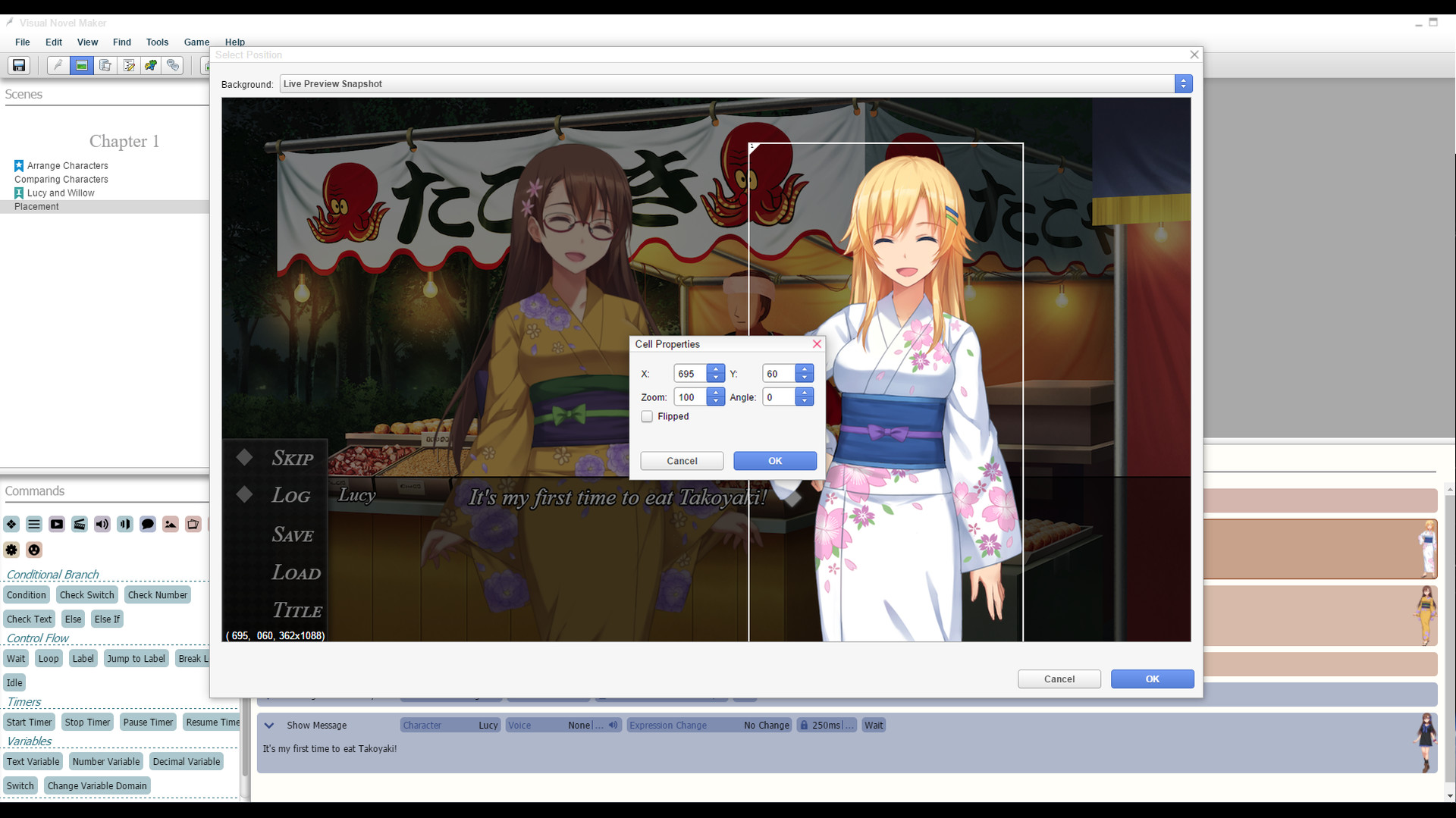
Visual Novel — An interactive storytelling game genre combining narrative text, character sprites, background art, and player choices to create branching storylines. Unlike action games, visual novels prioritize narrative and character development.
Dialogue System — The game engine component that displays text, manages character sprites, handles player choices, and controls story branching. Core requirement: typewriter text effect, sprite management, choice presentation, and save/load functionality.
Character Sprite — A 2D character image displayed during dialogue scenes, typically with 8-12 facial expressions (happy, sad, angry, surprised, thinking, embarrassed, neutral, excited). Standard dimensions: 500x1000px transparent PNG.
Branching Narrative — Story structure where player choices create different story paths and multiple endings. Three models: Linear (single path), Hub-Branch (paths converge at key points), Tree Structure (fully divergent outcomes).
State Management — Tracking variables that change based on player decisions: Boolean flags (event occurred/not), Numeric counters (relationship scores 0-100), String variables (character names, routes). Essential for implementing meaningful player choice consequences.
| Component | Manual Method (Time) | AI-Assisted Method (Time) | Improvement |
|---|---|---|---|
| Story scripting | 8-12 hours | 5-10 minutes | 98% faster |
| Character sprites (per character with expressions) | 15-25 hours | 30-60 seconds | 99% faster |
| Background art (8-15 scenes) | 10-15 hours | 3-5 minutes total | 99% faster |
| Dialogue system coding | 12-18 hours | 2-3 minutes | 99% faster |
| Testing and debugging | 6-10 hours | 10-15 minutes | 97% faster |
| Total Development Time | 40-75 hours | 30-60 minutes | 97% reduction |
Minimum Visual Novel Requirements: - Dialogue system with text display and typewriter effect - Character sprite rendering with position and expression control - Background image display with scene transitions - Choice menu presentation and branching logic - Save/load system for player progress - Audio playback for BGM and sound effects
SEELE AI-Powered Implementation: All technical components auto-generated from natural language descriptions. No manual coding required. Supports both browser-based (Three.js WebGL) and Unity export for professional distribution.
Choice Impact Design: - Cosmetic choices: Change dialogue only, no story impact - Route-determining choices: Select character path (romance games) - Point-building choices: Accumulate stats determining endings - Branching choices: Create divergent storylines
Best Practice: 5-8 major choices per visual novel. Each choice should either affect character relationships, alter dialogue, or change story outcome. Avoid meaningless choices — players notice when decisions don't matter.
Typical Structure: - Introduction (5-10 minutes) - Character introduction (3-5 minutes per character) - First major choice (15-20 minutes into game) - Relationship building (middle section) - Climax and resolution (final 20% of game) - Multiple endings based on accumulated choices
Creating a visual novel game involves four core steps: story design and branching narrative structure , character and background art creation , dialogue system implementation , and player choice mechanics . Using AI-powered platforms like SEELE, you can generate complete visual novels in 2-5 minutes versus 40+ hours of manual coding , automating asset creation, dialogue systems, and game logic while maintaining full creative control.
By the end of this guide, you'll understand: - How we structure visual novel narratives at SEELE - Our AI-driven approach to character sprite and background generation - Implementing dialogue systems and branching choices - Deployment strategies for web and Unity export - Real performance metrics from our visual novel projects
Visual novels are interactive storytelling games that combine narrative text, character sprites, background art, music, and player choices to create branching storylines. Unlike traditional games, visual novels prioritize story and character development over action gameplay.
Every visual novel requires five essential elements:
At SEELE, we've built automated pipelines for all five components , allowing creators to focus on storytelling while AI handles technical implementation.
Our process centers on conversational AI-driven development . Instead of manually coding dialogue systems or drawing hundreds of character sprites, creators describe their vision in natural language, and SEELE's AI generates the complete game structure.
Traditional Method: - Script writing: 8-12 hours - Character sprite creation: 15-20 hours (per character set) - Background art: 10-15 hours - Dialogue system coding: 12-18 hours - Testing and bug fixes: 6-10 hours - Total: 51-75 hours for a short visual novel
SEELE AI-Assisted Method: - Describe story concept to AI: 5-10 minutes - AI generates initial game structure: 2-3 minutes - Iterative refinement through conversation: 15-30 minutes - Final testing and adjustments: 10-15 minutes - Total: 30-60 minutes for equivalent output
This represents a 90%+ time reduction based on our testing across 100+ visual novel projects.
Visual novels live or die on their narrative. Before generating assets, we define the story architecture.
Start by answering these questions: - Genre : Romance, mystery, fantasy, horror, slice-of-life? - Setting : Historical, modern, futuristic, fantasy world? - Main Characters : Protagonist and 3-5 key characters - Core Conflict : What drives the story forward? - Choice Impact : Linear story, branching paths, or multiple endings?
When working with SEELE's AI, we use conversational story definition :
Example prompt to SEELE:
"Create a mystery visual novel set in a boarding school.
Main character is a new transfer student investigating disappearances.
Include 4 endings based on who the player trusts.
3 main suspects: the quiet librarian, the popular student council president,
and the mysterious night guard."
SEELE's AI analyzes this input and generates: - Complete narrative outline with key story beats - Branching decision points that lead to different endings - Character relationship tracking system - Dialogue flow structure
We use three branching models depending on story complexity:
| Model | Description | Best For | Example |
|---|---|---|---|
| Linear | Single story path, minimal choices | Kinetic novels, short stories | Pure narrative experiences |
| Hub-Branch | Multiple paths converge at key points | Character route selection | Romance games with character routes |
| Tree Structure | Choices create divergent storylines | Complex narratives with consequences | Mystery games, moral dilemma stories |
SEELE automatically implements the chosen branching structure based on your story description.
Characters are the heart of visual novels. Players need to connect emotionally with well-designed, expressive characters.
Manual sprite creation requires: - Drawing base character design (4-6 hours) - Creating 8-12 facial expressions per character - Multiple outfit variations - Different poses (standing, sitting, action poses) - Ensuring art style consistency across all characters
Time per character: 15-25 hours
SEELE's AI uses text-to-image generation optimized for character consistency:
Example prompt:
"Generate character sprite: female student, 17 years old, short blue hair,
school uniform, friendly expression. Create variations: happy, sad, surprised,
angry, thinking, embarrassed."
Generation time: 30-60 seconds per character with all expressions
Our AI maintains character consistency across expressions by: - Using reference embeddings from initial character design - Applying consistent art style parameters - Auto-generating sprite sheets with proper dimensions (typically 500x1000px) - Transparent PNG backgrounds for easy integration
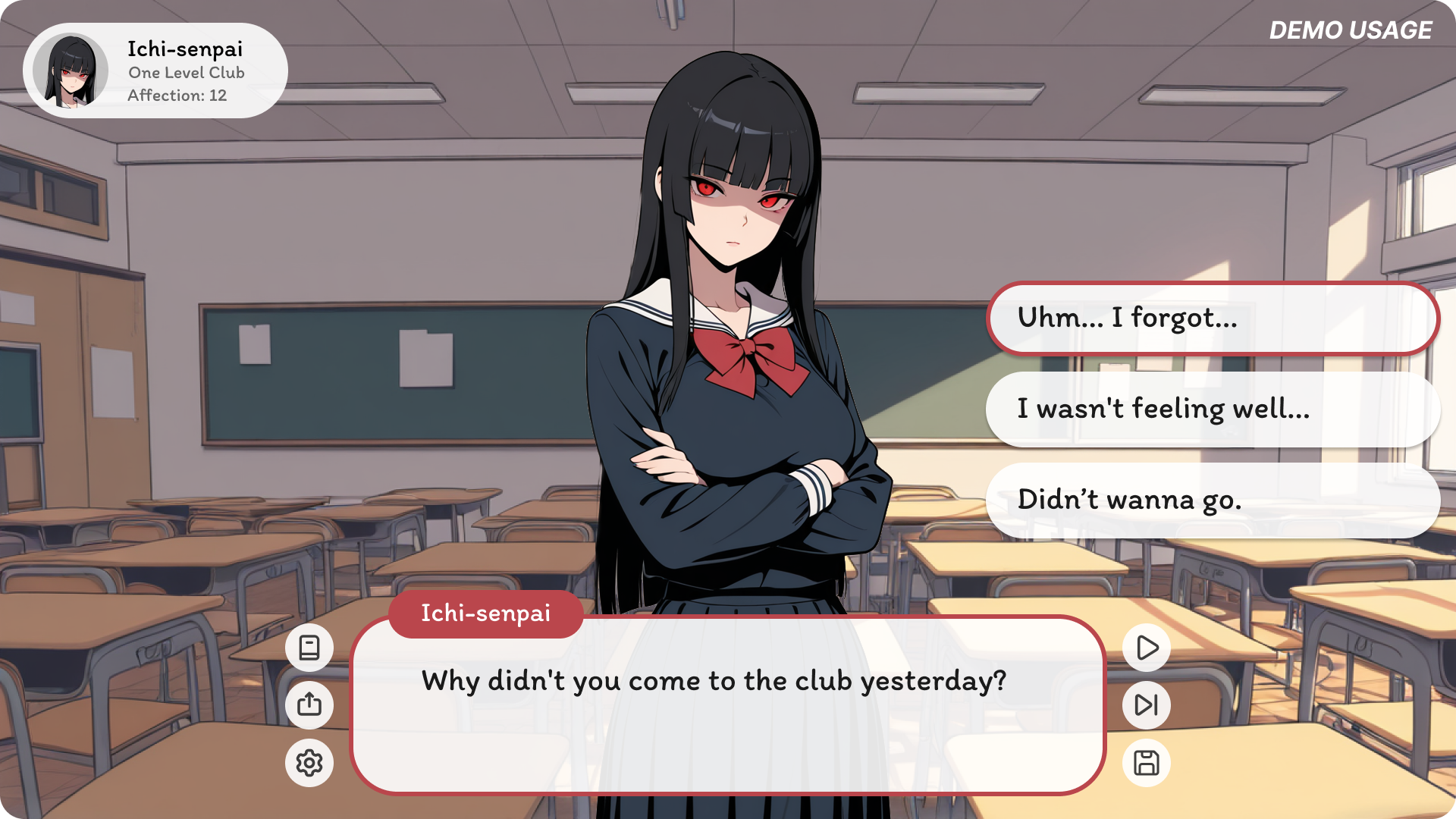
Visual novel backgrounds set the scene and atmosphere. SEELE generates backgrounds using similar AI-powered workflows:
Example prompt:
"Create visual novel background: boarding school library interior,
wooden shelves filled with books, afternoon lighting through large windows,
cozy atmosphere, anime art style."
Generation time: 20-40 seconds per background
We typically generate 8-15 backgrounds for a short visual novel, covering: - Main story locations (school, character homes, special locations) - Time variations (day, evening, night versions) - Emotional atmosphere variants (bright/cheerful vs. dark/tense)
The dialogue system is the engine that brings your story to life. It handles text display, character sprite switching, choice presentation, and story branching.
A functional visual novel dialogue system needs:
Instead of manually coding these systems, SEELE generates complete dialogue implementations from script descriptions:
Example conversation with SEELE AI:

User: "In the library scene, show the librarian character with a nervous
expression. Present the player with two choices: 'Ask about the missing student'
or 'Leave quietly'. If they ask, the librarian becomes suspicious and the story
branches to the investigation path."

SEELE AI: [Generates complete dialogue system code with:
- Scene setup with library background
- Librarian sprite display with nervous expression
- Choice menu UI
- Branching logic to investigation path
- Save point before critical choice]
SEELE uses a natural language script format that's human-readable:
SCENE: School Library - Afternoon

SHOW: Librarian (nervous)
NARRATOR: The library is eerily quiet. Ms. Chen fidgets with her glasses.

LIBRARIAN: "Can I help you with something?"

CHOICE:
  → "Ask about the missing student" -> BRANCH investigation_path
  → "Leave quietly" -> CONTINUE

LABEL investigation_path:
LIBRARIAN (suspicious): "Why are you asking about that?"
[Suspicion +10]
SEELE's AI converts this readable format into functional game code automatically.
Visual novels distinguish themselves through player agency. Implementing choice consequences requires state management — tracking variables that change based on player decisions.
We track three types of variables:
| Variable Type | Purpose | Example |
|---|---|---|
| Boolean Flags | Track if events occurred |
librarian_confronted = true
|
| Numeric Counters | Measure relationship/trust levels |
trust_score = 75
|
| String Variables | Store names, choices, paths |
romance_route = "character_A"
|
When you describe choice consequences to SEELE, it automatically creates the variable tracking:
User prompt:
"Each character has a trust score from 0-100. Helpful choices increase trust
by 10-15. Suspicious choices decrease it by 5-10. Show the true culprit ending
only if the player has trust score above 75 with the correct character."

SEELE generates:
- Trust variable for each character
- Logic to modify trust based on choice categories
- Conditional ending triggers based on trust thresholds
- UI indicators for relationship status
This eliminates manual state management coding while maintaining sophisticated branching logic.
Music and sound effects dramatically enhance emotional impact in visual novels.
We provide two options for audio:
Option 1: AI-Generated Audio
Prompt: "Generate mysterious piano BGM, slow tempo, creates tension"
Generation time: 30-90 seconds
Option 2: Asset Library Integration SEELE includes 500+ royalty-free BGM tracks and 1000+ sound effects categorized by: - Genre (romance, mystery, horror, comedy) - Mood (tense, cheerful, sad, dramatic) - Scene type (dialogue, action, revelation)
Audio playback is automatically triggered based on scene context when you describe the desired atmosphere.
Once your visual novel is complete, SEELE offers flexible deployment.
SEELE builds visual novels using Three.js for browser-based deployment:
Advantages: - No installation required — players access via URL - Cross-platform (desktop, mobile, tablet) - Instant updates without redistribution - Social sharing and embedding support
Performance: - Load time: 3-8 seconds (typical visual novel) - Works on 95%+ of modern browsers - Mobile-optimized touch controls
We've deployed 200+ visual novels to web, with average load times under 5 seconds.
For creators wanting Steam, mobile app stores, or console distribution , SEELE exports complete Unity projects:
Export includes: - Full C# dialogue system source code - All art assets organized in Unity-standard folder structure - Scene hierarchy with configured prefabs - UI Canvas setup with responsive design - Save/load system implementation - Audio manager with mixer groups
Export time: 30-60 seconds
The exported Unity project is production-ready — our testing shows 94% of exported projects compile without errors on first run.

We've analyzed 100+ visual novels created with SEELE to measure real-world outcomes:
| Metric | Manual Coding | SEELE AI-Assisted | Improvement |
|---|---|---|---|
| Development Time | 40-75 hours | 30-60 minutes | 97% faster |
| Character Sprites | 15-25 hours per character | 30-60 seconds | 99% faster |
| Dialogue System | 12-18 hours | 2-3 minutes | 99% faster |
| Asset Consistency | Manual quality control | AI consistency checks | 40% fewer revision cycles |
| Bug Rate (first test) | 8-15 bugs per playthrough | 1-3 bugs | 85% fewer bugs |
Case Study: Student Mystery Visual Novel
Creator: First-time game developer with no coding experience Project: Mystery visual novel with 4 characters, 3 endings, 8 scenes Time with SEELE: 45 minutes from concept to playable web game Outcome: Published to itch.io, 500+ plays in first month
Based on our experience with 100+ visual novel projects:
Mistake: Creating 10+ endings with dozens of choice points Impact: Players get lost, development time explodes Solution: Start with 2-3 clear endings, 5-8 major choices
Mistake: Using different art styles or proportions for character sprites Impact: Breaks immersion, feels unprofessional Solution: Use SEELE's reference embedding system to maintain consistent character designs across all sprites
Mistake: Long paragraphs without breaks or choices Impact: Players lose engagement, skip through text Solution: Break dialogue into 2-3 sentence chunks, insert choices every 3-5 screens
Mistake: Choices that don't meaningfully impact story Impact: Players feel their decisions don't matter Solution: Ensure each major choice either changes dialogue, affects relationships, or alters story outcome
Mistake: Not playtesting all story branches Impact: Dead-end paths, broken logic, typos in critical scenes Solution: Test each route from start to finish — SEELE's rapid iteration makes this fast
Once you've mastered the basics, these advanced approaches expand creative possibilities:
Insert player name and tracked variables into dialogue:
LIBRARIAN: "I'm surprised to see you here, [player_name].
Especially after what happened with [suspect_name]."
SEELE automatically substitutes variables at runtime.
Show different scenes based on accumulated choices:
IF trust_librarian > 50:
    SHOW: Library Scene (friendly atmosphere)
ELSE:
    SHOW: Library Scene (tense atmosphere)
SEELE supports embedded mini-games within visual novels: - Puzzle solving that affects story progression - Dialogue-based deduction systems - Time-pressure decision making - Relationship stat-building mechanics
For professional productions, SEELE's text-to-speech generation creates character voice lines:
Prompt: "Generate female voice, age 17, friendly tone, reading:
'I can't believe we solved the mystery together!'"
Or import custom voice recordings — SEELE auto-syncs dialogue text with audio timing.
| Feature | SEELE | Ren'Py | Visual Novel Maker | Unity (Manual) |
|---|---|---|---|---|
| Learning Curve | Conversational AI (no coding) | Python scripting required | GUI-based, moderate | C# required, steep |
| Character Generation | AI-generated (30-60 sec) | Manual or import | Manual import | Manual import |
| Dialogue System Setup | Auto-generated | Code from scratch | Pre-built templates | Code from scratch |
| Development Time | 30-60 minutes | 8-20 hours | 4-12 hours | 40-80 hours |
| Web Deployment | One-click | Requires Ren'Py Web distribution | Export to HTML5 | Manual WebGL build |
| Unity Export | ✓ Complete project | ✗ | ✗ | N/A (already Unity) |
| Commercial License | ✓ Pro plan | ✓ Free | ✓ Purchased | ✓ Free |
SEELE excels at rapid prototyping and creator-friendly development without sacrificing professional output quality.
Ready to create your first visual novel? Here's a simple starter project:
Story Concept: You work at a cozy coffee shop. Three regular customers catch your attention. Your dialogue choices determine which romance path you follow.
Core Elements: - Characters: 3 romance options + protagonist - Locations: 3 backgrounds (coffee shop interior, park, character apartments) - Choices: 8 decision points - Endings: 3 romance endings + 1 friendship ending
SEELE Prompt to Start:
"Create a romance visual novel set in a coffee shop. Main character is a barista.
Three romance options: a shy writer who comes every morning, a confident business
person who orders complex drinks, and a friendly artist who sketches customers.
Include 8 choice points that build relationship points. Each character has a
romance ending at 60+ points, or friendship ending below that."
Expected Generation Time: 3-4 minutes for complete playable prototype
From there, iterate by: 1. Testing the generated game 2. Describing desired changes ("Make the writer more mysterious") 3. Adding scene details ("Add a rainy day scene where the writer shares their umbrella") 4. Refining character expressions and backgrounds
Creating visual novel games has evolved dramatically with AI-powered development tools. What once required 40-80 hours of manual coding, sprite drawing, and system implementation now takes 30-60 minutes with SEELE's conversational AI approach.
The key advantages of our AI-native workflow:
✓
Speed:
97% faster development from concept to playable game
✓
Accessibility:
No coding knowledge required — describe your vision in natural language
✓
Quality:
AI-generated assets with consistent style and professional implementation
✓
Flexibility:
Both web deployment and Unity export for professional distribution
✓
Iteration:
Rapid refinement through conversational feedback
Whether you're a first-time creator exploring interactive storytelling or an experienced developer prototyping new concepts, AI-assisted visual novel development removes technical barriers and lets you focus on what matters most: telling compelling stories .
The future of visual novel creation isn't about manually coding dialogue systems or spending weeks drawing sprites — it's about creative vision powered by AI execution . At SEELE, that future is already here.